
Lieferung heute & morgen

Qualitätsgarantie

Willkommens-Angebote freischalten: KOSTENLOSE Lieferung | Bis zu 80 % RABATT | Kostenlose 30-Tage-JoyPlus-Testphase
App herunterladen
The search for the right baby doll can quickly become overwhelming. Manufacturers advertise numerous functions and designs, but not every doll that looks appealing at first glance is a good choice for long-term play. Certain pitfalls often lead to disappointment for the child and unnecessary expense. We'll show you what to look for to avoid making the wrong choice and find a model that will bring real joy.
Before you make a decision, it's helpful to know the three most common problems that can arise during the selection process:
To make an informed decision, you should check three core aspects. These will help you objectively assess a doll's quality and long-term play value.
The doll's size is crucial for the availability of accessories. The most common size for dolls like Baby Born is 43 cm. For this standard size, you'll find a wide selection of 43 cm doll clothes and other Baby Born accessories like high chairs or doll prams. Smaller models, often designed as baby dolls for toddlers, are typically 36 cm. There is also a good range for this size, but it is slightly more limited. Check the size before buying to ensure you can easily find matching add-ons.
The doll's body type significantly affects the play experience and its uses.
A doll with functions can enrich role-play. These include drinking and wetting functions, sleeping eyes, or the ability to make sounds. For toddlers (1–2 years), a doll without complex functions is often the better choice. A simple design with sleeping eyes or a soft body encourages imagination without being overwhelming. For children aged 3 and up, advanced functions can make parent-child role-play more realistic and exciting. Always look for the CE mark, which confirms compliance with EU safety standards for toys.
Here are some recommendations tailored to different age groups and play preferences.

Why This Fits Their Persona: This doll is specially designed for the youngest doll parents. Its soft body makes it lightweight and ideal for cuddling, while the 36 cm size is easy for little arms to handle.
It deliberately avoids complex, fragile electronics and focuses on basic, robust features like sleeping eyes. This minimises the potential for frustration.
The soft body and low weight encourage an emotional bond. Includes a bottle, romper, and hat for initial role-playing.

Why This Fits Their Persona: For children who are ready for the next level of role-play. This doll offers seven lifelike functions that encourage nurturing and care.
All functions are purely mechanical and work without batteries. This makes it robust and durable. The doll is also suitable for play in the bathtub.
Offers 7 functions, including drinking, crying, and a potty function. The extensive set of accessories (potty, bottle, plate) allows play to start immediately.
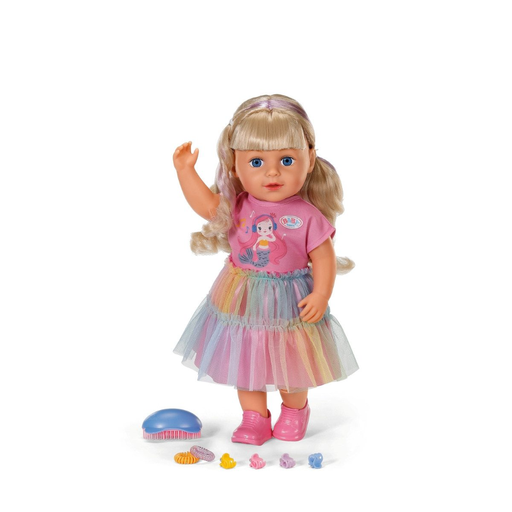
Why This Fits Their Persona: Ideal for children who love to style hair and create fashionable outfits. The long hair and movable knee joints open up many creative play possibilities.
The focus is on a durable, creative function (hair styling) rather than fragile electronics. The standard size of 43 cm ensures compatibility with a huge range of clothes and accessories.
Long, high-quality hair for countless hairstyles. Flexible knees allow for more realistic poses. Includes a brush and hair accessories.
We have compiled a complete, up-to-date list of products that fully meet these strict selection criteria and all relevant safety regulations.
1. Can you bathe every Baby Born doll? No, it depends on the body type. Only dolls with a full hard body (often marked as "bathable") can be taken into the water. A soft-bodied doll would be damaged by water inside and could develop mould. Always check the manufacturer's instructions on the packaging.
2. What clothing size fits a Baby Born doll? The classic Baby Born doll has a size of 43 cm. Most 43 cm doll clothes are compatible with these models. For the smaller "Little" versions, you will need clothes in size 36 cm. Although many clothing items are a universal fit, there can be discrepancies with shoes or hats.
3. From what age does a doll with functions make sense? This largely depends on the child's development. Simple functions like sleeping eyes are interesting even for children from one year old. More complex role-play involving drinking and wetting functions is often only truly engaging for children aged three and up, as they have developed the necessary motor skills and understanding for the play sequences.