
Lieferung heute & morgen

Qualitätsgarantie

Willkommens-Angebote freischalten: KOSTENLOSE Lieferung | Bis zu 80 % RABATT | Kostenlose 30-Tage-JoyPlus-Testphase
App herunterladen
When buying baby bottle accessories, many sets appear more comprehensive at first glance than they actually are in everyday use. A high number of pieces does not automatically mean that every component will be used regularly. At the same time, small details such as a hard-to-reach valve, an unsuitable teat size or a lack of drying options can make daily use more difficult.
For parents combining breastfeeding and bottle-feeding, looking for a baby bottle gift set or wanting to clean breast pump parts hygienically, three common purchasing misconceptions are particularly relevant:
A baby dummy 0-6 months and a bottle teat are not interchangeable. When choosing a teat, consider its shape, material, opening and stated age range. According to the product information, the milk flow in Philips Avent Natural Response bottles is controlled by the baby’s active drinking. This may be of interest to families who want to combine breastfeeding and bottle-feeding.
The stated age range is a guide, not an automatic requirement for every child. Check whether your baby is comfortable with the flow rate and whether the teat is compatible with the bottle system in question. Different brands and product ranges are not necessarily compatible.
The specific material details for bottles and accessories should be easy to verify. According to the product description, the Philips Avent sets mentioned are made from BPA-free polypropylene. The Momcozy cleaning set is stated to contain food-grade silicone and BPA-free plastic.
Cleaning is also crucial:
Not every plastic part is suitable for the same temperature. ‘Dishwasher-safe’ and ‘suitable for boiling’ are different specifications. The Momcozy set specifically states that the silicone parts are suitable for boiling. The relevant care instructions should be followed for all other components.
Moisture inside closed containers can make hygienic storage more difficult. A bottle drying rack or integrated draining rack keeps cleaned parts away from the work surface. For travel, a closed case is practical, provided that only completely dry components are stored inside it.
A good bottle cleaning set should suit your existing equipment. A straw brush, for example, is useful if you use training cups or bottles with straws. If you only use wide-necked baby bottles, a large bottle brush with a small teat brush may be sufficient.
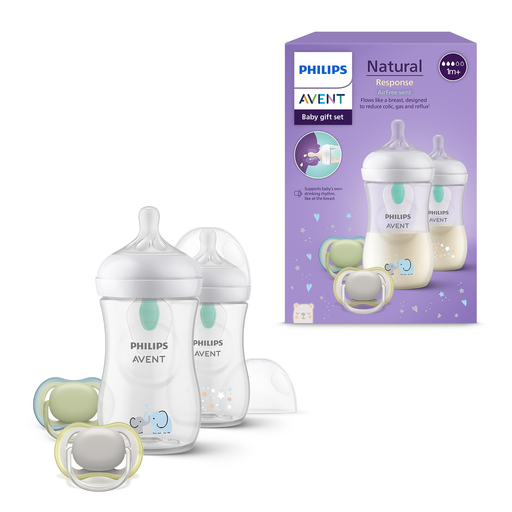
Why this product suits this profile: The set combines two 260-ml bottles with two Ultra-Air dummies for 0-6 months, covering essential needs without including four dummies.
The included bottles and dummies are clearly specified. This makes it easier to check whether the age range and quantity meet your needs.
BPA-free polypropylene according to the product information; bottles and dummies are put together for the stated age group.
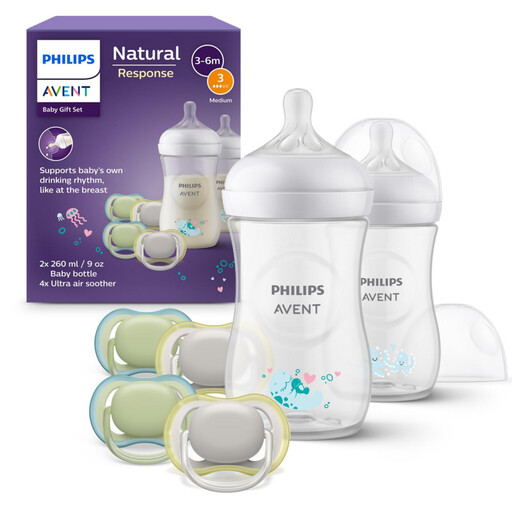
Why this product suits this profile: If you need several dummies and value a coordinated set, you receive two 260-ml bottles and four Ultra-Air dummies for 0-6 months.
The Natural Response teats and anti-colic valve design are described as specific product features, without promising individual success during feeding.
Four dummies included; according to the product description, the components are dishwasher-safe and BPA-free.

Why this product suits this profile: For families with breast pump parts, teats, drinking straws or frequent travel, this set brings together several cleaning tools and a foldable drying rack.
The small teat brush and straw brush reach narrow components. The integrated draining rack means freshly cleaned parts do not have to be placed directly on a cloth.
Seven components according to the contents list, including a soap dispenser, silicone bottle brush, teat brush, straw brush, folding drying rack and carry case.
For daily use, a consistent routine is usually all you need. Take the bottle completely apart and pay particular attention to valves, threads and the teat opening. A large bottle brush removes milk residue from the inner surfaces, while a teat brush is designed for narrow openings. When cleaning straws, use a straw brush, as residue inside them can otherwise be difficult to spot.
After rinsing, all parts should be placed on a clean bottle drying rack or a clean, dry area intended for this purpose. Closed storage boxes should only be used once there is no residual moisture left. Before every use, check teats and dummies for cracks, deformation or sticky areas, and replace them if any visible damage is found.
We have put together a complete, regularly updated list of products that fully meet these strict selection criteria and the safety regulations applicable in the EU.
Depending on your feeding method, several suitable bottles, appropriate teats, one or more age-appropriate dummies, and a bottle and teat brush are enough to get started. If you express breast milk, you should also check whether the brushes can reach the pump parts. A comprehensive baby bottle set is only worthwhile if the included components suit your actual everyday needs.
Bottles should be replaced if they develop cracks, deep scratches, discolouration or a persistent smell. Teats and dummies need to be checked regularly. They should be replaced if they are damaged, have a sticky surface or have changed shape. There is no universal service life, as this depends on the material, care, frequency of use and the manufacturer’s instructions.
No, it is not essential. A suitable baby bottle brush and a small teat brush may be sufficient. However, a 7-in-1 set offers additional functions such as a soap dispenser, straw brush, drying rack and carry case. This is particularly useful if you have lots of small parts, breast pump accessories or travel regularly.