
Lieferung heute & morgen

Qualitätsgarantie

Willkommens-Angebote freischalten: KOSTENLOSE Lieferung | Bis zu 80 % RABATT | Kostenlose 30-Tage-JoyPlus-Testphase
App herunterladen
A baby bottle brush with a foaming function is designed to make everyday cleaning easier while reaching bottles, teats, valves and narrow openings. In practice, however, it quickly becomes clear whether a model is suitable for family life: some brushes produce foam but are difficult to rinse afterwards. Others clean the bottle but do not reliably reach teats or straws.
For parents cleaning baby bottles, well-thought-out details matter more than marketing promises. The following criteria can help you avoid making the wrong purchase.
An integrated foaming function can distribute washing-up liquid and water directly through the brush. However, it does not automatically remove residue from hard-to-reach areas. What matters is whether the brush head reaches the base and inner walls of the bottle, and whether additional attachments are available for teats and narrow openings.
When choosing a bottle brush for baby bottles, you should therefore consider not only the pump mechanism, but also the shape, length and interchangeability of the brush heads.
Rigid plastic bristles can leave scratches on certain bottle materials when used frequently. Residue may later collect in these indentations. A silicone bottle brush with soft, flexible bristles can therefore be a possible alternative, provided it is sufficiently sturdy and easy to manoeuvre.
Soft bristles alone are not proof of quality, however. It is still important that the brush head does not twist and that the bristles reach the bottom of the bottle.
A baby bottle brush set can cover several tasks, but it also requires storage space. If attachments are stored loose in a drawer, they may take longer to dry or become lost. For families who are frequently on the go, a compact case, detachable heads and a way to hang the brush up are practical features.
Look for specific material details such as food-grade silicone and BPA-free plastic. These details relate to the product description and should be checked for the individual listing. A BPA-free bottle-cleaning brush is particularly useful if it regularly comes into contact with bottles, teats and breast pump accessories.
You should also check the following:
After every use, rinse all parts with clean water and allow them to dry completely. Moisture in enclosed containers can make hygienic storage more difficult.
Ideally, a teat brush should have a narrow, angled head so that it can reach inside the teat and around its rim. A straw brush with a small diameter is useful for valves, sippy cups and bottles with straws.
A versatile set should therefore cover at least the following uses:
A non-slip handle makes cleaning easier, particularly when your hands are wet or covered in washing-up liquid. With a press-to-foam brush, the mechanism should work with gentle pressure and be easy to rinse out completely after use.
For a bottle brush for use on the go, a folding design and travel case are important. The case should only be used once the brushes are completely dry. An integrated or separate drying solution can make storage at home easier.
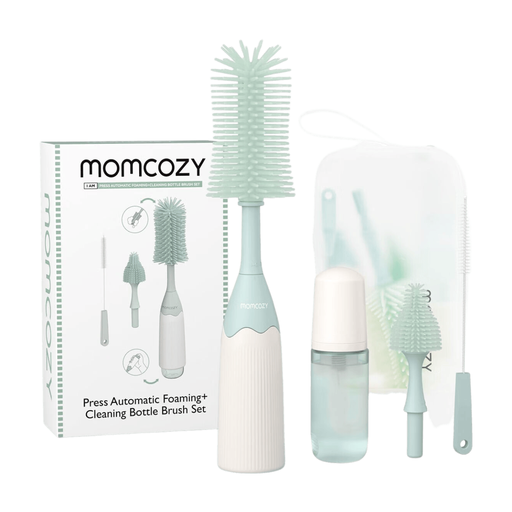
Why this product suits this profile: The set combines a main brush with a press-to-foam function, an angled teat brush and silicone brushes for narrow openings. This gives beginners several uses in one set.
The detachable brush heads reduce the need to buy separate products for teats and straws. According to the product details, the bristles are made from soft, food-grade silicone.
Press-to-foam head, two replacement heads, angled teat brush and travel case, with a stated weight of 0,23 kg.

Why this product suits this profile: The set is designed to provide extensive equipment, including a brush, teat brush, straw brush, soap dispenser, folding draining rack and travel case.
The integrated draining rack addresses the common problem of inadequate drying. According to the product details, the individual parts can be removed and the silicone parts boiled.
Seven components, a folding washing-up or drying rack and a waterproof storage case; material details: food-grade silicone and BPA-free plastic.
Why this product suits this profile: For travel, visits or use in small kitchens, the folding set offers space-saving storage and several attachments for bottle accessories.
The travel case prevents the brushes from lying loose in your luggage. The detachable head allows the handle to be stored more compactly.
Compact design, non-slip handle, hangable components and silicone brushes for straws and narrow openings.
Rinse the brush under running water after every use. With a foaming function, make sure the pump head, connection and brush holder are kept free from washing-up liquid residue in particular. Remove the attachments regularly and check whether residue has collected around the joins.
If you notice visible cracks, deformation, significant wear or a persistent odour, the affected component should be replaced. The service life depends on frequency of use, material, cleaning and storage. It is therefore not possible to give a reliable fixed number of months for every model.
We have put together a complete, regularly updated list of products that fully meet these strict selection criteria and the safety regulations applicable in the EU.
With press-to-foam models, the handle or brush head is gently pressed while being dipped into soapy water. This creates cleaning foam directly at the brush. Follow the relevant instructions for use and rinse the brush thoroughly afterwards.
Replacement is advisable when the bristles become frayed, the silicone develops cracks, the handle becomes unstable or the brush can no longer be kept odour-free despite cleaning. With daily use, the components should be checked regularly rather than relying solely on a fixed timeframe.
This depends on the case, drying arrangements and packed size. A folding handle, detachable brush heads and a travel case make transport easier. All parts must be completely dry before being stored away. For longer trips, a set with an integrated draining rack may require additional space, but it provides more organised drying.