
Lieferung heute & morgen

Qualitätsgarantie

Willkommens-Angebote freischalten: KOSTENLOSE Lieferung | Bis zu 80 % RABATT | Kostenlose 30-Tage-JoyPlus-Testphase
App herunterladen
A baby bottle needs to do more in everyday life than simply hold milk. It should suit your baby’s age, feeding method and the amount of cleaning required each day. Particularly when buying your first bottle, eye-catching advertising claims can quickly lead to the wrong purchase.
1. Age recommendations and teat flow are overlooked
A large bottle is not automatically practical for a newborn. During the first few months, a slow milk flow is often helpful, while older babies may manage better with a medium- or fast-flow teat. However, the manufacturer’s guidance and your child’s drinking behaviour should always be the deciding factors.
2. “Anti-colic” is interpreted as a promise of effectiveness
An anti-colic baby bottle can use valves or a particular teat shape to influence the way air enters during feeding. This does not mean that discomfort will definitely be prevented. It is also essential that the bottle, teat and valve are assembled correctly and cleaned regularly.
3. BPA-free alone says nothing about suitability for everyday use
A BPA-free baby bottle is an important material specification. Parents should also check whether the plastic is dishwasher-safe, whether the teat is made of silicone, and which parts are approved for use in a microwave, sterilisation or heating. Not every bottle can be placed entirely in the microwave, or heated while sealed.
For newborns, smaller models of around 140 to 150 ml are often easy to handle and keep track of. A baby bottle for newborns should be fitted with a slow-flow teat. For babies from around two months, models holding 250 to 260 ml with a medium flow may be suitable, depending on how much they drink. From approximately six months, a 330 ml bottle and a faster-flow teat may be appropriate.
The age recommendation is not a substitute for observing your individual baby. If your baby frequently coughs while feeding, loses milk or takes a very long time, the teat flow may not be suitable. A faster-flow teat should not be chosen simply because the bottle has a larger capacity.
A silicone teat is odourless and tasteless, and can be cleaned hygienically with the correct care. With a baby bottle for combination feeding, many parents look for a soft, breast-like shape. This design may make it easier to switch between breastfeeding and bottle-feeding, but it does not guarantee a trouble-free transition.
When it comes to brand specifications: according to Chicco’s product description, the bottles in the NaturalFeeling range are made of polypropylene and the teats are made of silicone. The relevant product details state that the materials are BPA-free; check the specific care instructions before first use.
The bottle should be capable of being fully taken apart. Narrow sections, valves and threads require particular attention, as milk residue can collect there. Dishwasher suitability can make everyday life easier, but it does not replace checking for any residue.
Before first use, all parts should be cleaned and sterilised in accordance with the manufacturer’s instructions. The teat should be checked regularly for cracks, deformation or porous areas, and replaced if there is any visible damage. Replacement teats may be useful if the bottle is used for a longer period.
A baby bottle steriliser with steam and drying functions can simplify the routine when you have several bottles and breast pump parts. A baby milk bottle warmer should offer suitable temperature control. Always check the milk after heating, as the temperature may not be distributed evenly throughout the bottle.
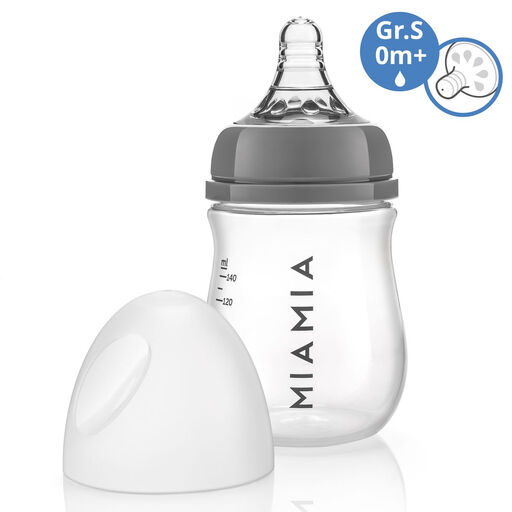
Why this product suits this profile: According to the product description, its compact capacity and size S teat are suitable from birth for milk, first infant formula, water and tea.
The clear size and age guidance helps prevent choosing a container that is too large and a teat that flows too quickly for the early months.
140 ml capacity, BPA-free PP and silicone teat; according to the product details, the bottle and teat are dishwasher-safe.
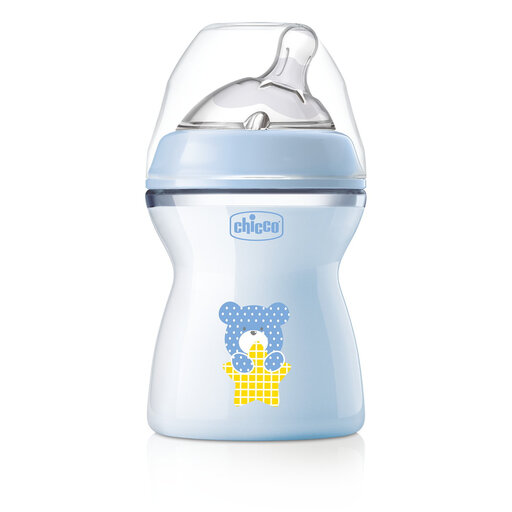
Why this product suits this profile: The 250 ml bottle is intended for babies from two months and combines a medium flow with an angled silicone teat.
The age group and medium teat flow are clearly stated. The integrated double valve is described as an anti-colic design, not as a guarantee against discomfort.
250 ml capacity, PP bottle, BPA- and latex-free silicone teat, plus dishwasher suitability according to the product data.
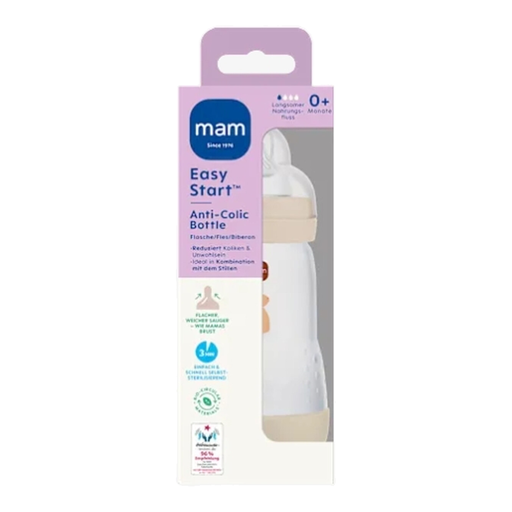
Why this product suits this profile: According to the manufacturer’s information, the flat, soft teat and slow flow are designed for babies from birth and for combining breastfeeding with bottle-feeding.
The slow-flow teat reduces the risk of choosing based solely on bottle capacity. Self-sterilisation must be carried out exactly as described in the instructions.
260 ml capacity, PP bottle, silicone teat, slow flow and self-sterilisation in three minutes, according to the product description.
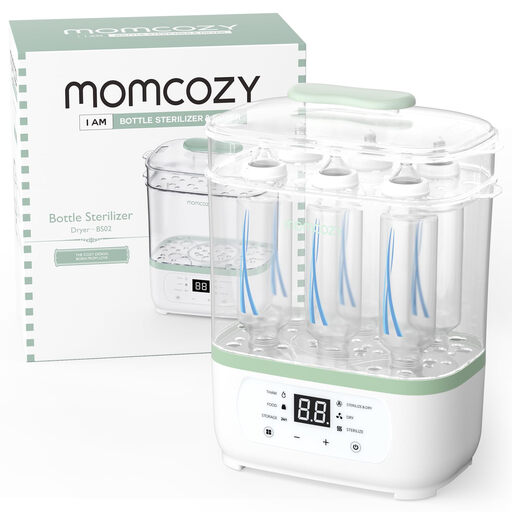
Why this product suits this profile: This appliance is aimed at households with several bottles, breast pump parts or additional needs for heating and drying.
The capacity for up to eight standard bottles means frequent users do not need to combine several smaller appliances. Steam and hot surfaces require safe positioning and supervision.
Eight functions according to the product description, including steam sterilisation, drying, defrosting and heating baby food; mains-powered operation.
We have put together a complete, regularly updated list of products that fully meet these strict selection criteria and the safety regulations applicable in the EU.
For newborns, consider models approved for use from birth and fitted with a slow-flow teat. Examples from our selection include the MiaMia Baby Bottle 140 ml, the MAM Easy Start Anti-Colic with a capacity of 260 ml, and certain Chicco NaturalFeeling models with a capacity of 150 ml. The manufacturer’s guidance and your child’s drinking behaviour remain the key factors.
The bottle itself can be used for longer if the material remains in good condition. However, teats should be checked regularly and replaced if they show signs of wear, cracks or deformation. Some product details recommend replacing them at regular intervals regardless of their visible condition. The relevant instructions for use and hygiene requirements are the decisive factors.
Neither appliance is essential in every household. A baby bottle steriliser can save time if you use several bottles each day and have lots of individual parts to clean. A baby milk bottle warmer allows controlled heating, but it must be set correctly and cleaned after every use. If you only use a bottle occasionally, you may also be able to use a suitable bain-marie, depending on the manufacturer’s instructions.