
Lieferung heute & morgen

Qualitätsgarantie

Willkommens-Angebote freischalten: KOSTENLOSE Lieferung | Bis zu 80 % RABATT | Kostenlose 30-Tage-JoyPlus-Testphase
App herunterladen
Finding the right baby bottle might seem straightforward at first. In practice, however, models differ significantly in teat shape, flow rate, capacity, cleaning requirements and age suitability. Particularly with newborns, an unsuitable combination of an overly large bottle and a teat that is too fast can make daily life unnecessarily difficult.
Three typical buying mistakes occur especially often:
For newborns, smaller models of around 140 to 150 ml with a slow or normal flow are often suitable. A baby bottle with a slow flow releases liquid more controllably. As feeding needs increase, models with 250 to 260 ml can be useful. For babies from around six months, there are baby bottles with a fast flow and, for example, 330 ml capacity.
The age recommendation on the packaging should always be matched to the child’s developmental stage. A fast teat is not suitable just because the baby needs a larger bottle. The teat’s flow rate is what matters.
With a BPA-free baby bottle, it should be clearly stated what material the bottle body and teat are made from. The product range includes polypropylene (PP) and silicone. PP is lightweight and more shatter-resistant than glass, while a silicone teat can be soft, flexible and easy to clean.
It is also worth considering:
Milk residue can build up in valves, teat openings and screw rings. Therefore, a baby bottle should be taken apart and thoroughly cleaned after each use. A baby bottle cleaning set with a bottle brush, teat brush and, if necessary, a straw brush makes it easier to clean hard-to-reach areas.
A bottle steriliser can be practical when you have several bottles and feed frequently. However, it does not replace prior cleaning. With steam or hot-air appliances, you should follow the operating instructions, water fill level and be aware of the risk of burns.
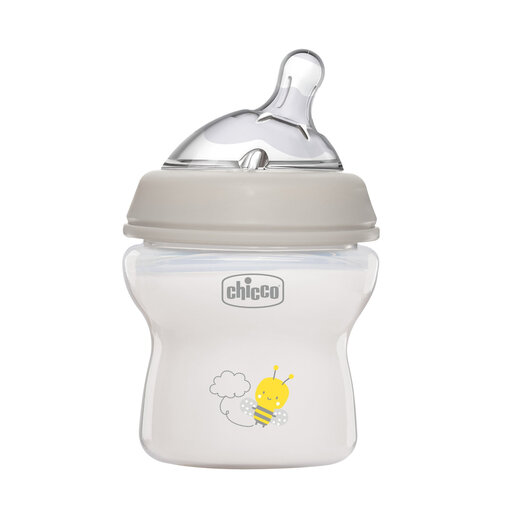
Why this product fits the profile: According to product information, this compact baby bottle is suitable from birth and features a soft silicone teat with a 150 ml capacity. This makes it ideal for getting started and for smaller feeding amounts.
The clear age recommendation and smaller capacity prevent unnecessarily large bottles from being bought from the start.
150 ml capacity, BPA-free bottle body, dishwasher-safe and designed for a slow start to feeding.
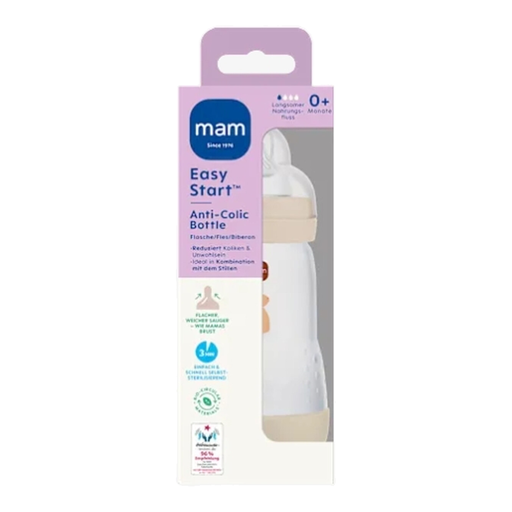
Why this product fits the profile: According to the product description, the MAM Easy Start Anti-Colic is suitable from birth, holds 260 ml and features a flat silicone teat with a slow flow. This makes it an interesting option for combining breastfeeding and bottle feeding.
The slow flow rate makes it clear that the anti-colic design and teat speed must be considered separately.
260 ml capacity, PP bottle, silicone teat, disassemblable construction and, according to the supplier, a self-sterilisation function.

Why this product fits the profile: This set is aimed at families who want to clean baby bottles, teats, straws and breast pump parts at home and on the go.
Multiple brush sizes address hard-to-reach areas, while the foldable drying rack prevents wet parts from being stored directly in the bag.
Seven components, food-grade silicone, BPA-free plastic and a waterproof storage box.
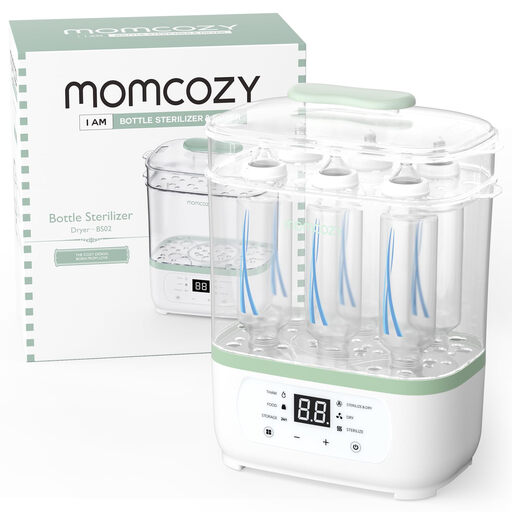
Why this product fits the profile: This electric steam steriliser is designed for households with several bottles and accessories, and also offers a drying function.
The capacity should match your actual bottle collection before purchase. This avoids buying a device that is too small for multiple daily cleaning cycles.
According to product information, space for up to eight standard bottles, plus functions for sterilising, drying, defrosting and warming baby food.
For on-the-go use, a portable bottle warmer such as the Momcozy MW05 could be of interest. Before each use, check the temperature of the food and follow the manufacturer’s instructions. For older children from 12 months, a drinking bottle with a straw, such as the Kikka Boo Flora Sage Mini Bottle, is a different product category from baby bottles for milk.
We have put together a complete, regularly updated list of products that fully meet these strict selection criteria and the safety regulations in force in the EU.
That depends on your feeding routine and how often you wash up. With regular bottle feeding, several bottles are practical so you do not have to wash up immediately after every feed. You should also plan for replacement teats and, if necessary, a cleaning set.
The bottle body can be used for longer if the surface remains intact. Teats and valves, however, should be checked regularly and replaced if they show cracks, deformation, stickiness or visible wear. Always follow the manufacturer’s instructions.
Plastic bottles made from certified BPA-free PP are lightweight and more shatter-resistant. Glass is dimensionally stable but heavier and can break. Your choice should therefore depend on where you will use it, handling, cleaning and the temperature resistance specifications.