
Lieferung heute & morgen

Qualitätsgarantie

Willkommens-Angebote freischalten: KOSTENLOSE Lieferung | Bis zu 80 % RABATT | Kostenlose 30-Tage-JoyPlus-Testphase
App herunterladen
As a Joybuy Product Recommendation Officer, my role is to provide you with clear, objective information so you can make informed purchasing decisions. Daily life with a newborn is demanding enough—choosing the right equipment shouldn't be. A key concern is the hygiene of baby bottles. A baby bottle steriliser and dryer promises to make this task significantly easier. However, not every device delivers on its promise.
The market is filled with a variety of devices whose marketing often promises more than the technology can deliver. Many parents invest in a unit only to find it barely simplifies their daily routine. Look out for these three common problems to avoid a bad investment.
To avoid the problems mentioned above, you should check three core technical features before buying. These define the efficiency and practical value of a device in daily use.
Sterilisation using hot steam is the established and reliable method for ridding baby bottles of harmful germs. An effective steam steriliser for baby bottles heats water to around 100°C and circulates the steam throughout the interior for several minutes. This process reliably kills bacteria and viruses without the use of chemicals. Pay attention to the specified duration of the sterilisation cycle and the steam distribution within the unit.
This is what separates the good from the great. A high-quality drying function is an active process. Look for devices that circulate hot, filtered air to completely dry the bottles and accessories. An integrated HEPA filter is a key feature here, as it ensures that only clean, particle-free air is used for drying. This achieves the goal of sterilising and drying baby bottles without compromising on hygiene.
The degree of automation determines how much time you actually save.
Instead of presenting an overwhelming list, we are highlighting one model that fulfils the above criteria in a thoughtful way.
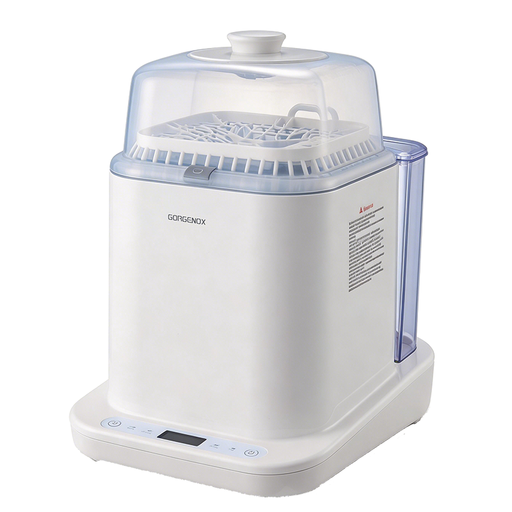
Why This Fits Their Persona: This device is aimed at parents who want maximum time savings and uncompromising hygiene. It automates the entire process from cleaning to a dry, ready-to-use bottle, fitting seamlessly into the demanding daily routine with a baby.
As a 2-in-1 device, it completely bypasses the "sterilise-only" trap. The combination of washing, steam sterilisation, and active drying ensures that the bottles are not only sterile but also ready for immediate use, without any manual follow-up.
The key advantage is the fully automatic cycle. According to the manufacturer, a three-arm spray system provides a thorough pre-wash, followed by steam sterilisation and drying. This reduces manual effort to a minimum.
We have compiled a complete, real-time list of products that fully satisfy these strict selection criteria and UK safety regulations.
1. How often should you descale a baby bottle steriliser? The frequency depends on the water hardness in your area and how often you use it. With hard water, descaling every 1-2 weeks is recommended; with soft water, every 4 weeks is sufficient. Many manufacturers recommend using distilled water to minimise limescale build-up from the start and extend the life of the appliance.
2. Is a device with a drying function really necessary? It's not strictly necessary, but it offers a significant gain in convenience and hygiene. Without a drying function, you have to let the bottles air-dry, which takes time and risks re-contamination, or dry them manually, which can compromise the sterilisation effect. An electric bottle steriliser with an integrated, active drying function completes this process hygienically and efficiently.
3. Can I also sterilise other baby items in a bottle steriliser? Yes, most units are also suitable for sterilising teats, dummies, teething rings, and parts of breast pumps, provided they are heat-resistant. Always check the manufacturer's instructions for both the steriliser and the items to be sterilised. Larger devices often offer more flexibility for various accessories.