
Lieferung heute & morgen

Qualitätsgarantie

Willkommens-Angebote freischalten: KOSTENLOSE Lieferung | Bis zu 80 % RABATT | Kostenlose 30-Tage-JoyPlus-Testphase
App herunterladen
The right baby bottle teat affects how easily and controllably your baby can drink, as well as how well the teat fits the bottle you already have. At the same time, unclear age recommendations, different hole sizes and brand-specific systems often lead to unsuitable purchases. A teat that appears compatible on the outside will not necessarily sit securely in the bottle ring.
“From birth”, “from 4 months” or “from 6 months” are useful points of reference, but they do not replace observing your baby’s drinking behaviour. A slow milk flow may be suitable for newborns and babies who are being combination-fed. A medium milk flow is often suitable for older babies, while a fast milk flow or a teat for thickened food should only be considered for the right bottles, food and developmental stage.
A flow that is too fast may cause your baby to drink more hurriedly. A teat that is too slow, on the other hand, can make feeding take a long time. The manufacturer’s information, your baby’s age and their individual drinking style are therefore all important.
Anti-colic valves vary depending on the brand and design. They can regulate the air supply within the bottle system, but they do not guarantee a particular drinking pattern or prevent discomfort. For example, according to the product information, the Philips Avent Anti-Colic teat uses a valve that directs air into the bottle rather than towards the baby’s tummy. Depending on the model, Chicco NaturalFeeling products use two valves.
Such information should be understood as a technical product feature, not a medical promise. According to a Philips Avent clinical study, the valve described there was associated with a reduction in colic, spit-up and fussiness. This statement relates to the brand’s information and cannot be applied to every baby.
A BPA-free baby bottle teat meets an important material requirement, but this alone says nothing about the bottle neck, teat shape or milk flow. Silicone is tasteless, odourless and temperature-resistant, but a silicone bottle teat must still belong to the relevant bottle range. For example, a Philips Avent teat is intended for specific Philips Avent bottles, while a MAM teat can be used with MAM wide-neck bottles and the MAM Trainer.
Pay attention to the teat’s specific marking:
Terms such as “Size 1”, “Size 2” or “Normal Flow” vary from brand to brand. Do not compare numbers alone; also check the age recommendation and flow description. A replacement baby bottle teat should ideally use the same teat shape and bottle ring as the original.
Silicone is commonly used for many baby bottle teats. Check whether the manufacturer states that the product is BPA-free and what other material information is provided. Chicco NaturalFeeling products are described as being made from 100 per cent silicone, while certain models are also described as phthalate-free. For its Size 2 teat, MAM specifies SkinSoft silicone, BPA-free construction and compliance with EN 14350.
Before every use, check the teat for cracks, sticky areas, deformation or thin sections. Do not continue using it if there is any visible damage.
Read the care instructions for the relevant model carefully. Some teats are dishwasher-safe, while others may only be cleaned by hand. Depending on the manufacturer, boiling, steam sterilisation or cold-water sterilisation may be possible. A teat should be sterilised before first use and thoroughly cleaned after every feed.
Several product descriptions recommend replacing the teat after around one to two months, or immediately if it shows signs of wear. Checks can be particularly important for teething children, as bite marks may damage the material.
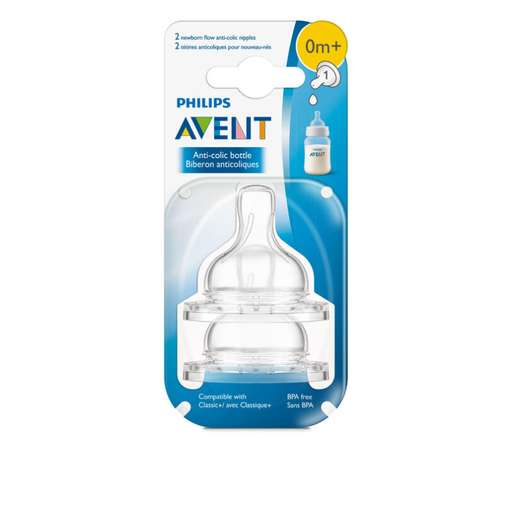
Why this product suits this profile: The 2-pack is intended for babies from birth and provides a slower, controlled milk flow for getting started.
The “from birth” size indication and single-hole design make it easier to identify a slow milk flow.
BPA-free silicone, anti-colic valve, dishwasher-safe and compatible with Philips Avent Anti-Colic and Classic+ bottles.
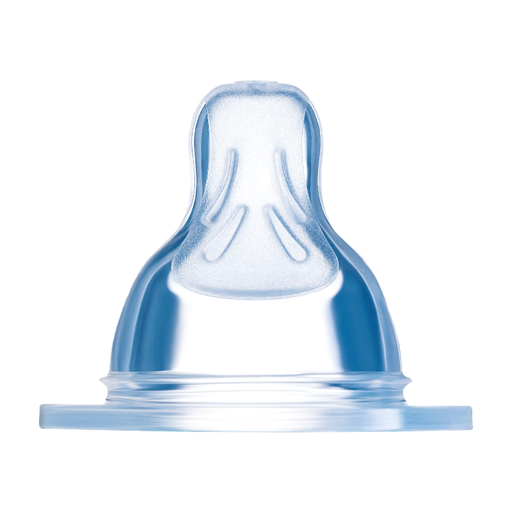
Why this product suits this profile: This teat is intended for babies from 4 months and combines a medium milk flow with detailed care and material information.
Compatibility is limited to MAM wide-neck bottles and the MAM Trainer, making it more clearly defined than universal compatibility claims.
SkinSoft silicone, BPA-free, compliant with EN 14350 according to the product information, and dishwasher-safe in the upper rack up to 65 °C.
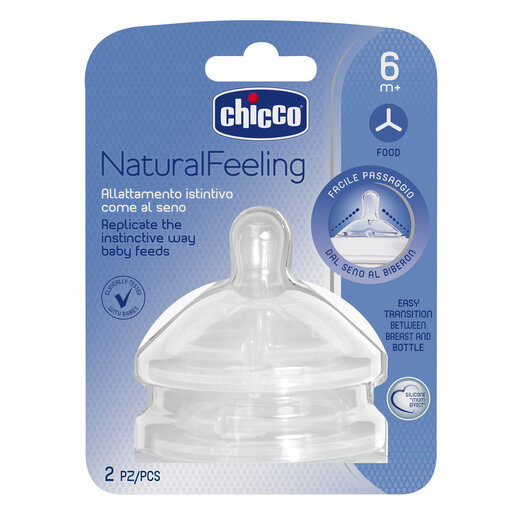
Why this product suits this profile: This teat is intended for particular food consistencies; the packaging information must still be checked to select the appropriate flow.
The marking for thickened food helps prevent a standard or fast milk flow from being used for the wrong purpose.
BPA-free silicone, dual valve and compatibility with Chicco NaturalFeeling bottles.
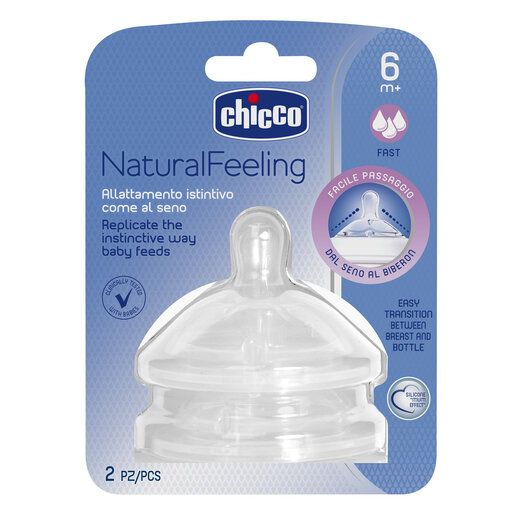
Why this product suits this profile: The fast milk flow is specified for babies from 6 months and is suitable for families who want to change the teat in line with their baby’s developmental stage.
The age and flow information distinguishes this teat from models for newborns or medium milk flow.
100 per cent silicone according to the product information, BPA-free, dual anti-colic valve and dishwasher-safe in the upper rack.
We have put together a complete, regularly updated list of products that fully meet these strict selection criteria and the safety regulations applicable in the EU.
Many manufacturers recommend replacing the teat after around one to two months. Regardless of the time period, replace it immediately if you notice cracks, discolouration, stickiness, deformation or any other damage. It should be cleaned and dried completely after every use.
For newborns, teats marked “from birth”, “0M+” or “Newborn Flow” with a slow milk flow are generally suitable. Bottle compatibility and your baby’s individual drinking style are also important. According to the product information, the Philips Avent Anti-Colic Teat Size 1 is intended for babies from birth.
A medium milk flow is often offered with bottle teats from 4 months, while a fast milk flow is often available with bottle teats from 6 months. The age recommendation is intended as a guide. Only change the teat when your baby’s drinking behaviour, the teat marking and the manufacturer’s recommendation all match.