
Lieferung heute & morgen

Qualitätsgarantie

Willkommens-Angebote freischalten: KOSTENLOSE Lieferung | Bis zu 80 % RABATT | Kostenlose 30-Tage-JoyPlus-Testphase
App herunterladen
A baby bottle warmer can make everyday life with milk, breast milk or baby food easier. However, not every appliance is suitable for every household. Some models promote a particularly large number of programmes, even though only two functions are relevant in daily use. Others heat quickly but offer no suitable setting for different bottle materials or are difficult to clean.
As a Joybuy Product Recommendation Officer, I filter the key information from product descriptions and categorise it according to typical usage situations. This makes it easier to assess which bottle warmer for babies fits your own routine.
A short heating time alone says little about how evenly the temperature is distributed. Different areas within a container can reach different temperatures when heating milk. The bottle should therefore be swirled after heating, and the temperature checked before feeding. An appliance that uses a water bath or circulation may be more practical than heating in a microwave, where the temperature can be uneven.
A 4-in-1 bottle warmer or an appliance with ten functions may sound versatile. What matters, however, is whether your own bottles, jars and containers will fit inside. Check the following before buying:
A keep-warm function is useful when feeding does not begin immediately. However, it does not replace the manufacturer's instructions for storing and preparing milk or baby food. An automatic switch-off reduces the risk of the heating process continuing indefinitely, but the appliance should still be supervised during operation.
If you want to warm milk for your baby, look for straightforward controls. An electric bottle warmer often uses water in a heating chamber. The required amount of water and programme selection depend on the instructions, the starting temperature, the quantity and the container material.
For warming breast milk, a low or gradual setting is sensible if the appliance offers this function. Baby food may require different heating times. The manufacturer's claim that a product is “fast” should therefore always be considered in relation to the volume and starting temperature.
Depending on your household, the following functions may be relevant:
An appliance for use on the go should not just be compact. Check whether a car adapter is included and whether the output in 12-volt mode differs from the output at home.
The baby bottle warmer should be placed on a stable, level surface. Any remaining water must be removed after use to limit build-up. Removable parts make cleaning easier. For products with plastic components, details such as BPA-free construction and food-safe materials are relevant, but these should always be checked in the specific product description and instructions.
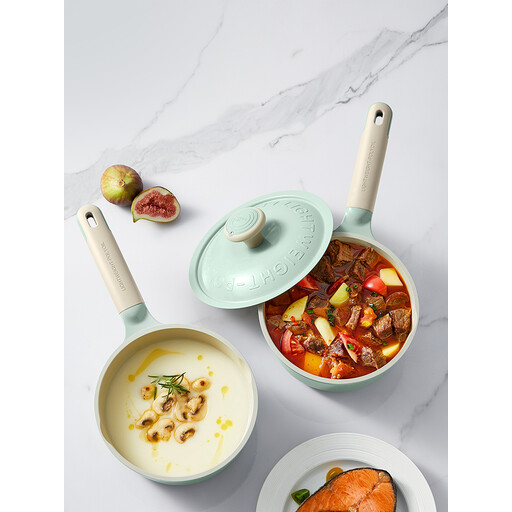
Why this product suits the profile: This small pot is suitable for households that want to heat milk or small portions of baby food directly on the hob and do not need automatic programmes.
It does not promise automatic temperature control. This makes it clear that supervision, stirring and temperature checks are entirely the responsibility of the person using it.
Compact single-serve design and non-stick coating according to the product name; not presented as an automatic baby bottle warmer with automatic switch-off.
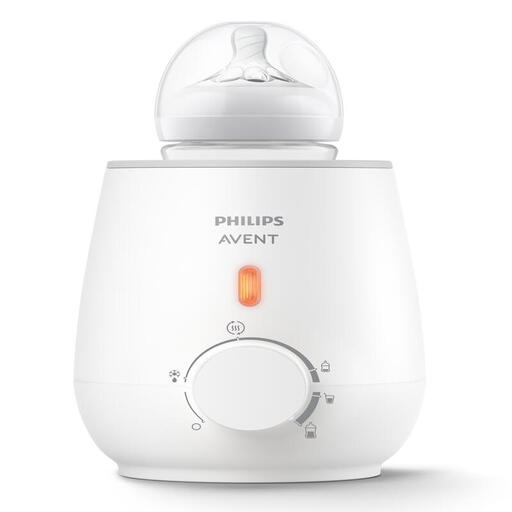
Why this product suits the profile: Suitable for parents looking for an electric bottle warmer with clear dial controls, a defrosting function and a keep-warm setting.
The product description mentions continuous milk circulation and suitability for containers from other brands up to 7 cm in diameter. Compatibility should nevertheless be checked with your own container.
Integrated defrosting function, keep-warm setting and compatibility with Philips Avent products as well as standard jars and bottles up to 7 cm.
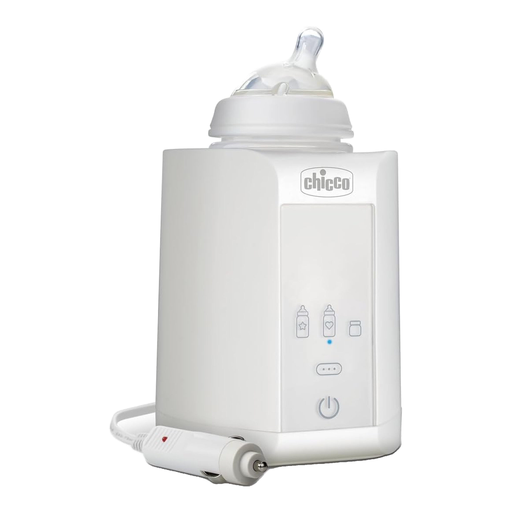
Why this product suits the profile: For families wanting to use a bottle warmer both on the go and at home, the included adapter for the vehicle's 12-volt connection is particularly useful.
The description explicitly states different power ratings for 220–240 volts and 12 volts. This makes it easier to plan realistically for use at home and in the car.
Five functions according to the supplier, including defrosting, keeping food warm for up to one hour and automatic switch-off with an audible signal.
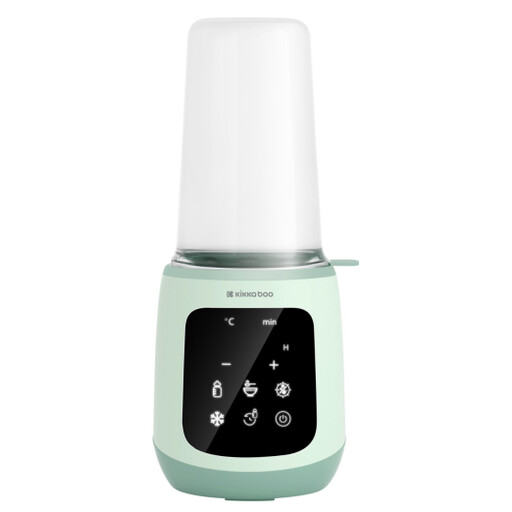
Why this product suits the profile: A suitable option for parents who want to combine warming, defrosting, sterilising and keeping food warm in one compact appliance.
It is operated via a touch display with a timer. A basket, lid, maximum diameter of 7.5 cm and automatic switch-off are also specified.
Four stated functions, BPA-free and food-safe materials according to the product information, plus compact dimensions of 12.6 × 13.7 × 29.8 cm.
We have put together a complete, regularly updated list of products that fully meet these strict selection criteria and the safety regulations applicable in the EU.
The bottle or jar is placed in a heating chamber filled with water. The appliance heats the water, which transfers the heat to the contents. Depending on the model, programmes may be available for chilled or room-temperature milk, baby food, defrosting and keeping food warm.
This depends on the appliance and its instructions. Models with a dedicated breast milk setting may be designed for this purpose. Regardless of the programme used, the temperature must be checked before feeding. Claims made by a brand about specific features should be understood as manufacturer information; they do not establish medical efficacy or guarantee the preservation of particular nutrients.
Electricity consumption depends on the power rating, heating time and frequency of use. Appliances rated at 220 to 240 volts are connected for domestic use; a model with an additional 12-volt adapter can be used on the go. For a realistic estimate, the rated power in watts, the number of heating cycles per day and the duration of each cycle are the key factors.