
Lieferung heute & morgen

Qualitätsgarantie

Willkommens-Angebote freischalten: KOSTENLOSE Lieferung | Bis zu 80 % RABATT | Kostenlose 30-Tage-JoyPlus-Testphase
App herunterladen
A baby bottle warmer can make life easier at night, at home, or on longer journeys. However, these devices differ significantly in terms of power supply, bottle compatibility, heating programmes and operation. If you only focus on a short advertising claim like “heats quickly”, you might overlook important limitations.
Time specifications often refer to a specific volume of milk, a defined starting temperature, and a particular bottle type. Cold milk from the fridge usually requires different settings than liquid at room temperature. Glass and plastic bottles can also behave differently.
So check whether the information in the manual matches your typical fill volume. With some devices, the amount of water in the heating chamber has to be measured manually.
A milk bottle warmer may be suitable for many standard bottles, but wide-neck bottles, jars, breast milk bags or special ventilation systems need enough space and, where necessary, a suitable adapter. With the portable bottle warmer from Momcozy, for example, the green ventilation system must be removed from Dr. Brown’s bottles before connecting.
Before buying, bottle diameter, height and adapter range are therefore more important than a general label like “multi-compatible”.
A keep-warm function maintains the contents at a chosen temperature for a certain period, depending on the model. However, it is not a substitute for following the preparation and storage guidelines for breast milk or infant formula. Always check the milk temperature before feeding. This applies even if the device switches off automatically or sounds a signal.
An electric bottle warmer usually works with a water bath or a heated chamber. The heat is transferred to the bottle or jar. Models with gradual heating can be useful if breast milk or baby food shouldn’t be heated too intensely straight away. What matters is that the instruction manual provides clear information about milk volume, starting temperature and container material.
If you want to warm breast milk, you should look for a programme designed for that purpose. With the Philips Avent SCF355/09, the milk is continuously moved during warming, according to the product description. This is intended to support a more even temperature distribution within the device. Nevertheless, the contents must be checked before feeding by gently swirling and testing the temperature.
A bottle warmer with a defrost function can bring frozen milk bags or baby food to temperature more practically than improvised methods. Check whether the function is equally suitable for bags, bottles and jars.
A bottle warmer with a keep-warm function should state a clearly defined maximum duration. With the Chicco model, the product description indicates keeping warm for up to one hour. Another Momcozy model states up to 24 hours according to product information. These figures are not equivalent: the actual suitability depends on the food type, hygiene, starting temperature and the manufacturer’s instructions.
For the kitchen, a device with 220–240 V is usually sufficient. If you need a bottle warmer for on the go, you should distinguish between three variants:
Also make sure you have a stable, heat-resistant surface, a secure bottle connection, and cleaning that is possible without hard-to-reach areas.
The following models are assigned to different user profiles. The information is based on the respective product descriptions. Before buying, also check the full instruction manual and the current compatibility list.
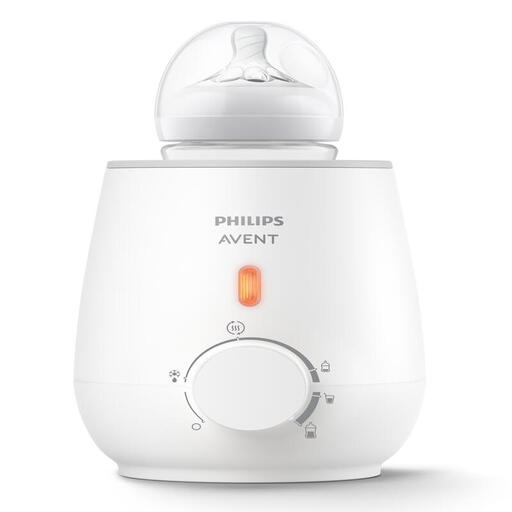
Why this product fits the profile: The device is designed for home use and operates on 220–240 V. According to the product description, it is also suitable for standard jars, bottles and cups up to a diameter of 7 cm.
The product description mentions an integrated defrost function and a keep-warm setting. This means you don’t need to buy several devices for these tasks.
Simple operation via a rotary dial, continuous movement of the liquid according to the description, and compatibility with several types of container.
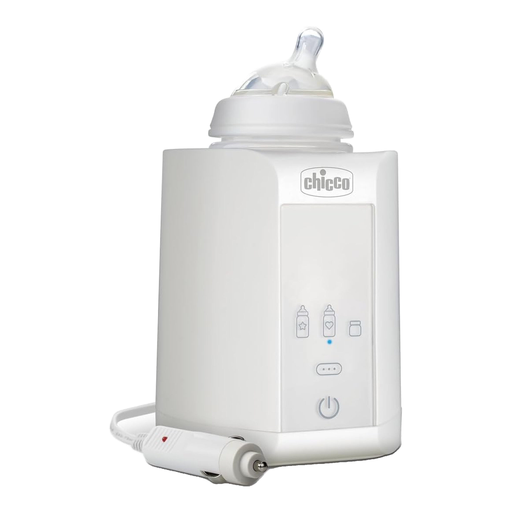
Why this product fits the profile: It combines mains socket use with a supplied car adapter and is described as suitable for plastic and glass bottles as well as larger containers.
The power supply for 220–240 V and 12 V is clearly stated. The description also mentions automatic switch-off and a signal tone after the programme ends.
Five functions including defrosting and keeping warm for up to one hour; a separate programme for breast milk according to the product description.

Why this product fits the profile: For households with different warming tasks, the model offers ten functions according to product information, including warming, defrosting, steaming and keeping warm.
The selection of milk state, bottle material and volume is intended to make the setting more understandable. An automatic switch-off and a timer display are present according to the product description.
According to product information, suitable for breast milk, infant formula and baby food; removable parts are described as dishwasher-safe.

Why this product fits the profile: The integrated rechargeable battery and several supplied adapters make the model interesting for trips and situations without a direct power connection.
The power supply is not limited to a mains socket or a car connection. Before use, you need to check the battery charge level, adapter and secure fit of the bottle.
USB-rechargeable battery, multiple bottle adapters and, according to the product description, a leak-proof connection concept.
We have put together a complete, regularly updated list of products that fully meet these strict selection criteria and the safety regulations in force in the EU.
Regardless of the baby bottle warmer you choose, you should keep these points in mind:
That depends on the milk volume, starting temperature, bottle material and programme. Individual product information may state, for example, a few minutes under set conditions. This time cannot automatically be transferred to every bottle. The instruction manual remains the definitive guide.
Many devices have a programme for breast milk. Use only the settings intended for this purpose and avoid unnecessarily high temperatures. The milk must be checked before feeding. You should obtain advice on storage and preparation from medical professionals or your relevant health advisory service.
A bottle warmer with a rechargeable battery can be suitable for frequent trips, travel or longer waiting times away from home. For use exclusively in the kitchen, a corded model is usually more straightforward. With a battery-powered device, also factor in charging time, battery level, adapter requirements and cleaning.