
Lieferung heute & morgen

Qualitätsgarantie

Willkommens-Angebote freischalten: KOSTENLOSE Lieferung | Bis zu 80 % RABATT | Kostenlose 30-Tage-JoyPlus-Testphase
App herunterladen
A baby bottle warmer with steriliser can combine several tasks involved in preparing bottles: warming milk, bringing baby food to the right temperature, sterilising accessories or drying bottles. This saves space and can make your daily routine easier. However, not every multifunctional appliance is suitable for every household.
Names such as 4-in-1 bottle warmer or 8-in-1 baby bottle steriliser may sound impressive. What matters, however, is which items will actually fit inside the appliance. A compact model may be sufficient for a single bottle, while families with twins or more children may need greater capacity.
So check the following:
Depending on the model, an electric bottle warmer uses a water bath, steam or a combination of temperature control and timed programmes. Heating time depends on factors including the fill quantity, starting temperature and bottle material. A short advertised heating time often refers to a specific test configuration.
Milk or baby food should be stirred after every cycle or its temperature checked. Automatic shut-off reduces the risk of the appliance running for too long, but it does not replace checking the food before feeding.
A baby bottle steriliser does not remove dried-on milk residue. Bottles, teats and accessories must first be cleaned according to the manufacturer’s instructions. A baby bottle washer with an automatic washing programme carries out this step separately on suitable models.
For appliances that use steam sterilisation, you should also consider water quality, descaling and drying. Limescale deposits can affect heating performance and appliance maintenance.
For preparing milk every day, a milk bottle warmer with temperature selection and a keep-warm function is often sufficient. If you also want to warm jars or defrost frozen food, a combination appliance may be worth considering.
A steam steriliser for baby bottles uses heated water and requires sufficient cooling time after the programme. Models with a drying function also use warm air. With an appliance offering washing, sterilisation and drying programmes, check whether the individual steps can be run separately or only in set combinations.
The appliance’s external dimensions determine whether it can remain permanently on the kitchen worktop. Small appliances are easier to store, but may offer less space for accessories. Larger models are more suitable for families using several bottles a day.
Also look for:
Contact surfaces should be made from materials suitable for their intended use. Product specifications may mention polypropylene (PP), stainless steel and ABS, for example. A BPA-free design may be an important selection criterion, but this should always be verified in the specific product description.
Important safety features and points to note include:
Appliances that produce high-temperature steam pose a scalding risk. Children should not have access to the appliance or its cable.
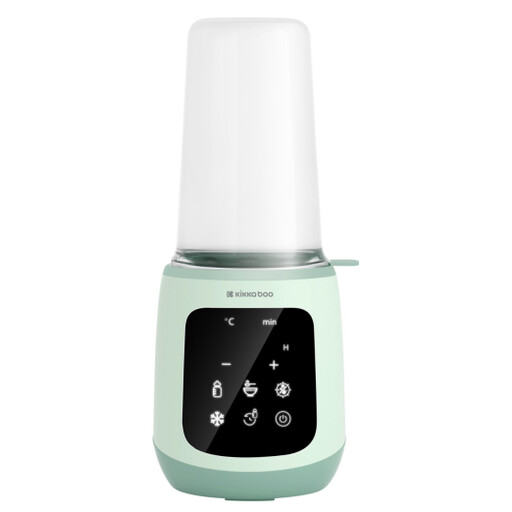
Why this product suits this profile: According to the manufacturer, this compact appliance combines warming milk and food, sterilising and defrosting in a single unit. Weighing 0.63 kg and measuring 12,6 × 13,7 × 29,8 cm, it is suitable for households with limited space.
The four clearly stated functions make it easier to compare options. Nevertheless, you should check the practical capacity against the dimensions of your own bottles before buying.
Touchscreen, timer with keep-warm function and automatic shut-off; suitable for bottles, jars and small accessories.
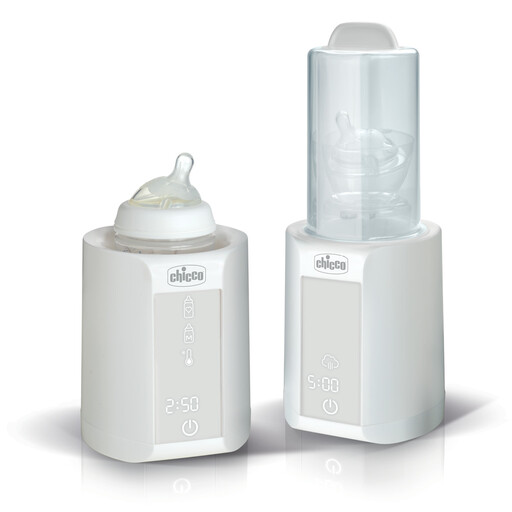
Why this product suits this profile: According to the manufacturer, this 2-in-1 appliance offers programmable warming, a keep-warm function for up to one hour and a separate steam sterilisation programme.
According to the product information, the programme selection takes the bottle type, size and starting temperature into account. A descaling reminder supports planned maintenance.
Digital display, automatic shut-off and a basket for smaller accessories; suitable for plastic and glass bottles according to the manufacturer’s description.
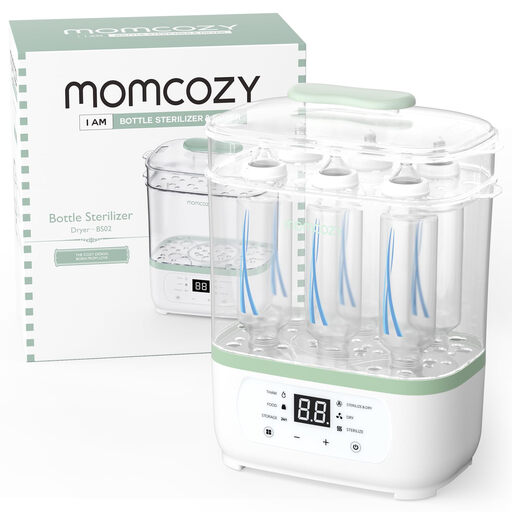
Why this product suits this profile: According to the manufacturer, the appliance holds up to eight standard bottles and combines steam sterilisation, drying, defrosting and warming baby food.
The capacity is clearly stated. Even so, you should check your own bottle shapes and the available worktop space before buying.
Drying function, several combination options and dimensions of 36,2 × 32,5 × 19,7 cm.
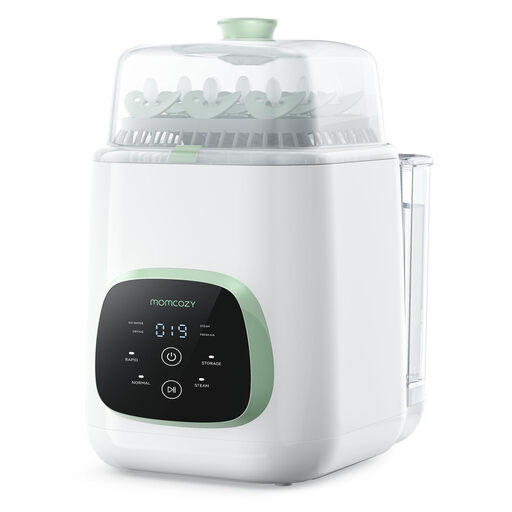
Why this product suits this profile: This appliance is designed for households with lots of bottles and, according to the manufacturer, handles washing, steam sterilisation and drying in a single cycle.
The washing function separates cleaning from the subsequent steam treatment. However, the filter, water tank and waste-water container require regular maintenance.
26 spray nozzles, up to four standard bottles per cycle and nine combinable programmes according to the product description.
We have put together a complete, regularly updated list of products that fully meet these strict selection criteria and the safety regulations applicable in the EU.
Ongoing costs mainly depend on electricity consumption, water usage, cleaning products and descaling intervals. An appliance with a larger interior may require more water and energy per cycle, but it can process several bottles at the same time.
For a longer service life, we recommend:
Place the appliance on a stable, heat-resistant surface and use only the amount of water specified in the instructions. Bottles and accessories should be cleaned before sterilisation and placed correctly in the basket. Once the programme has finished, check the temperature of the food.
There is no single fixed service life that applies to every appliance. It depends on the material, maintenance, limescale build-up and frequency of daily use. Damaged cables, cracks, leaking containers or faulty shut-off functions are reasons to stop using the appliance.
A baby bottle steriliser and dryer can be useful if you regularly clean several bottles or breast pump parts. For occasional use, a simpler bottle warmer or steriliser may be sufficient. The key factors are your daily needs, the capacity and the amount of space available in your kitchen.