
Lieferung heute & morgen

Qualitätsgarantie

Willkommens-Angebote freischalten: KOSTENLOSE Lieferung | Bis zu 80 % RABATT | Kostenlose 30-Tage-JoyPlus-Testphase
App herunterladen
As a Joybuy Product Recommendation Officer, my mission is to provide you with clear and objective information. Daily life with a newborn is demanding, and constantly cleaning baby bottles can quickly become a time-consuming chore. A combination device that washes, sterilizes, and dries promises relief. However, not all models live up to their promises. This guide will help you identify the essential features and make an informed decision.
The market is filled with a variety of devices whose marketing often promises more than the technology can deliver. Watch out for these three common weaknesses to avoid a poor investment:
To separate the wheat from the chaff, you should focus on objective technical parameters. These three aspects are decisive for a device's performance and utility.
A true baby bottle washer should do more than just a simple rinse. Pay attention to the type and number of water jets. Models with multiple, precisely targeted high-pressure water jets can reliably remove even dried-on milk residue from inside the bottle and in hard-to-reach areas like the bottle thread. A simple steam or rinse cycle is often not enough.
Most devices sterilize using hot steam. A steam sterilizer for baby bottles reliably kills germs with high temperatures. However, what happens next is crucial. A high-quality bottle sterilizer with drying function initiates the drying process immediately after sterilization. Look for models that use a HEPA filter. This ensures that the air used for drying is filtered and free of ambient dust particles and germs, thus maintaining the sterility of the bottles.
Check the device's capacity before buying. How many bottles fit at once? Is the interior flexible enough to also accommodate accessories like nipples, pacifiers, and especially the individual parts of a breast pump? Modern devices like the Momcozy bottle washer often have a modular design to accommodate a wide range of accessories from different brands. The material used should, of course, be BPA-free and heat-resistant.
Based on the criteria above, we are featuring a model that stands out for its well-thought-out functionality.
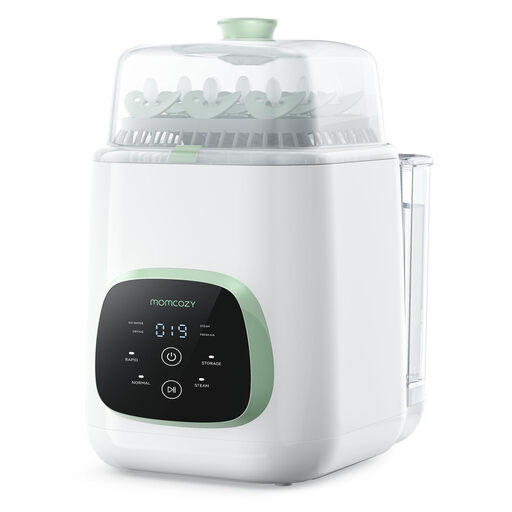
Why This Fits Their Persona: This device automates the entire process from washing and sterilizing to drying. It's a significant time-saver for parents who have to clean a large number of bottles and breast pump parts daily. As a high-quality and useful gift for new mothers and fathers, it takes care of one of the most repetitive tasks of early parenthood.
The device has an integrated, effective drying function that prevents residual moisture. According to the manufacturer, the flexible interior is designed for up to 4 bottles of most brands, as well as for accessories and breast pump parts, which bypasses the pitfall of incompatibility.
The combination of 26 high-pressure water jets for cleaning and a subsequent steam sterilization with drying in a single, automated cycle. The manufacturer, Momcozy, also refers to this model as the Momcozy KleanPal Pro.
We have compiled a complete, up-to-date list of products that fully meet these strict selection criteria and rigorous safety standards.
1. How often should you descale a bottle sterilizer? The frequency depends on the water hardness in your area. With hard water, descaling every 2 to 4 weeks is recommended to maintain heating efficiency and the device's lifespan. It's best to use descaling agents recommended by the manufacturer or a diluted solution of citric acid or vinegar, if permitted by the user manual.
2. Can you also clean breast pump parts in a baby bottle washer? Yes, many modern combination devices are explicitly designed for this. Check the product description and the manufacturer's compatibility list. According to the manufacturer, models like the featured Momcozy KleanPal Pro are suitable for safely cleaning parts of wearable breast pumps, which is a significant convenience.
3. Is a 3-in-1 device (wash, sterilize, dry) really necessary? It's not strictly necessary, but it is a matter of efficiency and convenience. Washing by hand, then sterilizing in a separate device, and air-drying is time-consuming and potentially less hygienic if the environment isn't dust-free. For parents who pump frequently, have twins, or simply want to save valuable time, such a fully automated system offers significant added value.