
Lieferung heute & morgen

Qualitätsgarantie

Willkommens-Angebote freischalten: KOSTENLOSE Lieferung | Bis zu 80 % RABATT | Kostenlose 30-Tage-JoyPlus-Testphase
App herunterladen
Choosing baby bottles and bottle accessories may seem straightforward at first. In practice, however, teat shape, flow rate, capacity and cleaning requirements can vary considerably. Especially with newborns, an unsuitable teat can lead to slow feeding, frequent leaks or the need for unnecessary accessories.
Three common purchasing and marketing pitfalls occur particularly often:
First, check whether the teat is intended for your baby’s age. A baby bottle suitable from birth usually has a teat with a slow-flow opening. Models for older babies may have a medium or fast flow.
With a baby bottle for combination feeding, many parents look for a soft, flexible teat with a wide base. A breast-shaped design can support switching between breast and bottle, but it does not replace an individual adjustment period.
Examples of common sizes:
A BPA-free baby bottle should have clear material information. Bottle bodies are often made from polypropylene (PP), while teats are made from silicone. PP is lightweight and resistant to breakage. Silicone is flexible and, when suitably designed, can be cleaned and sterilised.
You should also look for:
According to the product information, MiaMia baby bottles are tested in accordance with EN 14350 for liquid food intended for infants and young children. For other products, follow the relevant manufacturer’s information and the instructions supplied with the product.
A bottle should be completely dismantled before it is cleaned. This is particularly important for valves, screw rings and teats. A baby bottle cleaning brush with a separate teat or straw brush can reach small openings more effectively than an ordinary kitchen brush.
There are several options for sterilisation:
The temperature of the feed must be checked before feeding. A portable bottle warmer can be practical when you are out and about, but it requires the correct bottle holder and safe, stable use. Milk should not be kept warm for extended periods.
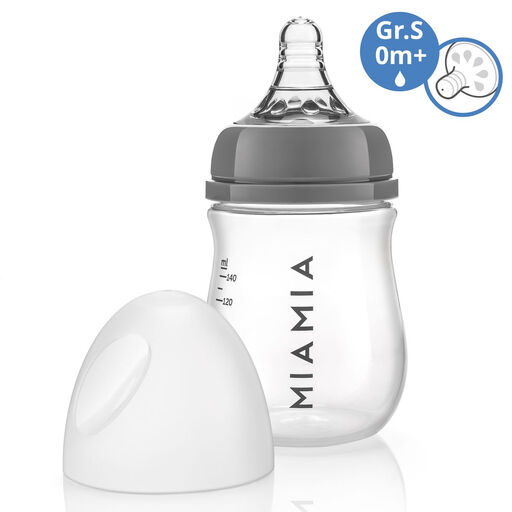
Why this product suits this profile: The compact 140 ml bottle is suitable for smaller feeds and, according to the product information, is suitable from birth with a size S silicone teat.
The stated size and flow make choosing a bottle for the early stages more transparent, rather than relying solely on a blanket anti-colic claim.
BPA-free PP, wide bottle neck, dishwasher-safe bottle and teat, and sterilisation suitability according to the product description.
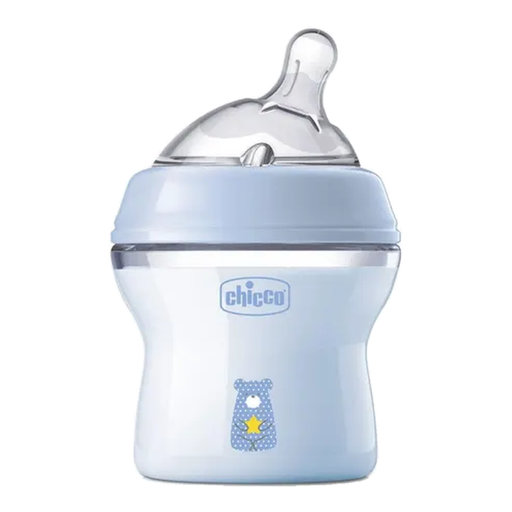
Why this product suits this profile: The angled silicone teat and stated 150 ml capacity are designed for smaller feeds and combination feeding.
The manufacturer provides specific information on age recommendation, flow rate, materials and care instructions. This makes it easier to compare the model objectively with other bottles.
BPA-free plastic, silicone teat, double valve and dishwasher suitability according to the product information.
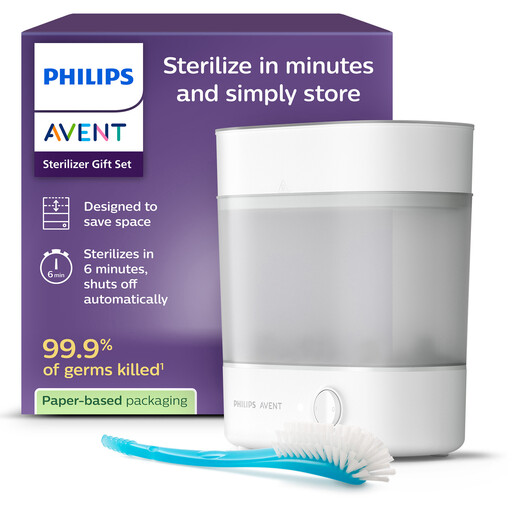
Why this product suits this profile: For households with several bottles and accessories, the appliance offers space for up to six bottles and an automatic shut-off function, according to the product data.
The capacity, cycle duration and automatic shut-off are specific details that help you assess the actual space and time required.
Steam sterilisation, integrated drip tray, automatic shut-off and supplied tongs according to the product description.

Why this product suits this profile: The USB-rechargeable bottle warmer is designed for use on the go and is supplied with adapters for different bottle brands.
Before buying, check the bottle diameter, adapters and charging method. This helps you avoid buying an accessory that is incompatible with your existing bottle.
Integrated battery, several adapters and a leak-proof design according to the product information. The milk temperature must always be checked before feeding.
We have put together a complete, regularly updated list of products that fully meet these strict selection criteria and the safety regulations applicable in the EU.
Regardless of the model, parents should check the bottle for cracks, deformation and leaking connections before every use. Teats are wear-and-tear parts. If there is visible damage, a sticky surface or a change in shape, the teat should be replaced. The specific replacement interval depends on the manufacturer’s instructions.
For infant formula, follow the temperature and preparation instructions provided by the relevant food manufacturer. A sealed bottle should not be heated excessively or kept warm for extended periods. After feeding, all parts should be rinsed promptly and dried thoroughly.
For newborns, consider models with an appropriate age recommendation and a slow flow. A 150 ml baby bottle with a soft silicone teat is often easy to manage for smaller feeds. The manufacturer’s information and your baby’s response while feeding remain the key factors.
The bottle body can be used for longer if the material remains intact. Teats should be checked regularly and replaced immediately if they show signs of wear. The manufacturer’s care instructions, frequency of use and condition of all individual parts are the deciding factors.
An electric steriliser can be worthwhile if several bottles, teats or breast pump parts need to be cleaned every day. If you only use a few bottles, boiling them according to the instructions may also be sufficient, depending on your household. Before buying, compare capacity, footprint, cleaning requirements and the automatic shut-off function.