
Lieferung heute & morgen

Qualitätsgarantie

Willkommens-Angebote freischalten: KOSTENLOSE Lieferung | Bis zu 80 % RABATT | Kostenlose 30-Tage-JoyPlus-Testphase
App herunterladen
The choice of baby bottles is vast: anti-colic baby bottles, BPA-free baby bottles, baby bottles with teats or complete baby bottle sets. For expectant parents and families who combination feed, many options sound sensible, but not every feature suits every age or lifestyle.
Three common buying mistakes frequently lead to unnecessary spending:
For newborns, smaller sizes such as a 150 ml baby bottle are manageable and easy to handle. Models with slow or normal flow are often available from birth. A baby bottle for newborns should have a clear age recommendation and an easy-to-read scale.
From around two months, a 250 ml baby bottle can be useful as your baby’s milk intake increases. The Chicco NaturalFeeling 250 ml models are, according to product information, intended for babies from two months and come with a medium-flow teat.
A 330 ml baby bottle is often aimed at older babies. The Chicco NaturalFeeling 330 ml Fast Flow is, according to the manufacturer, suitable from six months. The faster flow shouldn’t be chosen based on bottle volume alone, but rather on age, drinking behaviour and individual recommendations for your child.
A baby bottle with a teat should include details on material, shape and flow rate. Silicone is listed as the teat material for the products mentioned. The bottle itself is made from polypropylene or other food-safe materials.
For a BPA-free baby bottle, the BPA-free construction should be explicitly stated in the product information. This also applies to other components such as the screw ring and protective cap. A breast-shaped teat can be of interest to families who combination feed, but it doesn’t replace individual observation during feeding.
Important: age recommendations such as “from birth”, “from two months” or “from six months” aren’t just marketing claims. They usually refer to the combination of teat shape, flow rate and bottle size.
Bottles should be fully disassemblable. Narrow areas, valves and multi-part anti-colic systems require particular attention. A dishwasher-safe baby bottle can reduce daily effort; the manufacturer’s instructions on dishwasher placement and temperature are key here.
A baby bottle cleaning set with a bottle brush, teat brush and drying rack is especially practical when cleaning several bottles and breast pump parts. A bottle steriliser can handle steam sterilisation and, depending on the model, drying too. For electrical appliances, pay attention to water fill level, capacity, operating instructions and burn protection.
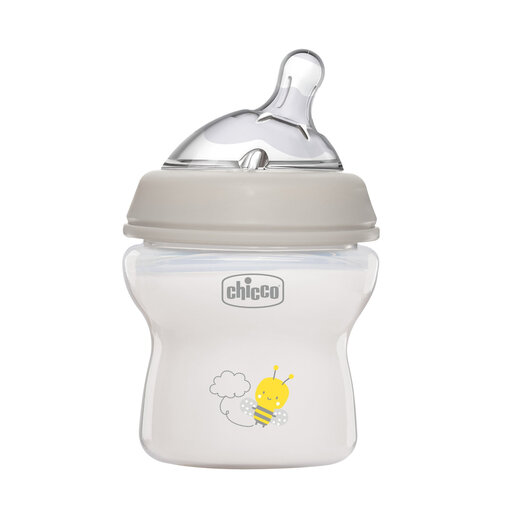
Why this product fits the profile: The 150 ml size and slow or normal flow are, according to product information, intended for newborns and younger babies. This makes the bottle a suitable, straightforward choice for getting started.
The smaller volume prevents you from buying an oversized bottle too early. The wide opening is said to make cleaning easier.
BPA-free plastic bottle, silicone teat, dishwasher-safe and with a double valve.
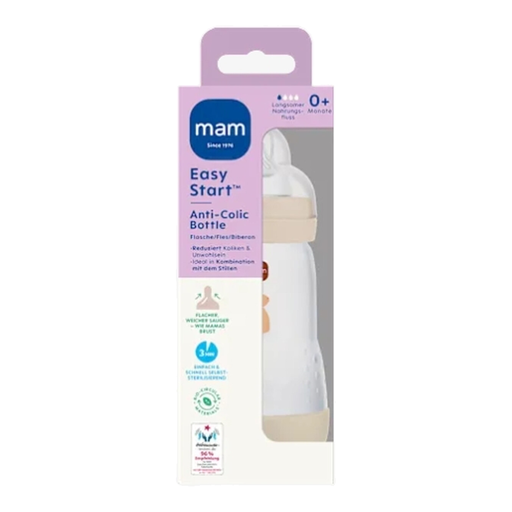
Why this product fits the profile: According to product information, this model is suitable from birth, holds 260 ml and features a flat, soft teat with slow flow. It’s an option for families who want to combine combination feeding with ease of care.
The age and flow information is clear before purchase. The bottle also needs to be disassembled into individual parts for cleaning, which supports thorough care.
260 ml capacity, slow teat flow, self-sterilising function according to the product description and dishwasher-safe individual parts.
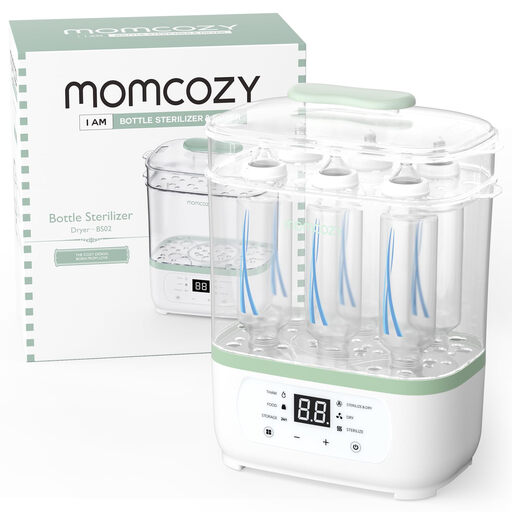
Why this product fits the profile: For households with several bottles, breast pump parts or a tight schedule, a device with a larger capacity can help organise the cleaning routine.
The functions are clearly stated: steam sterilisation, drying, defrosting and warming. This helps you avoid buying a device based on vague multi-function marketing.
Space for up to eight standard bottles according to product information, plus an integrated drying function. Steam can pose a burn risk.
We’ve put together a complete, regularly updated list of products that fully meet these strict selection criteria and the safety regulations in force in the EU.
For on-the-go use, a bottle warmer such as the Momcozy MW05 Portable Bottle Warmer could be of interest. Before buying, however, check the connection, power supply, compatible bottle sizes and temperature control. For cleaning, a baby bottle cleaning set with separate teat and bottle brushes is a good alternative.
For newborns, look for models with a “from birth” age recommendation and slow flow. A 150 ml baby bottle is often easier to hold and allows for straightforward measuring. However, the manufacturer’s instructions and your baby’s drinking behaviour are what really matter.
The bottle body can be used for longer if the material remains undamaged. Teats should be checked before each use for cracks, deformation or sticky spots, and replaced if there’s visible wear. Some manufacturers also specify a particular replacement interval. Always follow the product’s instructions for use.
An anti-colic baby bottle isn’t essential for every baby. The ventilation valve can help manage air intake during feeding. Whether a particular model suits your individual routine also depends on teat flow, feeding position, correct assembly and thorough cleaning. So-called anti-colic features shouldn’t be understood as having a medical effect.