
Lieferung heute & morgen

Qualitätsgarantie

Willkommens-Angebote freischalten: KOSTENLOSE Lieferung | Bis zu 80 % RABATT | Kostenlose 30-Tage-JoyPlus-Testphase
App herunterladen
The range of baby care and feeding accessories is vast: baby crockery sets, baby bottle sets, muslin cloths, towels and cleaning accessories are often sold as convenient all-in-one solutions. However, it is not the number of individual pieces that determines how useful they are in daily life. The material, cleaning requirements, age recommendation and format all need to match your actual needs.
A large set may look appealing at first glance. For newborns, however, plates, cutlery and drinking cups are usually not yet necessary. A silicone weaning set with a plate, bowl, cup, spoon and fork is typically intended for starting solids. So always check the recommended age range, for example from 6 months.
Terms like "soft", "skin-friendly" or "safe" do not explain how a product should be cared for. More meaningful are specific details such as 100% cotton, BPA-free polypropylene, food-grade silicone or a stated suitability for the dishwasher. For baby textiles, you should also check the washing temperature and drying instructions.
Bottles, teats, dummies and pump parts have hard-to-reach areas. A baby bottle brush that is too large or the wrong shape may not adequately reach the bottom of the bottle, valves or teat openings. With muslin cloths and towels too, it is not just absorbency that matters, but also the ability to wash several pieces regularly and dry them completely.
For items that come into direct contact with the mouth, the material information should be unambiguous. When buying, the following details can be helpful:
"BPA-free" refers to the stated material and does not replace checking all individual parts. With a baby bottle set, the bottle body, teat, valve and cap should each be considered separately.
For baby bottles, a wide neck is practical because it can make filling and manual cleaning easier. A baby bottle brush with an additional teat or straw brush is useful if you need to clean various accessories. After washing, all components should be allowed to dry completely before being reassembled or stored.
Dishwasher-safe products reduce the manual effort. Nevertheless, care instructions should be followed, as high temperatures or frequent mechanical stress can affect different materials in different ways. Silicone parts should be checked regularly for cracks, deformation and sticky surfaces.
A baby crockery set should suit the child's hand size and developmental stage. Non-slip bases can be practical on smooth table surfaces. For a cup, capacity, handle size and weight are relevant criteria.
For textiles, dimensions and quantity are key. A large bath towel measuring 70 × 140 cm is suitable for drying after a bath, while smaller cloths of around 30 × 50 cm can be used as baby burp cloths, flannels or changing mats. Having several pieces makes it easier to swap them when out and about and between washes.
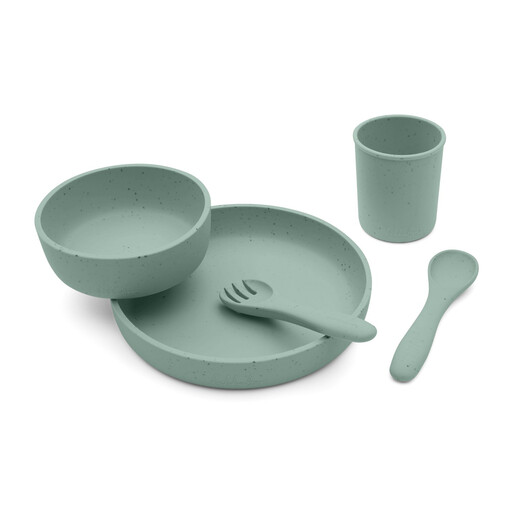
Why this product suits the profile: The set combines a plate, bowl, cup, fork and spoon for children from 6 months, covering several typical purchases needed when introducing solids.
The age recommendation of 6 months+ prevents a weaning set from being bought too early. The material and care details specify food-grade silicone as well as dishwasher and steriliser suitability.
Five coordinated pieces, 400 ml plate, 200 ml bowl and 150 ml cup; stated as BPA-free and suitable for -40 to +230 °C.
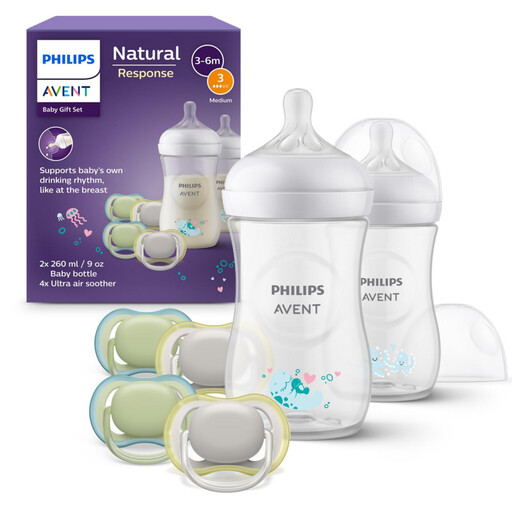
Why this product suits the profile: The set combines two 260 ml bottles with four Ultra-Air dummies for babies from 0 to 6 months, and is aimed at families who need several feeding and soothing items.
The individual age recommendations are stated separately: Natural Response teats from 1 month and dummies 0–6 months. All components are stated as dishwasher-safe.
BPA-free polypropylene, AirFree or anti-colic valve according to the manufacturer, and two bottles with identical capacity.

Why this product suits the profile: The set is designed for cleaning at home and on the go, and includes a storage box and a collapsible drying rack.
Multiple brush heads address bottles, teats, straws and pump parts. Drying separately helps prevent damp components from being stored directly in the box.
Seven components including a silicone bottle brush, teat brush, straw brush, soap dispenser and foldable drying rack.
We have put together a complete, regularly updated list of products that fully meet these strict selection criteria and the safety regulations in force in the EU.
For the first few weeks, a few baby bottles or breastfeeding accessories, dummies with the correct age recommendation, several muslin cloths, burp cloths, flannels and one or two bath towels are usually sufficient. A baby crockery set often only becomes relevant when introducing solids from around 6 months.
A fixed lifespan depends on the material, care and frequency of use. Check teats and dummies before each use and replace them at the first sign of damage or wear. Bottle bodies should also be discarded if cracks, sharp edges or permanent deformation appear.
That depends on your actual needs. A set can simplify buying several matching components individually. However, pieces you do not need increase the cost without providing any practical benefit. What matters most are the age range, quantity, cleaning method and how often you plan to use them.