
Lieferung heute & morgen

Qualitätsgarantie

Willkommens-Angebote freischalten: KOSTENLOSE Lieferung | Bis zu 80 % RABATT | Kostenlose 30-Tage-JoyPlus-Testphase
App herunterladen
A baby cot needs to stand securely, fit the mattress and integrate into the family’s daily routine. Yet some purchasing decisions later lead to unnecessary extra costs: an unsuitable mattress height makes a bed guard unusable, missing fitting instructions complicate assembly, and a bedside crib that is too small often gets replaced after just a few months.
A 3-in-1 baby cot sounds versatile at first. What really matters, however, is which functions are actually included. With some models, the mattress, extension set or required conversion components are sold separately. So check whether the cot can be used as a bedside crib, a standard cot or a junior bed, and up to what age or weight each function is intended.
A baby bed guard or toddler bed rail does not automatically fit every sleeping surface. What matters are the mattress height, the attachment to the slatted base and the width of the cot. A 38 cm high wooden bed guard, for example, may only be suitable for mattresses up to a certain height. If a thicker mattress is used, the effective protective edge changes.
A height-adjustable baby cot cannot necessarily be adapted to every adult bed. With divan beds or particular frame heights, a separate extension set may be required. Before buying, you should measure the height of the adult bed’s sleeping surface and consider the attachment with safety straps.
The mattress must fit the intended sleeping surface exactly. Common dimensions are 45 × 90 cm for a baby bedside crib and 70 × 140 cm for a larger combination baby cot. Only use the size specified by the manufacturer. There should be no dangerous gaps between the mattress and the cot sides.
A baby cot with mattress can simplify the selection because the mattress size and cot are coordinated. Nevertheless, check the care instructions, the removable cover and the ventilation details. With a model without a mattress, you will need to plan for a suitable sleeping surface separately.
For bedside cribs and baby cots, the specification EN 1130:2019 is a verifiable technical reference point. It does not replace an assembly check at home, but it does provide important information about the product’s construction.
Also look out for:
A bed guard should be checked for secure fitting before every use. With a foldable bed guard, it is also important that the folding mechanism does not release unintentionally and that access to the cot remains practical.
A wooden baby cot can be made from solid wood, plywood, MDF or wood-based materials. The material name alone, however, does not indicate its suitability. More important are a stable construction, manufacturer information on harmful substances, rounded edges and an easy-to-clean surface.
For everyday use, removable, washable fabric covers are practical. With detachable side panels, all small parts should be stored out of the child’s reach. The age recommendation is also binding: a bedside crib may only be used for as long as the child has not yet reached the specified developmental limit.
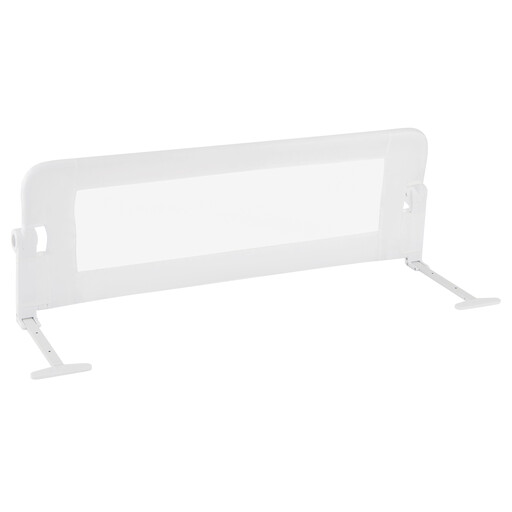
Why this product fits the profile: The foldable bed guard is suitable for families who want a flexible fall protection solution that can be fitted to different types of beds. Assembly is carried out using adjustable straps and a buckle.
The specified folding function makes getting in and out easier. Before use, you must check the bed type, strap routing and mattress position.
Steel frame, Oxford fabric, visible mesh material and removable, washable cover; specified load capacity up to 20 kg.
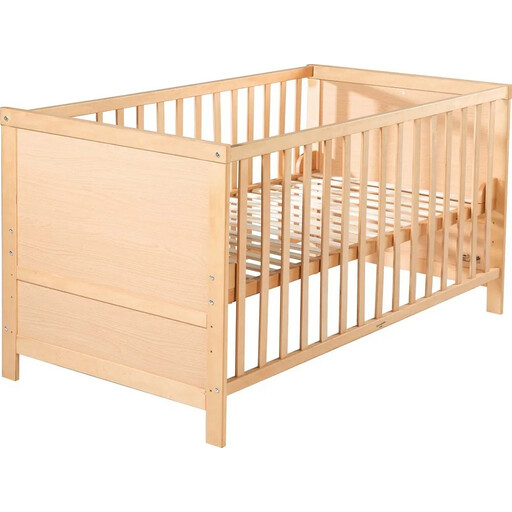
Why this product fits the profile: The combination baby cot with a 70 × 140 cm sleeping surface is intended for families looking for a larger sleep system with a later junior bed function.
The product details specify the correct mattress size, three height positions and a conversion option. The mattress needs to be purchased separately.
70 × 140 cm sleeping surface, three height-adjustable positions, three removable drop-side bars and conversion to a junior bed.

Why this product fits the profile: The height-adjustable baby cot is designed for the first few months next to the adult bed and can later be used as a bench.
The details specify seven height positions, safety straps and the EN 1130:2019 standard. The cot must be correctly attached to the adult bed.
Mattress in size 45 × 90 cm included, washable cover up to 60 °C, four castors with brakes and mesh fall protection.
We have put together a complete, regularly updated list of products that fully meet these strict selection criteria and the safety regulations in force in the EU.
That depends on the model and the child’s development. A bedside crib is often intended for the first few months and must no longer be used once the child can pull themselves up, sit or kneel independently. A combination cot with 70 × 140 cm can allow for a longer period of use by converting to a junior bed. The manufacturer’s instructions remain the decisive factor.
For a small baby bedside crib, 45 × 90 cm is common. A cot measuring 70 × 140 cm offers more space and can often be used up to toddler age. What matters is not just the external dimensions, but the exact mattress size specified.
No. Before buying, you must compare the cot construction, mattress height, attachment method and usable length. A foldable bed guard can make access easier, but it also requires a secure fit and regular checks. Damaged or loose parts should not be used further.