
Lieferung heute & morgen

Qualitätsgarantie

Willkommens-Angebote freischalten: KOSTENLOSE Lieferung | Bis zu 80 % RABATT | Kostenlose 30-Tage-JoyPlus-Testphase
App herunterladen
A baby cot must do more than simply look right in the nursery. What really matters is a suitable sleeping surface, sturdy connections and use that matches your child’s development. Expectant parents face a wide range of options, including a bedside cot for babies, baby cot with bars, Moses basket, folding baby cot and convertible models for different age groups.
Three common buying misconceptions often lead to unnecessary spending:
The mattress size must match the sleeping surface exactly. For a 60 x 120 cm cot, you need a mattress in the same size. There should be no significant gaps between the mattress and the frame. A baby cot with mattress can be practical, provided the included mattress is expressly intended for the particular sleeping surface.
Compact bedside cots often use dimensions such as 45 x 90 cm or 76 x 43 cm. A mattress with different dimensions is not suitable as a replacement. Also check:
Choosing a height-adjustable baby cot can make it easier to place your baby in and lift them out. However, the key question is whether the setting can actually be adjusted to the height of the parents’ mattress. When used as a bedside cot, it must be securely attached to the parents’ bed using the supplied straps or metal brackets.
Before buying, check:
A bedside cot must not simply be pushed up against the parents’ bed if the manufacturer specifies that it must be attached.
A convertible baby cot or combination cot can later be used as a child’s or junior bed. The stated age and weight limits still apply. As soon as a child can climb out independently, use as a cot with bars must end, or the model must be converted according to the instructions.
For larger cots, 60 x 120 cm and 70 x 140 cm are common sizes. A 70 x 140 cm cot offers more sleeping space, but also requires more room in the nursery. Check the external dimensions, including castors, side panels and any canopy.

Why this product suits this profile: The folding model can be stored compactly for use at grandparents’ homes, in the guest room or when travelling. Its 60 x 120 cm sleeping surface matches a common mattress size.
The product details specify two height settings and castors with brakes. Before every use, check the folding mechanism, height locks and brakes.
Folding frame, 60 x 120 cm sleeping surface, weight of 11.2 kg and stated load capacity of up to 40 kg.
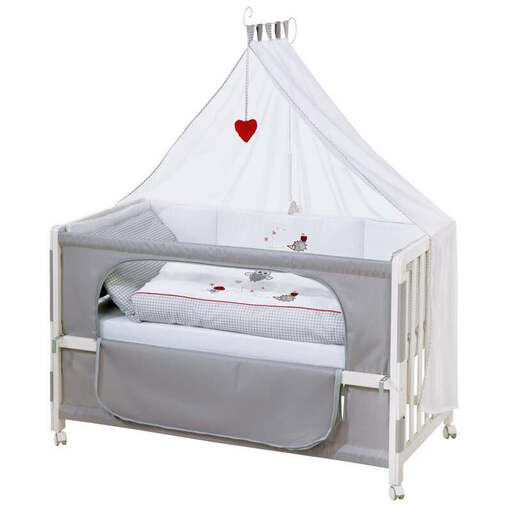
Why this product suits this profile: This bedside cot is designed for use next to the parents’ bed and can be adjusted to six height settings. According to the product description, bed linen, mattress and other components are included.
Height adjustment alone is not a substitute for secure attachment: the supplied metal brackets must be correctly fitted to the parents’ bed. The castor brakes must be applied when stationary.
Six-level height adjustment, zipped side panel, castors with brakes and stated use from birth to around four years.
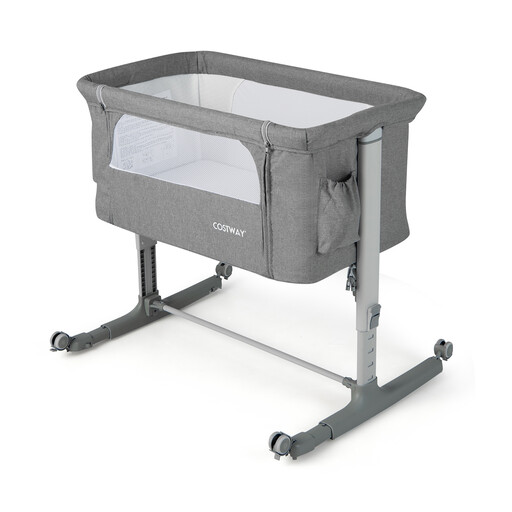
Why this product suits this profile: This model combines a bedside cot, cradle and Moses basket. A carry bag and castors make it easier to move around the home or take on trips.
The product data specifies five height settings, attachment straps and lockable swivel castors. The stated load limit of 9 kg and age recommendation of up to around five months limit the period of use.
Five height positions, breathable mesh side panels, carry bag and a 76 x 43 cm sleeping surface.
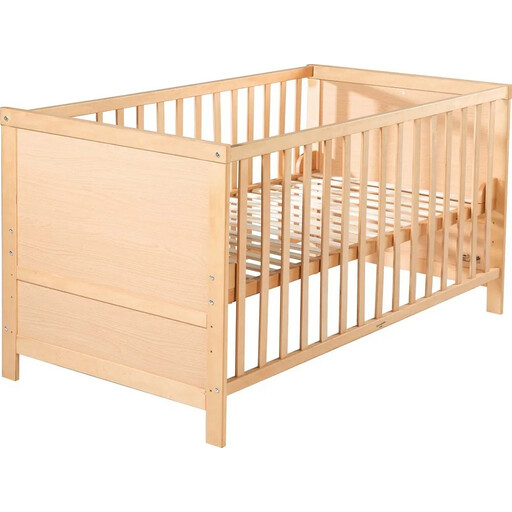
Why this product suits this profile: The larger sleeping surface and conversion into a junior bed are ideal for families looking for a permanent bed that can support their child through several developmental stages.
The three height settings and three removable rungs are clearly specified. However, conversion still requires correct assembly and a suitable 70 x 140 cm mattress.
Triple height adjustment, junior-bed conversion, three removable rungs and stated use from birth to around seven years.
We have put together a complete, regularly updated list of products that fully meet these strict selection criteria and the safety regulations applicable in the EU.
Regardless of the model, parents should do the following before first use:
A folding baby cot is particularly suitable for occasional use, but after every assembly you should check that all connections are fully locked into place. The same applies to a Moses basket with castors: only move it across a level floor, and ensure the brakes are engaged when stationary.
Many models are intended for use from birth according to the manufacturer’s specifications. The decisive factors are the specific age approval, the correct mattress and fully assembled condition. With height-adjustable bedside cots, you must also check that the cot is securely attached to the parents’ bed.
This depends on the sleeping surface, load limit and your child’s developmental stage. Compact bedside cots measuring 45 x 90 cm are often intended only for the first few months of life. A 60 x 120 cm cot or a convertible 70 x 140 cm model may be suitable for longer. However, use must end earlier if your child can climb out independently.
Castors can make repositioning easier, but they are not a substitute for a stable set-up. All brakes must be engaged when the cot is stationary. When using it next to the parents’ bed, the supplied attachment straps or brackets are also required. Check the castors regularly for proper operation and signs of damage.