
Lieferung heute & morgen

Qualitätsgarantie

Willkommens-Angebote freischalten: KOSTENLOSE Lieferung | Bis zu 80 % RABATT | Kostenlose 30-Tage-JoyPlus-Testphase
App herunterladen
Choosing the right baby dummies and bottle teats may seem straightforward at first. But whether you’re shopping in store or online, you’ll find a wide range of shapes, materials, age recommendations and product claims. Not every extra feature makes a difference in everyday use. Choosing the wrong size, buying attachments that are hard to clean or overlooking compatibility can all lead to unnecessary repeat purchases.
A dummy for 0–6 months differs in shape and size from a model for older babies. Different versions are designed for babies aged 6 to 16 months, followed by models such as a dummy for 16 months and over. The age range is the manufacturer’s guide, so check it against your child’s development and the instructions for use.
Age recommendations also matter for bottle teats. A teat with a slower flow may be designed for younger babies, while a faster flow is usually introduced later. According to the product information, a MAM bottle teat size 2 is designed for babies aged 4 months and over, with a medium flow. The MAM bottle teat size 3 is described as suitable for babies aged 6 months and over, with a faster flow.
Terms such as orthodontic dummy usually describe a symmetrical, flattened teat shape. They don’t guarantee a particular outcome for your baby’s teeth or jaw development. What matters is the fit, choosing the right size for your baby’s age and limiting how long the dummy is used.
When buying a silicone dummy, also check that the material is clearly stated. Silicone is odourless and tasteless, and easy to clean. However, the word ‘soft’ on its own tells you nothing about the shape, material quality or durability.
A dummy may come with a storage case, while a bottle teat may only fit certain bottle necks. Before buying, check the following:
For silicone dummies and teats, the material should be clearly stated. Many of the products featured here specify 100% silicone for the teat. Manufacturers also identify materials as BPA- and BPS-free and refer to relevant standards.
EN 1400 is particularly relevant for dummies, while EN 14350 applies to feeding teats. These standards don’t replace the need to check the product before every use. Inspect the teat in all directions and throw it away if you find cracks, a sticky surface, bite marks or other damage.
A symmetrical teat can be placed in the mouth either way round. Large ventilation holes in the shield help air circulate between the product and your baby’s skin. This can be useful in everyday life, particularly for sensitive skin, but it isn’t a therapeutic feature.
When choosing a dummy, make sure the shield leaves enough space around your baby’s nose. Ribbons, cords and clips not designed for this purpose should never be attached to a dummy, as they can pose a strangulation risk. Only use a suitable dummy holder if the manufacturer recommends one.
Follow the care instructions for each product before first use. Depending on the product, you may be able to sterilise it by boiling, using steam or with a microwave sterilising case. For self-sterilising products, follow the instructions for the amount of water, heating time and cooling time.
Many manufacturers recommend replacing dummies every one to two months; Philips AVENT recommends four weeks for the Ultra Air models listed. Always follow the product instructions. A dummy case helps keep a dummy separate from loose items in your changing bag when you’re out and about, but it doesn’t replace cleaning.
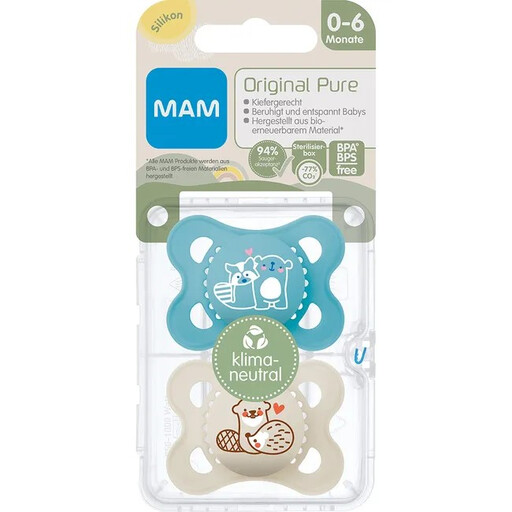
Why it’s a good fit: This two-piece set is for families looking for an age-appropriate silicone dummy supplied with a travel and sterilising case.
The 0–6 months age recommendation helps reduce the risk of choosing the wrong size. The case allows for protected storage and sterilisation in line with the manufacturer’s instructions.
Symmetrical silicone teat, two dummies per pack and BPA-/BPS-free labelling according to the product description.
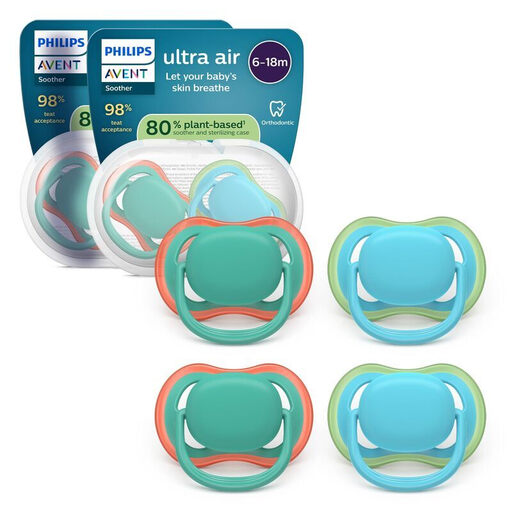
Why it’s a good fit: This set includes four dummies for regular replacement, as well as two reusable travel cases.
The clear 6–18 months age range helps you avoid choosing a model for the wrong stage of development. Large ventilation holes address the often-overlooked need for airflow around the shield.
Symmetrical silicone teat, four-piece pack and two sterilising cases; BPA-free according to the product information.
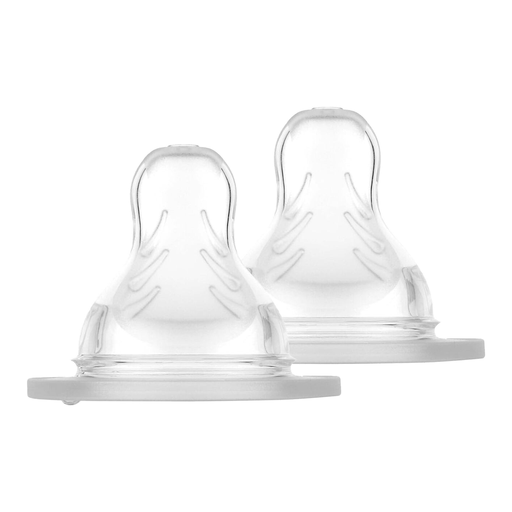
Why it’s a good fit: This teat is designed for families using MAM wide-neck bottles or the MAM Trainer who need a faster flow for babies aged 6 months and over.
The stated compatibility helps you avoid buying a teat that doesn’t fit your bottles. Don’t choose size 3 for a younger baby just because it has a faster flow.
Two-piece pack, SkinSoft silicone, suitable for cleaning on the top rack of the dishwasher, and BPA-/BPS-free labelling according to the product information.
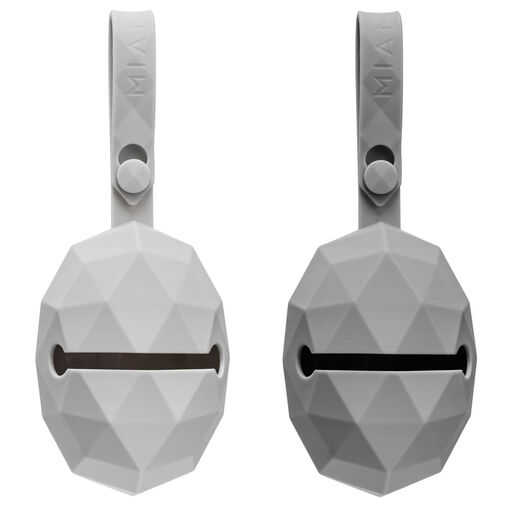
Why it’s a good fit: These two cases are ideal for families who want to store several dummies separately and attach them to a pushchair.
The cases stop dummies from lying loose in your bag or pushchair. Each case holds up to three dummies, making it easier to swap them while you’re out and about.
100% food-grade silicone according to the product information, BPA- and PVC-free, dishwasher-safe and supplied with an attachment strap.
We’ve put together a complete, regularly updated list of products that meet these strict selection criteria and fully comply with the safety regulations in force in the EU.
It depends on the manufacturer, how often it’s used and its condition. The product information available here generally recommends replacing dummies every one to two months, while Philips AVENT recommends four weeks. Bottle teats should also be checked regularly and replaced straight away if they become misshapen, cracked or sticky, or show bite marks.
Silicone is a commonly used material for dummies and teats. However, whether your baby takes to a particular model depends on the child. The shape, size, shield and feel of the teat can all vary. It may be worth starting with a small pack and seeing how your baby responds.
No. According to the product information, the MAM bottle teat size 2 and MAM bottle teat size 3 are designed for MAM wide-neck bottles and the MAM Trainer. If you have a different bottle system, check compatibility explicitly before buying.