
Lieferung heute & morgen

Qualitätsgarantie

Willkommens-Angebote freischalten: KOSTENLOSE Lieferung | Bis zu 80 % RABATT | Kostenlose 30-Tage-JoyPlus-Testphase
App herunterladen
An electric baby swing can make everyday life a little easier for parents when their baby wants gentle movement and their hands are busy with something else. However, electric baby bouncers, automatic baby swings and traditional bouncers all have important differences. Many products advertise a wide range of features without making it clear whether they’re genuinely useful in everyday life.
Three common buying mistakes come up time and again:
First, check the maximum weight limit and any specific restrictions on use. For the models listed here, manufacturers state that they can be used from birth up to 9 kg, or up to 18 kg or around 18 months, depending on the product. These specifications aren’t automatically comparable.
A baby bouncer for newborns should offer a sufficiently reclined position and suitable head support. An adjustable backrest can be useful when switching between lying down, playing and feeding. However, a flat position doesn’t mean the product is suitable for sleep. Electric bouncers and swings should only be used as instructed and under supervision; they’re not a substitute for a cot.
Also check when the product should no longer be used as your baby develops. For some models, use must stop as soon as your child can sit up unaided.
A baby bouncer with a safety harness should have a restraint system that’s easy to use correctly. Depending on the model, this may be a three- or five-point harness. Look for a secure fastening, well-fitting straps and clear instructions on how to fasten them correctly.
A stable design includes a sufficiently wide base, non-slip feet and a sturdy frame. Use the swing only on the floor, never on a table, sofa or other raised surface.
When choosing a product, buyers should look for the CE marking, German-language instructions and safety warnings. Depending on the type of product, European standards such as EN 12790 for baby bouncers or EN 16232 for baby swings may be relevant. The specific standard, permitted weight and usage limits should be clearly stated on the product, its packaging or in the manufacturer’s documentation. A standard number alone is no substitute for checking the full product information.
A baby swing with a remote control is useful when you want to change the settings without leaning over your baby. Timers, for example for 8, 15, 30 or 60 minutes, can help you structure use. However, an automatic shut-off isn’t a supervision feature.
For a baby bouncer with music or a baby bouncer with Bluetooth, check the volume, ease of use and power supply. Pre-installed melodies are straightforward, while Bluetooth or USB gives you more choice. For everyday use, it’s also worth checking whether the cover is removable and, according to the product description, washable.
A baby bouncer with a mosquito net can help keep insects at a distance indoors or in a sheltered outdoor area. The net mustn’t restrict ventilation, and it shouldn’t be treated as sun protection or as a way to leave your baby sleeping unsupervised.
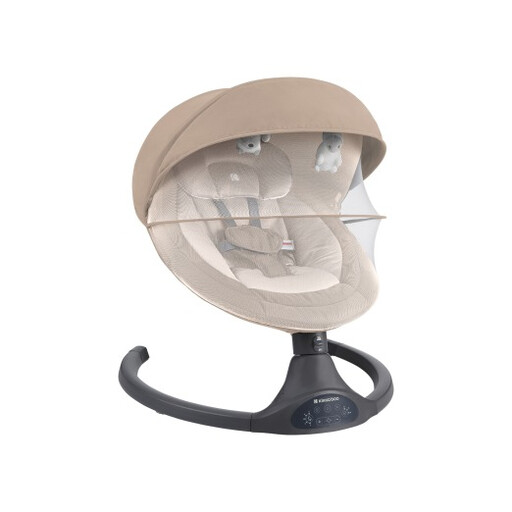
Why this product suits this profile: According to the product description, this model is suitable from birth up to a maximum of 9 kg. It combines five speeds, a timer and touchscreen controls with compact dimensions of 64 × 51 × 79 cm.
The clearly stated weight limit helps prevent the general claim that it’s “suitable for newborns” from being mistaken to mean it can be used right through to toddlerhood.
Five swing settings, three timer settings, a 5-point harness, mosquito net and remote control, according to the product information.
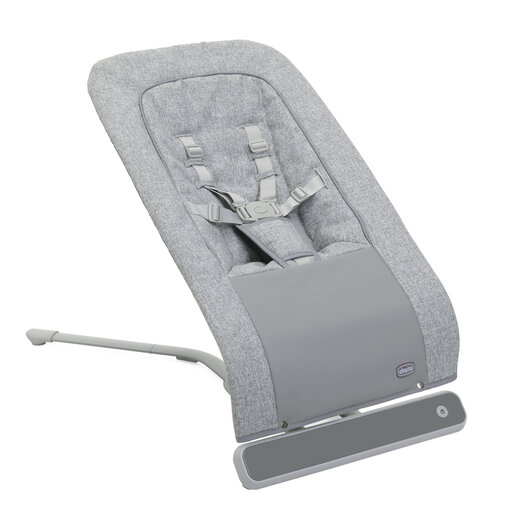
Why this product suits this profile: For parents who prefer simple controls and a lightweight design, this model offers two backrest positions, a side-to-side rocking motion and a weight of 3 kg, according to the manufacturer.
Its limited range of features makes it clear that a compact baby bouncer doesn’t offer the same adjustment options as a larger baby swing.
Foldable design, USB or battery operation, nature sounds and removable cover, according to the product description.
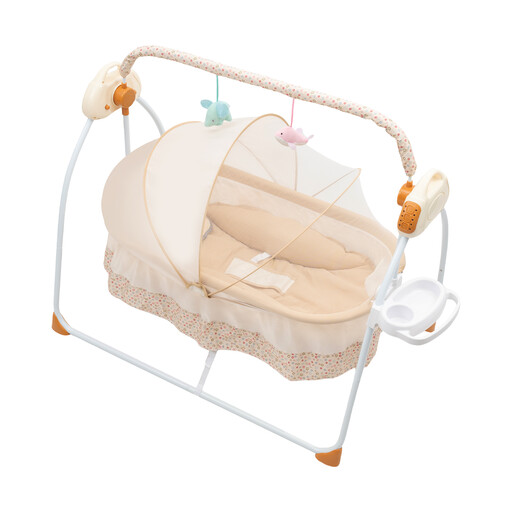
Why this product suits this profile: According to the product description, this model is aimed at families looking to combine several control options, fold-away storage and integrated audio features.
The five speeds and selectable timer settings are more specific than a vague claim about “automatic rocking”.
Remote control, control panel, Bluetooth, twelve pre-installed songs, foldable frame and mosquito net, according to the product details.
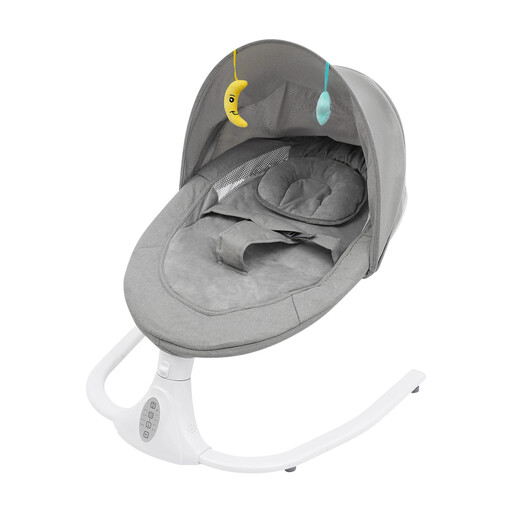
Why this product suits this profile: The seat position adjusts from 30° to 180°, according to the product description, and the swing runs on a 5-V power supply. These features may suit families with changing day-to-day needs.
The product explicitly states that it can be powered using a suitable adapter or power bank; the product description says that a power adapter isn’t included.
Four speeds, four swing amplitudes, timer, remote control, Bluetooth, USB playback and a fully enclosing mosquito net, according to the product information.
We’ve put together a complete, regularly updated list of products that meet these strict selection criteria and fully comply with the safety regulations in force in the EU.
It depends on the product’s instructions and your child’s stage of development. Follow the weight limit and age range, and check the guidance on sitting up unaided. A baby swing isn’t a permanent sleeping place. Don’t leave your baby to sleep in it unsupervised; for longer periods of rest, move them to a suitable cot.
Many models use USB or a 5-V power supply. The actual electricity cost depends on the power rating, how long you use it and your tariff. Battery-powered models also incur the cost of replacement batteries. Before buying, check whether a power adapter, USB cable or power bank is included.
Bluetooth is a convenience feature, not a safety requirement. It can be useful if you want to play your own music. If you prefer simple controls, pre-installed melodies, a timer and a control panel may be enough. The key things are still the harness, stability, suitable seating position and following the manufacturer’s instructions.