
Lieferung heute & morgen

Qualitätsgarantie

Willkommens-Angebote freischalten: KOSTENLOSE Lieferung | Bis zu 80 % RABATT | Kostenlose 30-Tage-JoyPlus-Testphase
App herunterladen
Baby learning toys should keep your little one occupied, encourage them to explore and support their development. In practice, though, choosing the right one isn’t always easy. Many products promise music, lights and supposedly educational features, while leaving out important details about age suitability, volume or small parts. As a Joybuy Product Recommendation Officer, I take an objective look at the features that matter and explain what parents, grandparents and other family members should consider before buying.
A toy with piano keys, a drum, a phone, lights and animal sounds may seem versatile. But for a younger baby, too many things happening at once can be confusing. What matters is whether your child can reach each feature independently and use it again and again.
A simple rattle or grasping toy may be more suitable for the first few months than a complex activity toy. From around six months, shape sorters, buttons and simple musical functions may be appropriate. The age on the packaging should only be a guide: your child’s development, ability to grasp and interests matter too.
A learning toy for toddlers isn’t automatically suitable for every baby. Small components, detachable parts or battery compartments can pose a risk. Check the warnings before buying and again after unpacking.
Montessori baby toys are often promoted as a way for children to learn independently. However, the concept is no substitute for a safety check. For children under three, avoid products with small parts that could be swallowed unless they are specifically intended for this age group.
Baby musical toys and musical toys for toddlers can quickly become loud with repeated use. Adjustable volume or a quiet mode is therefore useful in everyday life. However, neither guarantees a safe sound level. Don’t use the toy right next to your child’s ear, and keep the volume as low as possible.
Check whether the product is designed for lying down, tummy time, sitting or standing. An activity table with removable legs can be used across several stages of development, but it needs to be set up securely. For babies aged six months and over, low-level play features are often easier to reach than a tall table.
Look for:
A CE mark relates to the manufacturer’s or distributor’s declaration of conformity. It is not an independent quality assessment. For claims such as EN71 compliance or BPA-free, check whether this information is actually stated in the product description or accompanying documentation.
With a baby’s motor skills toy, how it will actually be used matters more than the number of features. Buttons should be easy to reach, and the base should not tip over easily during normal play. Volume controls and a mute function are useful features in homes with shared walls.
Dimensions should also factor into your decision: an activity cube is better suited to small play areas and travel, while a motor skills play set needs space and a flat surface.
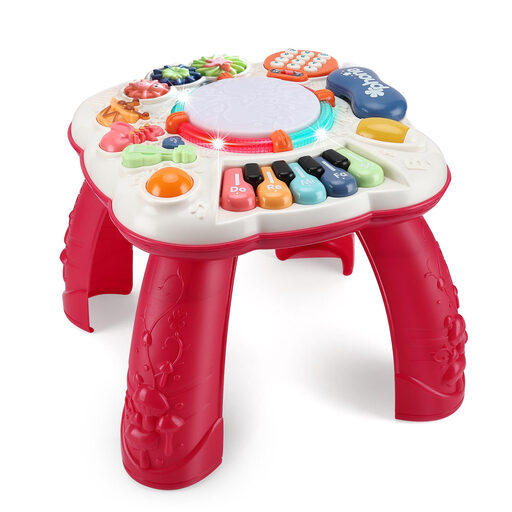
Why this product suits this need: The table brings together several easy-to-reach play features, including piano keys, a drum, cogs and a phone function. According to the product description, the removable legs also allow it to be used as a low-level play surface.
The product details list a volume control and a quiet mode. This helps keep noise levels down at home without having to give up all the features.
Suitable for ages 6 to 36 months, with six play areas and removable legs; batteries are not included according to the listing.
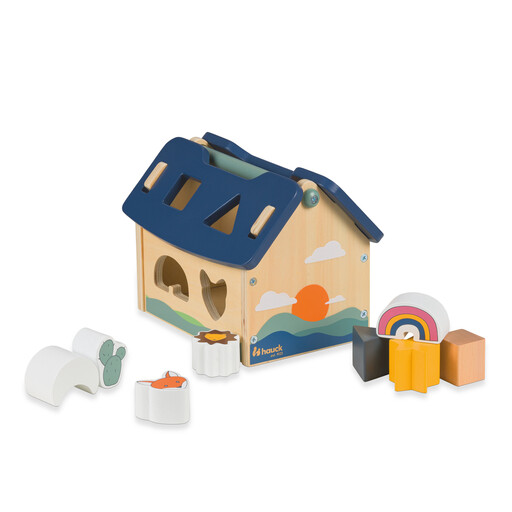
Why this product suits this need: This toy focuses on shapes, colours and fitting pieces together rather than electronic effects. The product description says it is made from FSC-certified wood and is suitable from 12 months.
Its clearly defined function helps reduce overstimulation. The product description also explicitly highlights the small parts and the age restriction.
Wooden construction, eight coloured blocks and storage space inside the playhouse; suitable from 12 months, subject to the warning.
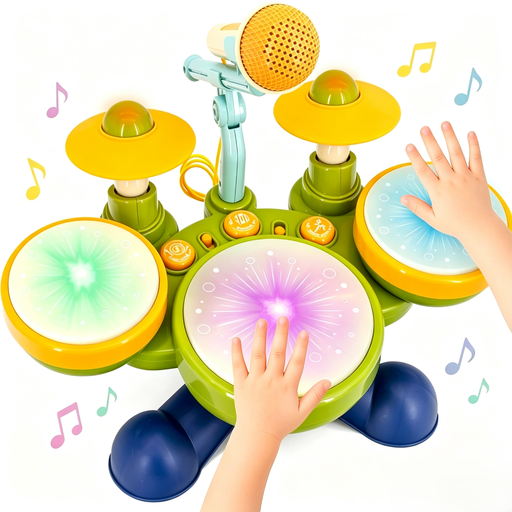
Why this product suits this need: For families looking to make music and active play part of the day, this set combines drum pads, cymbals and a microphone. The product details give an age range of one to three years.
The volume control lets you adjust the sound to suit the room and time of day. According to the supplier, the removable stand turns the set into a low-level play surface.
Three illuminated drum pads, two raised cymbals, a microphone and adjustable volume; batteries are not included.
We’ve put together a complete, regularly updated list of products that meet these strict selection criteria and fully comply with the safety regulations in force in the EU.
It depends on the product. Grasping toys and soft rattles may be suitable from birth. Shape sorters, activity cubes and baby musical toys are often aimed at children aged six or 12 months and over. The specific age guidance, your child’s development and adult supervision are all important.
Lifespan depends on the materials, construction and how the toy is used. Electronic products need batteries and should be checked regularly for damaged casings, loose parts and secure battery compartments. Wooden toys can last a long time if stored in a dry place, but should not be passed on if they have cracks or splinters.
Battery-powered toys have ongoing replacement battery costs. How long the batteries last depends on the type of battery, volume setting and frequency of play. Before buying, check whether batteries are included, whether the toy can be powered by mains or USB, and whether it has an automatic shut-off feature.