
Lieferung heute & morgen

Qualitätsgarantie

Willkommens-Angebote freischalten: KOSTENLOSE Lieferung | Bis zu 80 % RABATT | Kostenlose 30-Tage-JoyPlus-Testphase
App herunterladen
Baby learning toys should entertain while supporting your child’s development. But bright colours, lots of features and terms like “Montessori” don’t tell you much about whether a toy is actually suitable. Parents, grandparents and relatives should therefore check before buying whether a product matches the child’s age, home environment and play style.
The following criteria will help you avoid common mistakes when buying motor skills toys for babies, sensory toys and musical toys for babies.
A toy with lights, music, buttons and spinning parts can look impressive at first glance. What really matters, though, is whether the features are easy to understand and encourage different movements. An activity cube for babies, for example, shouldn’t just play sounds – it should also offer grabbing, turning, pressing or matching activities.
Also check whether the operation matches your child’s developmental stage. For a baby from 6 months old, large, easy-to-reach elements are more useful than tiny switches with complicated controls. For a toy for 1-year-olds, the demands on finger movements and pretend play can be a bit higher.
The label “6 to 36 months” covers a broad range, but it doesn’t automatically mean the toy is suitable for every child at every stage. A baby who is crawling needs different stimulation from a two-year-old toddler. So pay attention to:
A product may be designed for several age groups, but it will be used differently depending on the child’s age. Adult supervision remains important, especially with younger children.
“BPA-free”, “rounded edges” or “CE” are relevant details, but they don’t replace checking the individual product. The CE mark is a manufacturer’s declaration of conformity – it is not an independent quality seal. With toys, you should also be able to verify the EN 71 standard, the age rating and the responsible person in the EU.
Inspect the toy before first use for cracks, sharp edges, loose parts and any unusual smell. With electronic learning toys, the battery compartment should be securely fastened.
For learning toys from 6 months, look for large, easy-to-grasp elements, simple cause-and-effect reactions and materials that are straightforward to clean. A rolling toy can encourage visual tracking and crawling, while a play table with removable legs can be used both on the floor and when standing up.
From around 1 year old, sorting shapes, turning mechanisms, buttons and pretend play become more important. A Montessori toy shouldn’t just use the term as a marketing gimmick – it should genuinely enable independent actions: sorting, opening, closing, turning, pressing or matching.
With plastic toys, rounded edges, a sturdy construction and clear material information are essential. Details like ABS and BPA-free should be stated in the product description or on the packaging. “BPA-free” simply means the toy doesn’t contain bisphenol A – it’s not a statement about all product properties.
Look out for:
Musical toys can quickly become annoying in a flat. A volume control or a sleep mode is therefore a very practical feature, especially in apartment buildings or shared spaces. With electronic products, you should also check whether batteries are included and how easy they are to replace.
Size matters too: an activity cube measuring roughly 23 × 23 × 24 cm is much easier to store than a large play table. For travel, a carry handle, light weight and a robust surface are all useful.

Why this product fits the profile: This compact cube combines eight play areas in roughly 23 × 23 × 24 cm, making it ideal for families who want multiple functions without taking up too much space.
The 1–3 year age recommendation and the variety of mechanical elements make it easier to match the toy to your child’s developmental stage. Before buying, check the specific CE and EN 71 details on the product page.
Guitar, piano, telephone, gears and other interactive elements; BPA-free ABS according to the supplier and rounded edges.

Why this product fits the profile: This lightweight ball with a transparent shell and moving duck is designed for grabbing, rolling and observing, and can be used in a variety of play situations.
The product details state a diameter of around 10 cm and include specific warnings about cracks and possible small parts. For water play, only shallow water under constant supervision is recommended.
Water-resistant and lightweight according to the product description; recommended for ages 3 months to 3 years.
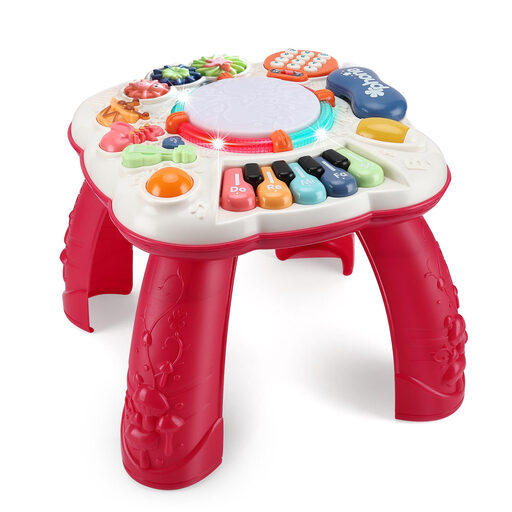
Why this product fits the profile: According to the product description, the table can be used as a floor play mat with removable legs or as a standing activity table.
The flexible use reduces the risk of the toy becoming unsuitable once your child moves from floor play to standing. Volume control and a sleep mode are practical features for everyday indoor use.
Six play areas including piano keys, drum, telephone and gears; dimensions of roughly 30 × 30 × 31 cm according to the product information.
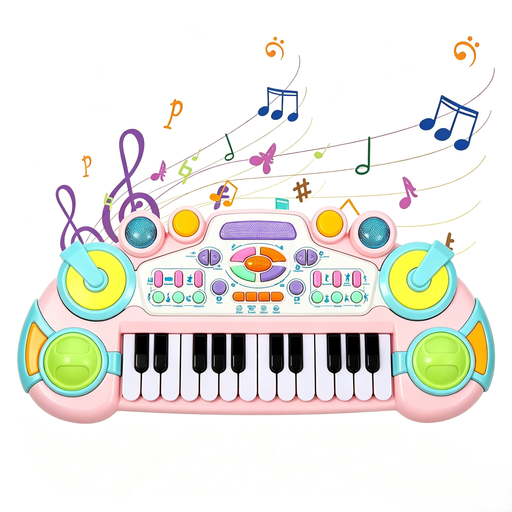
Why this product fits the profile: This keyboard is designed for children who enjoy pressing keys, distinguishing sounds and trying out their first musical pretend play.
The volume control and sleep mode address the common everyday challenge with electronic musical toys. Batteries are not included according to the product information, so you’ll need to budget for them separately.
24 keys plus light and sound effects; recommended for ages 1–5 years and made from BPA-free ABS according to the supplier.
We’ve put together a full, regularly updated list of products that meet these strict selection criteria and comply with EU safety regulations.
Suitable toys are large, easy to grasp and simple to clean, with straightforward cause-and-effect functions. An activity table, a rattle, a rolling ball or a sensory toy with big buttons could all work well. The age rating and safety warnings on each product remain the key factors.
How long a toy stays useful depends on the age range, build quality and range of features. Products with adaptable use – for example, a floor play mat with legs that can be added later – can fit into your daily routine for longer. Even so, you should regularly check the toy for damage, loose parts and secure battery compartment covers.
Battery-operated products come with ongoing costs for replacement batteries. How long they actually last depends on the volume, how often they’re played with and the type of battery used. So before you buy, check whether batteries are included, what size you need and whether there’s a sleep mode or volume control.