
Lieferung heute & morgen

Qualitätsgarantie

Willkommens-Angebote freischalten: KOSTENLOSE Lieferung | Bis zu 80 % RABATT | Kostenlose 30-Tage-JoyPlus-Testphase
App herunterladen
Baby learning toys should keep curious children engaged while matching their stage of development. However, choosing the right product is not always easy for parents, grandparents and other family members. Many products promote numerous functions, flashing effects or educational features. What really matters is not having as many extras as possible, but a suitable age recommendation, straightforward operation and clear safety information.
An activity cube, baby activity centre or musical table can combine several play areas. This is practical when space is limited. However, if too many buttons, melodies and light effects are activated at the same time, children can quickly become overwhelmed. Clearly separated elements such as rotary knobs, piano keys, gears or simple sound panels are more useful.
A product labelled “6–36 months” is not necessarily equally suitable for every child throughout this entire age range. A crawling baby needs different stimulation from a two-year-old who is already sorting, pressing buttons deliberately and beginning to engage in role play. The age recommendation should therefore be treated as a guide. Your child’s development, height and motor skills are equally important.
Batteries are often not included with battery-operated musical learning toys. A children’s bubble machine also incurs ongoing costs for bubble solution. Liquids must not be put into the mouth and should only be used under supervision. Products such as an automatic bubble gun are not suitable for babies because of their small components and liquid; according to the product information, the Tokky Bubble Gun is intended for children aged 3 and over.
For babies from around 6 to 12 months, toys that can be reached while lying down, during tummy time or when sitting are suitable. A rolling crawling toy can encourage movement without requiring the child to stand. For children from around 1 year, an activity cube, baby activity centre or small children’s drum toy may be suitable.
Look for:
According to the respective product information, several of the products featured are made from ABS plastic, are described as BPA-free and have rounded edges. These details should be checked against the product page and packaging. “BPA-free” refers to the specified substance and does not replace a general safety check.
The CE marking indicates that the supplier has declared the product to meet the relevant EU requirements. It is not an independent quality seal. Toys may also mention standards such as EN 71. Even so, check regularly whether parts are coming loose, battery compartments are damaged or cracks have appeared.
Musical learning toys should ideally have a volume control or silent mode. This is particularly useful in flats, during nap time or for longer play sessions. Toys containing liquids, small shapes or moving parts require adult supervision.
Cleaning should also be considered when choosing a toy: surfaces should be easy to wipe clean. With bath toys, it is important that water can drain away completely, preventing a permanently damp environment from forming inside.
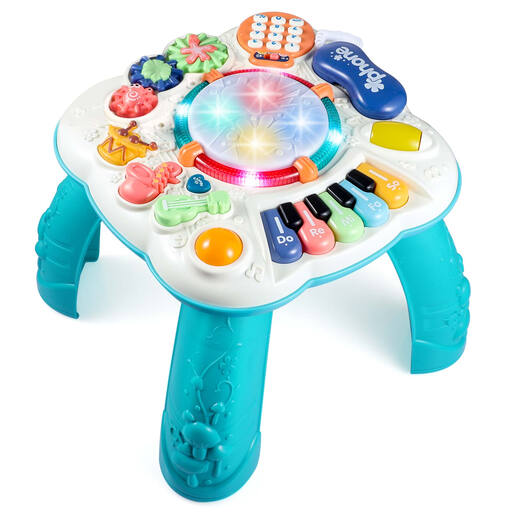
Why this product suits the profile: The table combines six play areas and, according to the product description, can also be used as a floor play panel with its legs removed. This makes it suitable for families looking for a versatile toy.
The 6–36-month age recommendation and adaptable design make the choice more transparent than a purely effects-based toy with no option to adjust its use.
Six play zones, volume control and rounded ABS edges according to the product information; batteries are not included.

Why this product suits the profile: This compact cube combines a piano, guitar, telephone play, gears and music, among other features. It is ideal for homes where a portable toy is needed for different everyday situations.
The dimensions of around 23 × 23 × 24 cm and the carry handle make its size clear. Parents can also consider whether the numerous functions are suitable for the volume levels in their home.
Eight clearly described play modes, a compact design and BPA-free ABS plastic with rounded edges according to the product information.
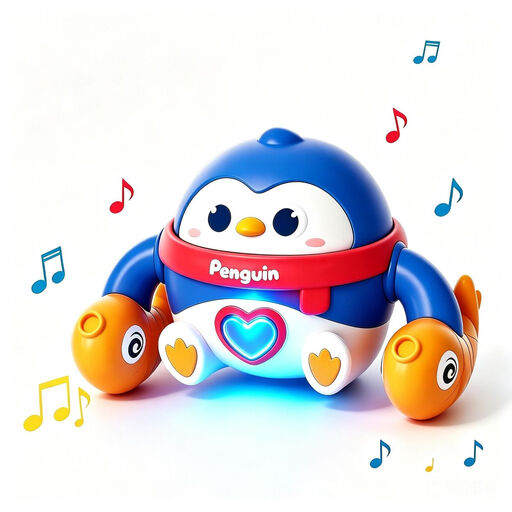
Why this product suits the profile: According to the product information, this rolling toy is intended for children aged 6 to 36 months. It is suitable for families who want to encourage tummy time, grasping and crawling through play.
Its operation focuses on movement and response rather than continuous lighting. The sensor can be activated by clapping or tapping; use should be supervised.
360-degree rolling movement, music and illuminated elements; BPA-free ABS plastic and rounded edges according to the product information.
Why this product suits the profile: This children’s drum toy combines drum surfaces, lights, animal sounds and shape and colour matching. It is suitable for playing together on the floor.
The volume can be adjusted according to the product description. This makes it easier to adapt the toy to indoor environments and different times of day.
Four play areas, non-slip base and BPA-free ABS plastic according to the product information; batteries are not included.
We have put together a complete, regularly updated list of products that fully meet these strict selection criteria and the safety regulations applicable in the EU.
From 6 months, toys that are easy to reach during tummy time and while sitting are a good choice. These include simple sensory toys for babies, grasping elements, rolling figures or a floor play panel. Look for a stable construction, rounded edges and no small parts that could be swallowed.
How long a toy remains usable depends on its materials, construction and how intensively it is played with. Models with removable legs or several difficulty levels may remain interesting for longer. Check edges, screws, battery compartments and moving parts regularly. Damaged toys should no longer be used.
Battery-operated products incur the cost of suitable batteries; the required quantity is stated in the product description or instructions. A children’s bubble machine also requires bubble solution. For toddlers, such products should only be used in accordance with the age recommendation and under direct supervision.