
Lieferung heute & morgen

Qualitätsgarantie

Willkommens-Angebote freischalten: KOSTENLOSE Lieferung | Bis zu 80 % RABATT | Kostenlose 30-Tage-JoyPlus-Testphase
App herunterladen
Baby learning toys should be age-appropriate, easy to fit into family life, and offer more than just bright colours or lots of buttons. Parents, grandparents and relatives are faced with a huge choice: Montessori baby toys, sensory toys, musical instruments, motor skills toys or a baby activity table each have different play objectives.
As a Joybuy Product Recommendation Officer, I focus on clear information about age, material, features, dimensions and care when making my selection. After all, not every product labelled as a “learning toy” is suitable for every child or every living situation.
Multiple play modes can be useful if they are clearly separated and easy to operate. However, a long list of melodies, lights and buttons does not automatically mean the toy will work well in everyday life. For younger children, easily accessible elements such as large buttons, spinning gears or chunky surfaces are usually more practical than small, fiddly controls.
“For babies and toddlers” is a very broad statement. A toy for six months is not necessarily suitable for a one-year-old, and vice versa. So always check the specific age recommendation, the size of the parts and the warning labels. Extra caution is needed with products that contain small accessories.
Musical toys for babies can quickly become annoying in a home. Look for a volume control, a sleep mode and check whether batteries are included. With electronic toys, the battery compartment should be lockable. Batteries should never be within a child’s reach.
For baby toys from 6 months, floor-level or easily reachable elements are best. A play table with removable legs can be used for longer if it can first be used as a play panel on the floor and later when standing. Rolling toys suit children who are already reaching for objects, following them with their eyes or crawling.
For children aged around one to three years, blocks, sorting games, simple musical instruments and role-play toys are suitable. Learning toys for toddlers should not be too small and should be usable without complicated instructions.
According to the product information, several of the models featured here are made from ABS plastic, are BPA-free and have rounded edges. You should check these details in the product description and on the packaging before buying. The CE mark indicates that the manufacturer declares the product meets the applicable EU requirements. However, it is not an independent quality seal.
References to EN 71 relate to European safety requirements for toys. Nevertheless, check before each use whether any parts have come loose, there are any cracks or the battery compartments can be opened. For toys that can be used with water, thorough cleaning and complete drying are also important.
Measure the intended play area. A cube measuring roughly 23 × 23 × 24 cm is more compact than an activity table with sides of about 30 cm and legs. For small homes, visits to grandparents or travelling, a carry handle and light weight can be practical advantages.
The volume should also suit the environment. In flats or apartments especially, models with a volume control or mute function are well worth considering.
Why this product fits the profile: The 4-in-1 play centre combines drum surfaces, lights, animal sounds and shape and colour sorting. This gives buyers several play options in one compact product for children from 6 to 36 months, according to the product information.
The functions are accessible directly via large surfaces and shapes. According to the supplier, the parts are made from BPA-free ABS with rounded edges; batteries are not included.
Shape sorting, drum surfaces, light and animal sounds; non-slip base according to the product description.

Why this product fits the profile: The cube combines eight play areas, including a piano, guitar, telephone game, gears and a windmill. At 23 × 23 × 24 cm and with a carry handle, it is ideal for households that want to combine different functions in a space-saving way.
The age recommendation of 1 to 3 years is specific. According to the product information, there are no loose parts, it has rounded edges and is made from BPA-free ABS; you should double-check these details before buying.
Eight integrated play modes and a compact cube shape; suitable for both shared and independent play.
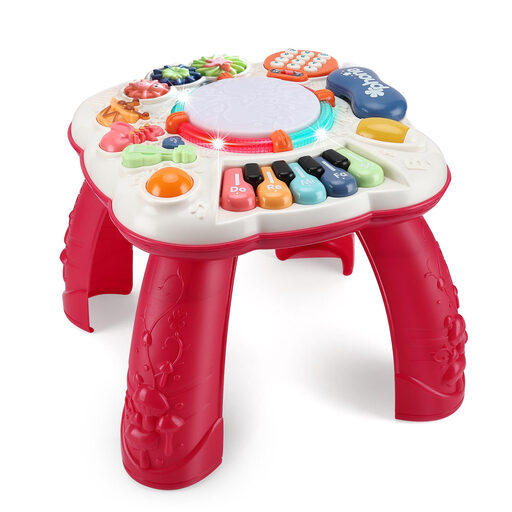
Why this product fits the profile: The activity table offers six play zones with a piano, drum, telephone game and gears. According to the product description, the removable legs allow it to be used as a floor panel first and later as a table.
Its use is not limited to just one developmental stage. According to the supplier, this model has a volume control and sleep mode; batteries are not included.
Two ways to use it, six play areas and volume control according to the product description.
We have put together a complete, regularly updated list of products that fully meet these strict selection criteria and the safety regulations in force in the EU.
From six months, large, easy-to-grasp, floor-level elements are ideal. These include simple rattles, soft grasping toys, rolling balls or an activity panel. The specific age rating, the absence of small parts and use under supervision are all crucial.
How long a toy stays interesting depends on the child’s developmental stage and the play options available. Models with several types of play, adaptable use or open-ended role play can hold a child’s interest for longer. There is no guarantee of a specific play duration. Rotate toys regularly and don’t offer everything at once.
Check the volume control, sleep mode, battery compartment and ease of use. Instruments should be stable and have no sharp edges. For electronic models, it is a good idea to use them together for the first time so that adults can set the volume and individual functions appropriately.