
Lieferung heute & morgen

Qualitätsgarantie

Willkommens-Angebote freischalten: KOSTENLOSE Lieferung | Bis zu 80 % RABATT | Kostenlose 30-Tage-JoyPlus-Testphase
App herunterladen
Baby learning toys should do more than provide entertainment. They should suit your baby’s current stage of development, your living space and your family’s daily routine. Yet among colourful claims such as “Montessori-inspired”, “multifunctional” and “suitable for multiple age groups”, important questions often remain unanswered: Is the toy genuinely age-appropriate? Are the battery compartment and small parts safe? Is its size suitable for the space available?
That is why the following selection from the Joybuy Product Recommendation Officers focuses on clear product information and practical buying criteria.
A toy labelled “6 to 36 months” may offer different ways to play. For example, a six-month-old baby might use an activity centre on the floor, while a toddler may later play with it while standing. The key considerations are whether parts can be removed and which functions are suitable for each stage of development.
For a toy from 6 months, parents should also check whether their child can already sit, grasp or crawl safely. The age recommendation does not replace supervision.
Labels such as “early learning” or “Montessori baby toy” say little on their own about the material, workmanship or specific play options. More useful information includes details about material, age recommendation, battery safety, small parts and product dimensions.
Interactive baby toys with lights and music often require batteries and can quickly become too loud in a home. A volume control or mute function is therefore a useful feature. For larger motor-skills toys, floor space, weight, ease of cleaning and secure connections are important considerations.
Check whether the product is designed for floor play, sitting, crawling or standing. A baby activity centre with removable legs can be used for longer, provided the construction remains stable in every position. For toddlers, soft building elements for climbing, crawling and stacking can also be useful.
For plastic toys, details such as ABS, BPA-free and rounded edges are helpful. However, you should compare them with the specific safety information in the product listing. The CE marking is applied by the manufacturer or the party placing the product on the market. It indicates declared conformity with applicable EU requirements; it is not an independent quality mark.
For foam products, EN71-1, EN71-2 and EN71-3 may be specified. These parts of the standard relate, among other things, to mechanical and physical properties and the migration of certain elements. Also check whether covers can be removed and washed.
Musical baby toys should ideally have adjustable volume. Check whether batteries are included, which type is required and whether the battery compartment is secured. For everyday use, wipe-clean surfaces or machine-washable covers are practical. Vacuum-packed foam parts may require 24 to 48 hours to expand fully.
Why this product suits this profile: This compact sensory baby toy combines drum surfaces, lights, animal sounds, and shape and colour sorting in one product.
The functions are clearly specified: four play areas rather than an unspecified educational benefit. The product information states ABS, BPA-free material and rounded edges.
Shape sorting, drum surfaces and animal sounds; suitable for tummy-time and seated play.
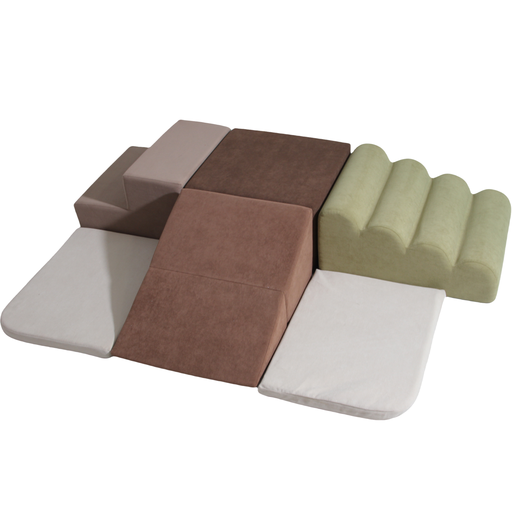
Why this product suits this profile: This six-piece set is designed for families who want to combine motor-skills toys for babies and toddlers with flexible play structures.
Instead of hard edges, it uses foam elements with fabric covers. Anti-slip bases, hook-and-loop fasteners and concealed zips are explicitly listed.
Removable, machine-washable covers; according to the product information, EN71-1, EN71-2, EN71-3 and Toy Safety Directive 2009/48/EC.

Why this product suits this profile: For families with enough space, this set offers several ways to climb, crawl and build indoors.
The product description explicitly states that balls are not included. This allows you to budget for any additional costs before buying.
Machine-washable covers, anti-slip bases and foam elements; the parts require 24 to 48 hours to expand after unpacking.
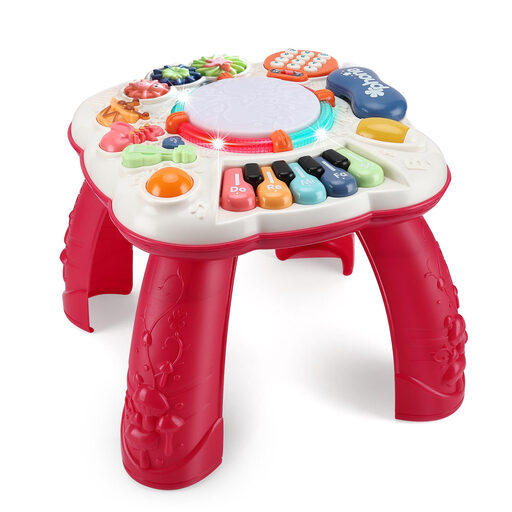
Why this product suits this profile: The 2-in-1 design can be used as a floor play panel and later, with its legs attached, as an activity table.
The product information lists six play areas, removable legs and a volume control with quiet mode. Batteries are not included and need to be factored in separately.
Piano keys, drum, gears, telephone and instrument sounds; ABS plastic, BPA-free material specification and rounded edges.
We have put together a complete, regularly updated list of products that fully meet these strict selection criteria and the safety regulations applicable in the EU.
Products with large, easy-to-grasp controls and a clear age recommendation are suitable. Simple drums, sorting games, floor play panels or movable figures may be appropriate at this stage. Small removable parts should be kept out of reach. The safety information for the specific product and your child’s development should always be the deciding factors.
The useful life depends on the material, workmanship and your child’s interest in playing. A toy with several play positions, washable covers or extendable components can be used for longer in everyday family life. Check edges, seams, fastenings, battery compartments and moving parts regularly. Damaged products should no longer be used.
In addition to the purchase price, you may need to pay for batteries, replacement parts and, for certain sets, extra accessories. Before buying, check the battery type, whether batteries are included and whether components such as play balls need to be purchased separately. For musical baby toys, it is also worth checking the volume control and automatic shut-off.