
Lieferung heute & morgen

Qualitätsgarantie

Willkommens-Angebote freischalten: KOSTENLOSE Lieferung | Bis zu 80 % RABATT | Kostenlose 30-Tage-JoyPlus-Testphase
App herunterladen
Music toys for babies can bring together sounds, colours, movement and early cause-and-effect experiences. Products can also vary considerably in their age guidance, volume controls, cleaning requirements and battery use. If you focus only on the number of tunes or flashing buttons, you could miss important details.
A toy with piano keys, shapes, lights and a microphone may look versatile. But for a baby who is still mostly lying down, large, easy-to-reach controls matter more than a long list of features. Small parts or complex card and slot systems may not be suitable for younger children.
So check the specific age recommendation and consider whether the child can already grasp, sit, stand or walk.
Musical baby toys can quickly seem loud in small rooms. Volume control or an off switch is especially useful if the toy will be used in a flat, while travelling or near siblings. However, a low volume setting is no substitute for adult supervision.
Look for information about volume control, quiet modes and how easy the switch is to use.
Fabric music boxes, rattles and activity toys regularly come into contact with hands, floors and sometimes mouths. For a baby music box, it should be clear whether the music module can be removed before washing. For electronic educational toys, check the battery compartment, battery type and what’s included.
Missing batteries, hard-to-reach compartments or non-removable modules can make a toy unnecessarily difficult to use.
For baby toys from 6 months, look for large buttons, easy-to-grip surfaces and simple responses to pressing, shaking or tapping. A musical learning toy for older toddlers can include several play modes, a microphone or a small instrument.
As a guide:
For plastic toys, details such as BPA-free ABS, rounded edges and a securely closed battery compartment are useful points to look for. The CE marking indicates that the manufacturer declares the product meets the relevant EU requirements. It is not an independent quality mark. References to EN 71 relate to European toy safety requirements.
Read the warnings too. Wording such as “not suitable for children under three years” because of small parts that could be swallowed should be taken seriously. Products for babies should not have loose parts, sharp edges or decorations that can come away easily.
An electronic music toy should stand firmly or have non-slip surfaces. For an activity table, also consider its size, removable legs and whether it can be used on the floor. For use on the go, a low weight and simple fastening are helpful.
For fabric products, you should be able to remove the music module before washing. Check the care instructions and only put the module back once the fabric is completely dry.
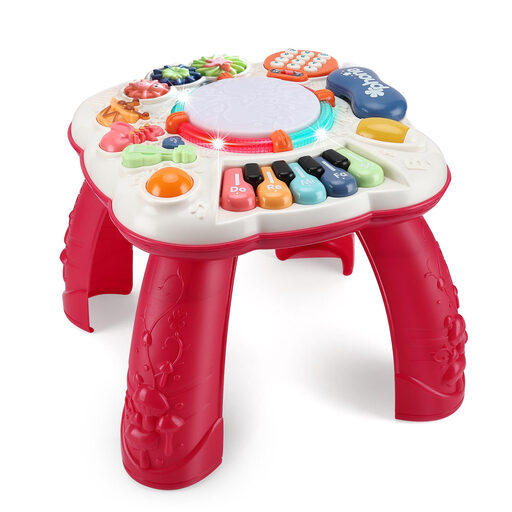
Why this product suits this profile: This activity centre combines piano keys, a drum, spinning gears and other controls. Its removable legs mean it can be used as a floor play panel or a table.
According to the product information, this model has volume control and a quiet mode. That means you’re not reliant on a single volume setting that plays continuously.
Two ways to play, six play areas and a recommended age range of 6 to 36 months.
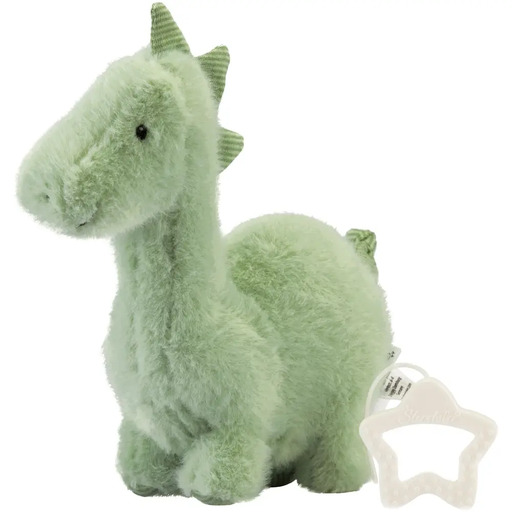
Why this product suits this profile: This fabric music box is suitable from birth and can be carried by its star-shaped handle. The removable music module makes it easier to care for.
According to the product description, the music module can be removed before washing. It must be kept out of reach of babies and toddlers.
Suitable from 0 months, machine-washable cover once the module has been removed, and mechanical operation with no batteries required.
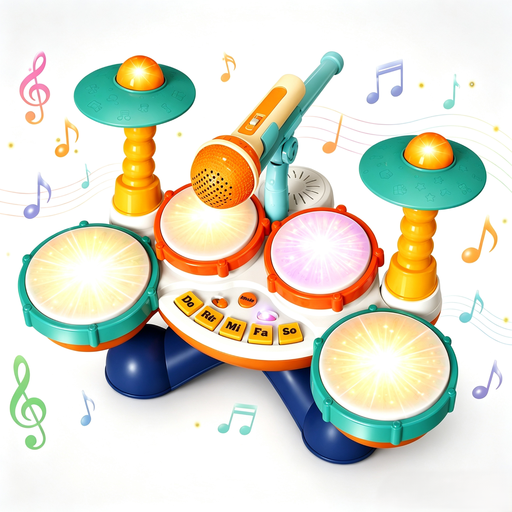
Why this product suits this profile: For toddlers who want to drum, sing and make music with adults. According to the product information, the set is designed for ages 1 to 4.
According to the product information, the set has a volume control, a wide four-point base and rounded ABS plastic edges. Batteries are not included.
Four illuminated drum pads, two cymbals, a microphone, ten built-in tunes and several play modes.
We’ve put together a complete, regularly updated list of products that meet these strict selection criteria and fully comply with the safety regulations in force in the EU.
From 6 months, large, easy-to-reach buttons, stable floor toys and simple cause-and-effect features are useful. A music ball, baby rattle or small sound toy should not contain detachable small parts. Always follow the age guidance for the specific product.
How long a toy lasts depends on its materials, battery compartment, care and how often it is played with. For electronic toys, remove the batteries if the toy won’t be used for a long time. Fabric music boxes with removable music modules are easier to clean. Damaged cables or casings, or loose parts, are reasons not to pass a product on.
Battery-operated products have ongoing costs for replacement batteries. Check whether batteries are included and what type is required. Mechanical music boxes don’t need batteries. Rechargeable devices can be cheaper to run, but should be charged under adult supervision and kept dry.