
Lieferung heute & morgen

Qualitätsgarantie

Willkommens-Angebote freischalten: KOSTENLOSE Lieferung | Bis zu 80 % RABATT | Kostenlose 30-Tage-JoyPlus-Testphase
App herunterladen
A multifunctional baby musical toy can combine several play interests: buttons, drums, shape sorting, light signals and animal sounds. However, choosing the right one is not always easy for parents, grandparents and other family members. Product descriptions often list numerous features, while important details about age suitability, volume and power supply may be less prominently displayed.
A toy with a piano, telephone, gears and drum may seem versatile. For a six-month-old baby, however, large buttons and simple cause-and-effect reactions may be more suitable than complex shape-sorting activities. An activity cube for babies or musical toy for babies aged 6 months and over should therefore match the child’s current development in terms of grasping, sitting and movement.
Check the manufacturer’s specific age recommendation. It provides guidance, but does not replace adult supervision.
An interactive toy with lights and sounds can quickly become disruptive in a home if its volume cannot be adjusted. A volume control is particularly useful when the toy is used frequently in the living room, in the car or in a flat with poor sound insulation.
If this feature is missing, parents should check whether the toy can be switched off completely and how easy it is to replace the batteries. Batteries are not included with several of the products mentioned here, so they need to be purchased separately.
Details such as BPA-free ABS, rounded edges or a CE marking are relevant product information. In general, the CE marking indicates that the supplier has taken the applicable EU requirements into account. However, it is not a quality seal and does not replace checking the toy before play.
Inspect the toy regularly for cracks, loose parts, sharp edges and damaged battery compartments. With electronic toys, the battery compartment should be closed and not easily accessible to children.
For babies aged approximately 6 to 12 months, flat play panels or sturdy elements suitable for tummy time are often a good choice. An activity table for babies with removable legs can, depending on its design, initially be used on the floor and later while standing.
For children aged between 1 and 3 years, larger activity cubes, small instruments and pretend-play elements may be suitable. Also consider stability, grip options and dimensions. A compact toy can be practical for travelling, while an activity table requires more space in the nursery.
The selected products list ABS plastic as the main material; several product descriptions also mention BPA-free materials and rounded edges. These details should be verifiable in the relevant product description and labelling.
Important features include:
A musical learning toy for babies should not only offer a wide range of sounds, but also be easy to operate. Buttons, drum surfaces and rotary controls should respond with minimal force. A volume control or quiet mode is useful for everyday use.
The stated features may encourage children to explore colours, shapes, sounds and cause-and-effect relationships. However, they do not guarantee any particular developmental outcome. Playing together, naming things and copying sounds or movements usually makes the experience easier to understand and more varied.
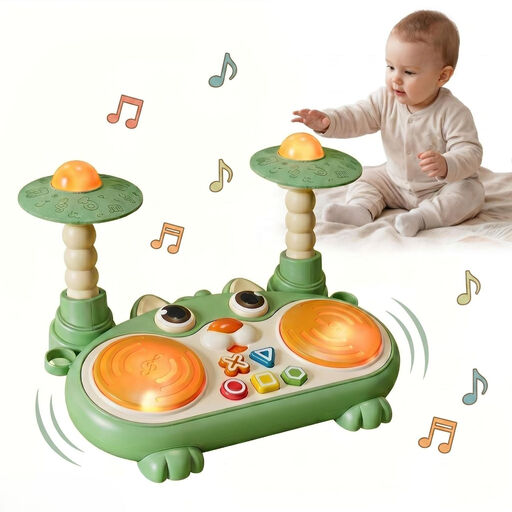
Why this product suits this profile: This compact baby musical toy combines drum surfaces, shape and colour sorting, light effects and animal sounds. It is suitable for families looking for several simple play activities in one device.
The age recommendation is clearly stated; rounded edges, BPA-free ABS and a non-slip base are also mentioned. No volume control is listed in the available information.
Five geometric shape pieces, two drum surfaces and several types of sound offer different ways to play. Batteries are not included.
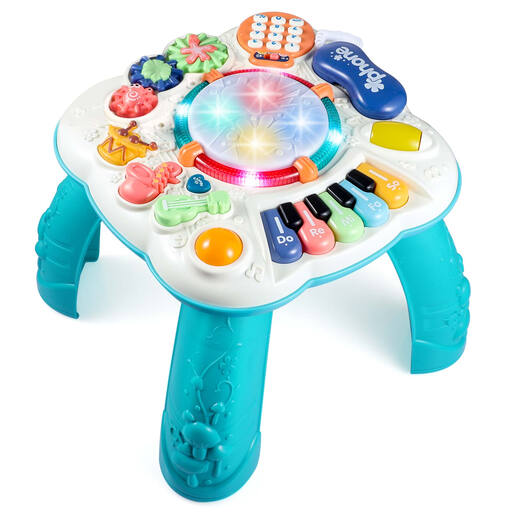
Why this product suits this profile: The table combines six play areas and, according to the product description, can be used as a floor play panel with its legs removed. This is practical as the child’s playing position changes.
The design supports two ways of playing. Volume control and a quiet mode are also listed, allowing the device to adapt more easily to different home environments.
Piano, bass drum, telephone, gears and instrument sounds are combined in one play centre. The stated size is approximately 30 × 30 × 31 cm.

Why this product suits this profile: This cube is designed for toddlers and offers several hands-on activities, including turning, pressing, dialling and making music. Measuring approximately 23 × 23 × 24 cm, it remains relatively compact.
The age range of 1 to 3 years defines its intended use. The cube focuses on several clearly identifiable controls rather than a single function that could quickly become uninteresting.
Eight play modes, including piano, guitar, telephone, windmill and gears. The carry handle makes it easier to transport around the home or when travelling.
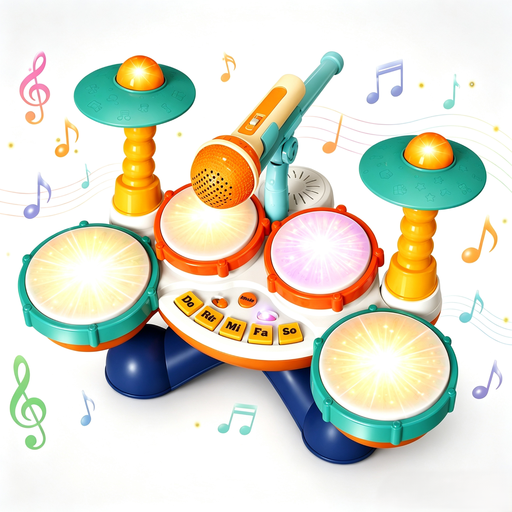
Why this product suits this profile: This drum toy for toddlers is aimed at children who enjoy playing rhythms, singing and experimenting with sounds. A microphone and several play modes extend its use beyond simple drumming.
An adjustable volume is specified. This is useful for everyday play; nevertheless, the device should not be used directly next to the child’s ear.
According to the product description, it includes four illuminated drum surfaces, two cymbals, ten melodies, animal sounds and a microphone.
We have put together a complete, regularly updated list of products that fully meet these strict selection criteria and the safety regulations applicable in the EU.
This depends on the individual product information and controls. For babies from around 6 months, simple drum, light and button functions may be suitable. Activity cubes and more extensive instrument sets are often intended for children aged 1 year and over. The manufacturer’s recommendation should always be considered alongside the child’s stage of development.
It is not possible to give a reliably suitable volume level without measuring the specific device. Choose a model with a volume control wherever possible and set it to a moderate level. The toy should not be placed directly next to the child’s head or ear. Stop using it if the sounds are unusually loud, distorted or damaged.
Its lifespan depends on the materials, batteries, frequency of use and storage conditions. Electronic functions can be affected by moisture, falls or leaking batteries. Remove the batteries if the toy will not be used for an extended period, clean it according to the manufacturer’s instructions and regularly check the casing, cables, battery compartment and moving parts.