
Lieferung heute & morgen

Qualitätsgarantie

Willkommens-Angebote freischalten: KOSTENLOSE Lieferung | Bis zu 80 % RABATT | Kostenlose 30-Tage-JoyPlus-Testphase
App herunterladen
Baby muslin cloths are part of the basic kit for many families. They can be used as baby burp cloths, lightweight changing mats, baby nursing covers or absorbent mats during feeding. However, the material, size, number of layers and care instructions can vary considerably. A low price alone says little about whether a muslin cloth set will really be practical for everyday use.
The Joybuy Product Recommendation Officer selection is therefore based on clear information such as material, dimensions, washing temperature and intended use.
Terms such as “extra soft”, “particularly kind to skin” or “highly absorbent” are of limited value if the product description does not specify the fibre composition. Check whether 100% cotton is actually stated. With baby muslin cloths, the number of layers can also affect absorbency and drying time.
A 70 × 70 cm cloth is suitable as a burp cloth, a small nursing cover or a mat. For swaddling a newborn or providing more extensive coverage, 80 × 80 cm is more practical. Very large cotton baby cloths, on the other hand, may take up more space in your changing bag when you are out and about.
Baby textiles need to be washed frequently. A cloth that may only be washed at a low temperature or takes a long time to dry can be impractical in everyday life. Before buying, check whether the product is machine washable, what temperature it can be washed at and whether it is suitable for tumble drying. Fabric softener should generally be avoided with muslin nappies and burp cloths if the manufacturer advises against it.
100% cotton is a commonly chosen material for baby muslin cloths. When properly processed, cotton can feel soft and is intended for direct contact with the skin. “Breathable” describes a material property, but it is not a medical promise. If your baby has sensitive skin, wash the cloth before using it for the first time.
A reference to OEKO-TEX Standard 100 means that the textile has been tested for certain harmful substances in accordance with the relevant standard. Test information should always be verifiable directly in the product description or on the label. This type of certification does not replace checking for loose threads, damaged seams or significant wear.
Classic muslin nappies and muslin cloths are usually lightweight and quick-drying. Multi-layer cloths can absorb more liquid, but may take slightly longer to dry depending on the material and wash programme. A six-layer cloth is therefore not automatically suitable for every use: it may be practical as a flannel or baby burp cloth, but less compact as a lightweight cover when you are out and about.
Choose according to how you plan to use the cloth:
When swaddling, the cloth must not be wrapped too tightly and should never cover the face. For sleep, follow the manufacturer's safety instructions and recommendations for a safe sleeping environment. Do not leave a loose cloth unattended in your baby's cot.
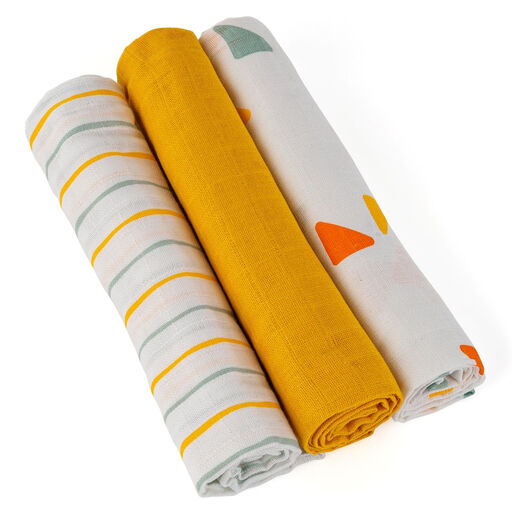
Why this product suits this profile: The set includes three 70 × 70 cm cloths, making it ideal for families who want to start with a manageable basic kit.
The product details state 100% cotton, machine washing at 40 °C and suitability for a range of everyday situations.
Three 70 × 70 cm cloths made from 100% cotton, described as absorbent and breathable; OEKO-TEX Standard 100 according to the product details.
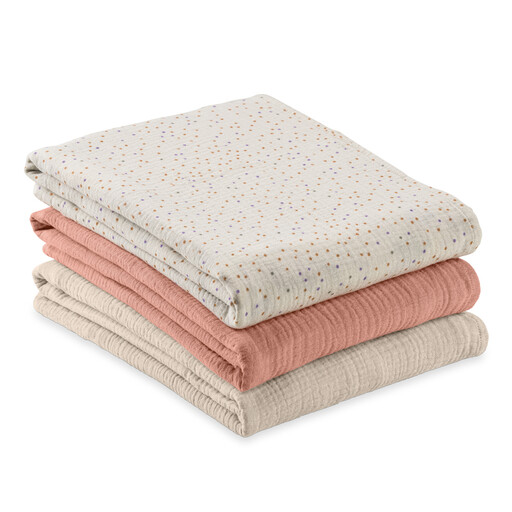
Why this product suits this profile: The 80 × 80 cm size provides more coverage for nursing when out and about, lightweight covers or a baby swaddle cloth, subject to the safety instructions.
The details specify the material, size, washability at 60 °C and clear warnings about using it as a blanket or during nappy changes.
Three 100% cotton cloths, 80 × 80 cm, machine washable at 60 °C; suitable from birth according to the product description.
We have put together a complete, regularly updated list of products that fully meet these strict selection criteria and the safety regulations applicable in the EU.
Wash new muslin cloths before using them for the first time to remove any potential production residues and allow their absorbency to develop. Sort them by colour and follow the manufacturer's instructions. High washing temperatures may be useful for hygiene, but should only be used if permitted by the care label.
A set routine is practical for everyday family life:
There is no fixed service life that applies in every case. It depends on how often the cloth is washed, the temperature, friction and drying method. Once the cloth has become noticeably thinner, developed a persistent unpleasant smell or its seams start to come undone, it should be replaced or used only for non-critical household purposes.
For starters, around six to ten cloths is a practical guide if they are used regularly as burp cloths, mats and washcloths. If your baby spits up frequently, you change nappies several times a day or wash less often, a larger muslin cloth set may be useful.
The terms are sometimes used interchangeably by retailers. Muslin nappies are often square cloths made from lightweight cotton, while muslin cloths may also be marketed as burp cloths, bibs, nursing covers or comforters. The key factors are the actual dimensions, the fabric construction and the care instructions.
That depends on the individual product. According to the manufacturer, some cloths are suitable for tumble drying at a low temperature, while others should be air-dried. Check the care label before buying, as heat can cause shrinkage or faster wear.