
Lieferung heute & morgen

Qualitätsgarantie

Willkommens-Angebote freischalten: KOSTENLOSE Lieferung | Bis zu 80 % RABATT | Kostenlose 30-Tage-JoyPlus-Testphase
App herunterladen
Baby muslin cloths are part of the basic kit for many families. They can be used as baby burp cloths, a lightweight mat, nursing cover, changing aid or – subject to the safety instructions – a swaddle cloth. However, the wide range of options does not always make the decision easier. Product names such as muslin nappies, muslin cloths or baby cotton cloths are sometimes used interchangeably, even though the actual properties can vary considerably.
“Extra soft”, “particularly absorbent” or “breathable” do not say much on their own. What matters is whether the product is made from 100% cotton, how many layers the fabric has and what type of care it can withstand. For an everyday essential, these details should be clearly stated in the product description.
A cloth measuring 80 x 80 cm is suitable for several uses, but requires more storage space and may be less convenient as a classic burp cloth. Smaller formats such as 30 x 50 cm can be practical when feeding or out and about, but offer less coverage than a muslin nappy or swaddle cloth.
Milk, purée and spit-up stains require regular washing. A set that can only be washed at a low temperature may create more work in everyday use. At the same time, high temperatures, frequent tumble drying and unsuitable detergents can put strain on the material. Care instructions and drying recommendations should therefore be checked before buying.
Muslin refers to a loosely woven type of fabric that is often made from cotton. 100% cotton muslin is a clear material specification for baby muslin cloths and is intended for direct contact with the skin, provided the product is labelled accordingly. An open weave can allow air to circulate; this does not, however, imply any medical benefit.
The thickness of the material increases with multi-layered cloths. For example, a six-layer cotton cloth may be designed to absorb liquid, but it is not automatically better suited to every use. Compact formats are often more practical as baby burp cloths, while larger cloths can be used as a mat, nursing cover or lightweight cover.
Before buying, it is worth making a simple comparison:
The quantity you need depends on how often you wash them. Anyone caring for babies who spit up frequently or need regular feeding changes will generally need more spare cloths than households where the cloths are mainly used as lightweight mats.
Absorbent muslin cloths should become softer after the first wash and absorb liquid without staying damp for a long time. A care instruction such as machine washable at 60°C can be relevant for intensive everyday use. Other products are designed for 40°C and, according to the manufacturer, dry quickly.
Baby cotton cloths should be washed before first use. Their feel and absorbency may change during washing. Avoid bleach and, where specified, fabric softener. Loose threads or damaged areas are a reason to stop using the cloth for your baby.
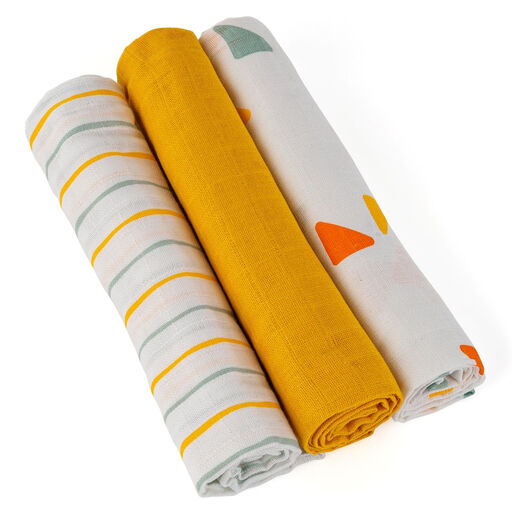
Why this product matches the profile: The 3-piece set, measuring 70 x 70 cm, offers an accessible starting point for use at home and on the go. The cloths can be used as burp cloths, bibs, mats or comforters.
The material, size and care instructions are clearly stated: 100% cotton, 70 x 70 cm and machine washable at 40°C.
100% cotton, tested for harmful substances according to the product details and Oeko-Tex Standard 100, 3-piece set.
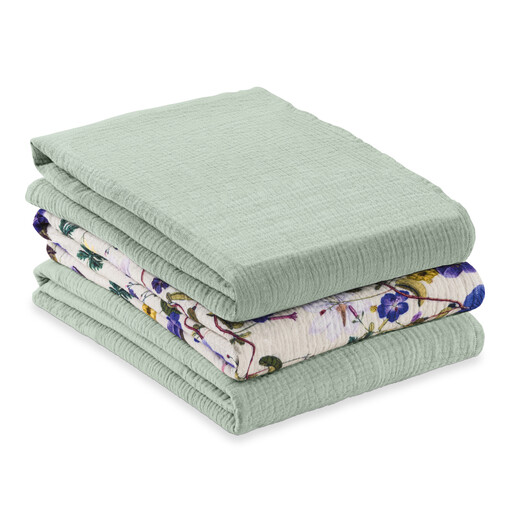
Why this product matches the profile: The larger size is ideal for parents looking for one cloth to cover several everyday situations, such as use as a nursing cover, mat or for careful swaddling in line with the safety instructions.
The product details specify 100% cotton muslin, double-layered fabric, 80 x 80 cm and machine washing up to 60°C.
Double-layered muslin fabric, 3-piece set, 80 x 80 cm, machine washable up to 60°C.
We have put together a complete, regularly updated list of products that fully meet these strict selection criteria and the safety regulations applicable in the EU.
Large cloths must not cover a baby’s face. No loose blankets or cloths should be left in the cot. When swaddling, the cloth must be loose enough not to restrict the natural movement of the hips. As soon as a baby shows signs of being able to roll over independently, swaddling should be stopped. When using a cloth as sun protection on a pushchair, make sure there is sufficient ventilation to prevent the interior from overheating.
You should also check seams and threads regularly. Damaged baby muslin nappies should no longer be used. The care label, manufacturer’s information and warnings take precedence over general advertising claims.
Several cloths are useful for everyday use, as spit-up, feeding and changing often require replacements. A 5-piece set offers more spares than a 3-piece set. The key factors are how often you wash them, drying time and whether they will mainly be used at home or on the go.
A 30 x 50 cm cloth is handy for use over the shoulder or in a changing bag. A 70 x 70 cm format is more versatile. Muslin cloths 80 x 80 cm offer more coverage, but are not essential as dedicated burp cloths.
That depends on the product. According to the care instructions, some cotton muslin cloths are machine washable up to 60°C, while others are limited to 40°C. The permitted temperature, drying method and avoidance of bleach should be observed before buying and before every wash.