
Lieferung heute & morgen

Qualitätsgarantie

Willkommens-Angebote freischalten: KOSTENLOSE Lieferung | Bis zu 80 % RABATT | Kostenlose 30-Tage-JoyPlus-Testphase
App herunterladen
Muslin cloths are part of the basic kit for many families. They can be used as burp cloths, changing-mat covers, lightweight nursing covers or an extra helper when you are out and about. However, because baby muslin nappies and baby muslin cloths can look very similar, choosing the right option is not always straightforward. The material, dimensions, weave and care instructions all affect whether a set is genuinely practical for everyday use.
A cloth measuring 70 x 70 cm is easy to handle and works well as a burp cloth, bib, changing mat cover or baby flannel. For swaddling or use as a nursing cover, a larger size such as 80 x 80 cm provides more coverage. The dimensions should therefore match the intended use, rather than being judged solely from the product photo.
A soft surface can be created by different types of fabric. More useful details include specific information such as 100% cotton, muslin, the number of layers and the washing temperature. With 100% cotton muslin cloths, you should also check that every part of the cloth is actually made from cotton.
Large baby-cloth sets may look attractive in terms of price, but they might be offered in an impractical size or contain too few cloths for daily changes. For baby burp cloths, several smaller cloths are often more useful, while larger muslin cloths may be suitable for swaddling, nursing or use as a lightweight cover. The key factor is the combination of quantity, size and intended use.
Cotton is a commonly used fibre in baby textiles. It can be breathable and absorbent, although the exact properties depend on the weave, fabric weight and number of layers. Details such as 100% cotton or 100% cotton, muslin provide a clear basis for comparison. If your baby has sensitive skin, new cloths should be washed before first use.
A label such as OEKO-TEX Standard 100 means that, according to the supplier, the product has been tested for harmful substances. It should not be taken to indicate any medical or therapeutic effect. Regardless of the material, cloths should be checked regularly for loose threads, damage and significant wear.
Multiple layers can increase liquid absorption. However, with a six-layer muslin cloth, you should also consider drying time, care instructions and the actual dimensions. “Absorbent baby cloths” should not be judged solely by marketing claims, but by considering the material, number of layers and how they perform in your own household.
Milk and food residue call for easy cleaning. Depending on the model, the products in this selection are machine washable at 40°C or 60°C. Instructions such as “do not bleach”, “do not use fabric softener” or “do not tumble dry” should be followed, as they can affect the product’s lifespan and ability to retain its shape. Before first use, washing the cloths according to the manufacturer’s instructions is recommended.
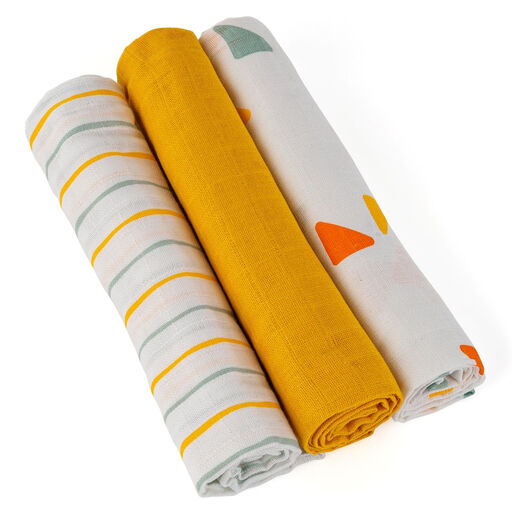
Why this product suits this profile: The 3-piece set, measuring 70 x 70 cm, offers an accessible starting point for use at home and when out and about. According to the product details, the cloths are made from 100% cotton and are machine washable at 40°C.
The specific size, quantity and material information make comparisons easier. This helps you judge whether three cloths will be enough for your personal rotation needs.
70 x 70 cm, 100% cotton, machine washable at 40°C and, according to the supplier, suitable for tumble drying at a low temperature.
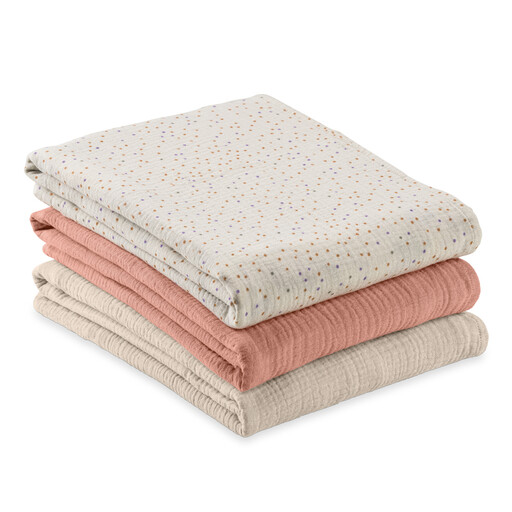
Why this product suits this profile: The larger size is suitable for parents who want to use muslin cloths for swaddling, nursing and as a lightweight cover. The set contains three designs made from 100% cotton.
The 80 x 80 cm dimensions help prevent you from choosing a cloth that is too small for larger applications. The 60°C care instruction is also relevant when planning household washing.
80 x 80 cm, 100% cotton and machine washable at 60°C according to the product details; suitable from birth.
Muslin cloths are versatile, but they are not a substitute for a safe sleeping environment. When swaddling or covering your baby, their face must remain uncovered. A cloth should never be left loose and unattended in the baby’s cot. When using one in a pushchair, make sure there is sufficient ventilation to prevent excessive heat from building up. When changing your baby, the cloth should not be wrapped tightly around their hips.
Muslin cloths should be allowed to dry completely after washing. Fabric softener can affect absorbency. Six-layer cotton cloths may take longer to dry than thinner muslin cloths. For this reason, a separate set of baby flannels, small burp cloths and larger cloths can be more practical for everyday use than a single universal size.
We have put together a complete, regularly updated list of products that fully meet these strict selection criteria and the safety regulations applicable in the EU.
This depends on how often you wash them and how they are used. Several small cloths are useful for spit-up, changing and use when out and about. If you also want to use muslin cloths for swaddling, nursing or bathing, you will need larger sizes as well. A 3-pack or 5-pack can provide a basic set; if your baby spits up frequently, having an extra supply is useful.
The appropriate temperature is stated in the individual care instructions. This selection includes models suitable for both 40°C and 60°C washing. Higher temperatures may be possible for certain cloths, but this should not be assumed without checking. Before first use, washing the cloths according to the manufacturer’s instructions is recommended.
“Muslin cloth” generally refers to a versatile cloth made from loose-weave muslin fabric. A baby swaddling cloth, on the other hand, is designed primarily for wrapping and may be larger or cut differently. An 80 x 80 cm muslin cloth may be suitable for this purpose, provided the usage instructions and safety recommendations are followed.