
Lieferung heute & morgen

Qualitätsgarantie

Willkommens-Angebote freischalten: KOSTENLOSE Lieferung | Bis zu 80 % RABATT | Kostenlose 30-Tage-JoyPlus-Testphase
App herunterladen
A baby rattle ball can keep babies engaged as they grasp, shake and observe it, and later encourage them to crawl or roll. However, not every model is suitable for every age or setting. Some balls are too heavy for little hands, while others are difficult to clean or are marketed as baby bath toys even though they should not be fully submerged in water.
This buying guide from the Joybuy Product Recommendation Officer helps you assess product information objectively and avoid common purchasing mistakes.
A rattle ball from 3 months should be easy to grasp and must not contain any loose small parts. At the same time, “from 3 months” is not blanket approval for every play situation. Additional rules apply when playing in the bath: the child must be supervised at all times, and the water depth must be suitable for their stage of development.
You should therefore check:
Transparent balls with figures, confetti or lights can attract a child’s attention. However, this alone says little about how practical the toy is for everyday use. What matters is whether the baby can pick up the ball safely, whether the movement inside remains visible and whether the toy rolls in a controlled way on a play mat.
A baby ball should not merely be decorative, but should encourage grasping, shaking, rolling and observation. These functions can support hand-eye coordination and an interest in movement during free play. No therapeutic or medical effect can be inferred from this.
A waterproof or water-suitable ball may be appropriate for the bath without being safe to submerge completely. For example, the Fisher-Price WaterMates Duck Ball is stated to be cleanable with a damp cloth when needed and should not be immersed in water.
Before buying, parents should therefore distinguish between the following descriptions:
If clear care instructions are missing, using the toy in water should be considered carefully.
The material should be clearly stated in the product description. The Fisher-Price baby ball from the WaterMates range is listed as being made of plastic and, according to the manufacturer, BPA-free. This information should be checked against the details on the packaging and safety label.
The following are also important:
With a ball containing confetti or a movable figure, the contents must not be able to escape. If any damage is found, the toy should no longer be used.
A diameter of around 10 cm, as stated for the Fisher-Price WaterMates Duck Ball, may be easy for small hands to manage. However, actual suitability depends on the child and the shape of the ball. A round ball rolls away more easily and may later encourage a child to crawl after it. For younger babies, a ball with handles, loops or a soft surface may be easier to hold.
A ball for babies and toddlers should also not be so small that it can fit into the child’s mouth. The manufacturer’s warnings and the applicable toy safety requirements are decisive.
Clear care instructions are particularly useful for everyday use. Textile rattles are not automatically suitable for machine washing. For example, the Little Dutch x Miffy model should only be wiped on the surface and must not be immersed in water. According to the product details, the Vulli Sophie La Girafe Baby Rattle should also be cleaned with a damp cloth and is not suitable for dishwashers or high-temperature sterilisation.
For bath time, the product should be explicitly described as suitable for water play. After use, it is advisable to dry it completely in accordance with the manufacturer’s instructions.

Why this product suits this profile: According to the product details, this lightweight, transparent ball is intended for children from 3 months to 3 years and can be used on play mats, in a playpen or while out and about.
The instructions distinguish between water play and cleaning: use only in shallow water under supervision, clean with a damp cloth and do not immerse.
Transparent ball with a movable duck figure and colourful confetti; diameter of around 10 cm according to the product details.
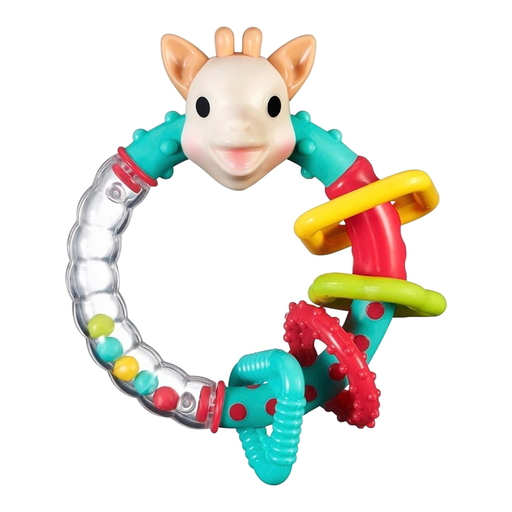
Why this product suits this profile: This model combines rattle and teething functions and is stated to be suitable from 3 months. Its varied surfaces and movable rings provide several ways to grip it.
The care instructions are clear: wipe with a damp cloth only, do not sterilise at high temperatures and do not clean in the dishwasher. This helps avoid unrealistic hygiene expectations.
Four movable rings, colourful balls and hard and soft surfaces; approximately 9 cm in size according to the product details.
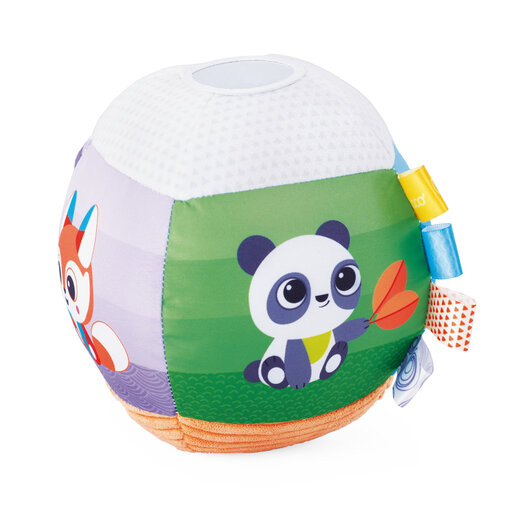
Why this product suits this profile: This textile ball is aimed at families looking for a toy that combines different surfaces, sounds and attachment options.
The product details provide specific care and battery information. Before buying, check the inconsistent age labelling on the product page and packaging.
Different textiles, hanging elements, sounds when moved and a removable battery compartment; batteries included according to the product details.
Before each use, briefly check a baby ball for cracks, loose seams, damaged attachments and leaking fillings. With electronic learning toys for babies, the battery compartment and batteries should also be checked. Batteries should not be accessible and must be removed immediately if there is visible damage or leakage.
Dry, clean places are suitable for storage. A baby bath toy should be dried after water play in accordance with the care instructions. Do not use aggressive cleaning products unless the manufacturer has expressly approved them.
If you are looking for baby toys to support motor skills, you should also observe your child’s activity: at first, feeling and grasping are often the main focus, followed later by shaking, rolling and crawling after the toy. Play should be voluntary and supervised.
We have put together a complete, regularly updated list of products that fully meet these strict selection criteria and the safety regulations applicable in the EU.
That depends on the individual product. According to the manufacturer, some models are intended from 3 months, while others are only suitable from 6 months. The age recommendation, safety warnings and the child’s abilities are always decisive. As a general rule, a baby ball should only be offered under supervision.
Only if the manufacturer states that it is suitable for use in water. “Waterproof” does not necessarily mean that the ball may be fully submerged. Use the ball only in shallow water and remain within close reach of the child at all times.
That depends on the play features and the child’s development. A model with movable parts, different textures or sounds can appeal to children at various stages of play. Nevertheless, check its condition regularly and replace the toy if it is damaged.