Households stocking up on rice cakes
If you mainly want to keep rice cakes on hand as a snack for adults, consider the pack size alongside how much you actually eat. A large pack is of little use if the opened rice cakes are left uneaten.


A plain pack of rice cakes can be a practical choice for adults, as long as the quantity suits how much your household gets through. If a baby or toddler will be eating them too, check the age guidance and ingredients on the specific pack: rice cakes for children aged eight months and over are not suitable for a newborn. The German Federal Institute for Risk Assessment and the consumer advice centre also recommend not relying on rice products as the only grain food for young children.
If you mainly want to keep rice cakes on hand as a snack for adults, consider the pack size alongside how much you actually eat. A large pack is of little use if the opened rice cakes are left uneaten.
For young children, a standard rice cake is not automatically the same as a product labelled for a specific age. The Lower Saxony State Office for Consumer Protection and Food Safety points to rice cakes with different age recommendations; the consumer advice centre recommends offering a variety of grains.
Plain, salted and sesame varieties can have different recipes and allergen information. If you need to avoid certain ingredients, check the label on the pack you choose, even if the front looks simple.
First, decide who will be eating the rice cakes. Then you can choose a suitable pack size, ingredients and portion format.
| Criterion | What to check when buying | Who it matters to |
|---|---|---|
| Pack size | Compare the pack weight with how much you expect to eat after opening. | If I want rice cakes within easy reach for the adults, I need a pack we can finish before they lose their crunch. Around 33% of consumers put this kind of stock planning first. |
| Suitability for young children | Read the age guidance and serving instructions on the specific pack, and include other grains in their diet. | If my young child will be eating them too, it matters more to me that the age guidance is right and rice isn’t the only grain they eat. For around 27% of consumers, this is their top priority. |
| Ingredients and allergens | Check the ingredients list, highlighted allergens and ‘may contain’ warnings. | If we need to avoid certain ingredients at home, the word ‘plain’ doesn’t tell me everything about the recipe. Around 20% of consumers prioritise ingredients and allergens. |
| Portions and varieties | Check the total weight, number of portions and ingredients in your chosen variety. | When I’m out and about, I want to be able to take individual portions with me; at home, a standard pack may be enough. For around 20% of consumers, portion size or choice of variety comes first. |
The number of bags doesn’t tell you how many rice cakes the pack contains altogether. So you can’t judge small portions and standard packs by the number of packs alone.
Compare the total weight and think about how much you’ll actually eat once the pack is open.
Products for young children have their own age guidance. The German Federal Institute for Risk Assessment also notes that rice products can contain comparatively high levels of inorganic arsenic.
Check the age guidance and serving instructions, and don’t rely on rice products as the only grain food for babies and toddlers.
For example, the gluten-free organic rice cake described by REWE contains sesame. A plain variety may also carry a ‘may contain’ warning.
Check the ingredients and allergen information on the pack for every variety you choose.
The rice cakes on offer may vary depending on the shop or delivery area you select.
Check the variety and pack size you want for your specific shop.
EDEKA describes a plain, unsalted rice cake in a 135-g pack, as well as a sea salt variety.
REWE offers a range that includes rice cakes and mini rice cakes in different varieties.
ALDI Nord stocks organic rice cakes in 135-g packs, with or without sea salt, as well as a separate mini variety for children aged eight months and over.
Kallo describes mini rice cakes with dark chocolate, supplied in a format containing four snack packs.
SupermarktCheck lists rice cakes as part of Lidl’s range.
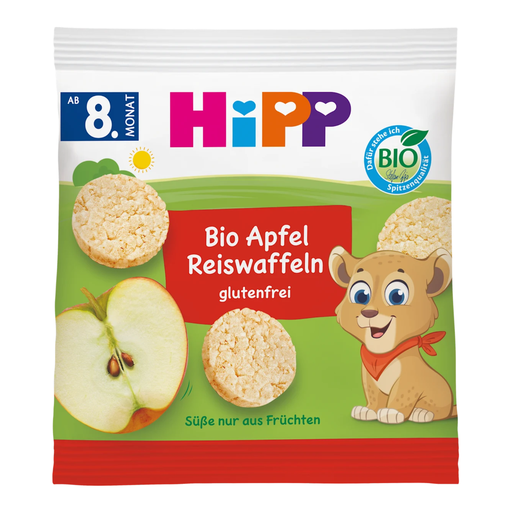
This section focuses on age-labelled rice cakes for children aged eight months and over. They are not intended for newborns; as a stock-up option for adults, the 30-g pack is not comparable to a standard pack.
 No image available
The age guidance makes this 30-g pack a relevant choice for a snack for children aged eight months and over, but not for a younger baby. Supervise your child while they eat, and don’t give them rice cakes while they’re lying down. Check the ingredients and allergen information on the pack before buying.
Rice products shouldn’t be the only grain food in a baby or toddler’s diet. The German Federal Institute for Risk Assessment notes that rice products may contain inorganic arsenic, while the consumer advice centre recommends offering a variety of grains. If you choose rice cakes, also make sure the age guidance is appropriate.
A larger pack is a good choice if your household is likely to finish it after opening. Compare the total weight rather than just the number of individual portions, and follow the storage instructions on the pack.
No. What matters is the ingredients list and ‘may contain’ information on the specific pack. EDEKA warns that its plain rice cakes may contain traces of sesame; the organic rice cake described by REWE contains sesame and may contain traces of milk and soya.
Store rice cakes in a dry place and follow the instructions on the relevant packaging. REWE also advises keeping one plain variety away from heat; once opened, an airtight container can help keep the rice cakes crisp.