
Lieferung heute & morgen

Qualitätsgarantie

Willkommens-Angebote freischalten: KOSTENLOSE Lieferung | Bis zu 80 % RABATT | Kostenlose 30-Tage-JoyPlus-Testphase
App herunterladen
A baby soft play course can make crawling, reaching, balancing and early climbing fun. But when you’re choosing one, colourful looks aren’t the only thing that matters. For parents, childminders and early years settings, materials, design, age guidance and supervision matter more than marketing claims about supposed developmental benefits.
“Soft” doesn’t automatically mean suitable for babies. Check whether the manufacturer specifies the material, such as EPE foam or EVA foam. You’ll also want details about the surface, cleaning, odour and whether there’s a cover. Without this information, it’s hard to know how to care for the course day to day.
A small course can look much bigger in product photos than it will in your living room or playroom. Check the dimensions of each piece and whether the blocks can be used side by side, stacked or arranged as a ramp. For smaller homes, a modular set is more practical than a fixed climbing frame.
A foam activity module isn’t automatically safe for children to use without supervision. Edges, changes in height and the risk of slipping need to be appropriate for your child’s motor skills. Before buying, check the age recommendation, warnings, manufacturer information and product compliance details. Babies and toddlers must be supervised by an adult.
EPE foam blocks are typically lightweight and retain their shape well. EVA foam is also commonly used for soft play and movement equipment. However, the material name alone isn’t enough to assess a product’s safety. The quality of construction, surface, any seams or coatings, and the manufacturer’s information all matter.
For everyday use, also check:
Four pieces are enough for a simple setup with a ramp, platform or short crawling route. Five pieces offer more ways to build a course, but they also take up more space. For a soft play course for toddlers, the number of pieces matters less than whether you can arrange the modules in an age-appropriate and stable way.
Avoid building high structures if your child isn’t yet confident at climbing. Set up the course on a level, non-slip surface, away from furniture edges, radiators and stairs.
Store foam pieces in a dry place and check them regularly for cracks, loose parts, deformation and surface damage. How long they last depends on how often they’re used, the weight they bear, and how they’re cleaned and stored. A course in a nursery group will get more use than one in a family home. If you’re buying for a setting, ask about an easy-to-follow cleaning and inspection routine.
Don’t buy a product solely because it carries the CE marking. Read the product information and warnings, and check the details of the responsible manufacturer. The CE mark isn’t a quality label; it indicates that the manufacturer has declared the product complies with the relevant EU requirements.
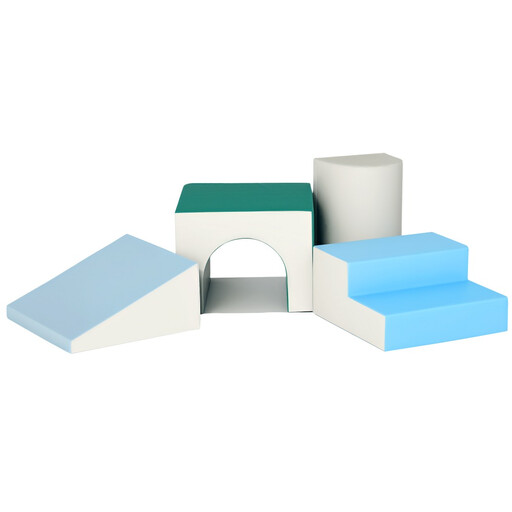
Why it suits this need: This four-piece EPE foam set is a good option for families looking for a manageable introduction to modular baby activity toys.
The material and number of modules are clearly stated. Even so, check the dimensions, warnings and cleaning instructions before use.
Four separate EPE foam pieces in a colourful, modular design that allows for different layouts.
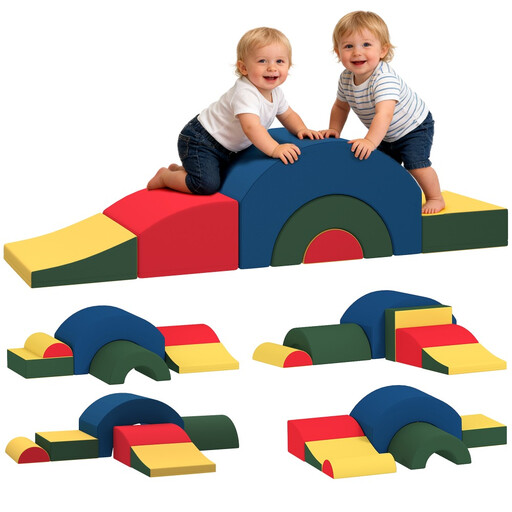
Why it suits this need: This five-piece EVA set gives you more blocks to create different courses at home, at a childminder’s or in a playroom.
The modular set-up means you aren’t limited to one fixed layout. Still, check that each arrangement is stable and that you have enough space.
Five EVA foam pieces, with the product title indicating that the set is suitable for use at home or in early years settings.

Why it suits this need: This fabric activity book complements a soft play course, encouraging fine motor skills in children aged 1 to 3.
It’s presented as a separate addition for quiet play and fine motor activities, not as a replacement for climbing and movement toys.
A 15-in-1 felt activity book with zips, laces, buttons and hook-and-loop fasteners, according to the product description.
We’ve put together a complete, regularly updated list of products that fully meet these strict selection criteria and the safety regulations in force in the EU.
It depends on the specific age guidance and design of the set. For babies, choose low pieces that won’t tip over easily. Climbing or balancing structures are only suitable once your child can manage those movements safely. Always supervise your child closely while they use the course.
Start by following the manufacturer’s care instructions. You can often clean the surface with a slightly damp cloth. Don’t use harsh cleaning products unless their suitability is specified, and let the foam pieces dry completely before using or storing them again.
There’s no reliable way to give a set lifespan. It depends on the material, how heavily the course is used, and how it’s cleaned and stored. In settings where the pieces are used every day, check them more often for cracks, deformation and loose parts. Stop using the product if you notice visible damage or unstable pieces.