
Lieferung heute & morgen

Qualitätsgarantie

Willkommens-Angebote freischalten: KOSTENLOSE Lieferung | Bis zu 80 % RABATT | Kostenlose 30-Tage-JoyPlus-Testphase
App herunterladen
When a baby or toddler has a fever, fast and reliable temperature readings are crucial. However, the market for thermometers is overwhelming and filled with products that over-promise and under-deliver. As your Joybuy Product Recommendation Officer, I'm here to help you distinguish essential features from unnecessary ones and find a device that truly meets your family's needs.
Many parents invest in a device that proves to be impractical or inaccurate when it matters most. You should be aware of three common pitfalls:
To avoid a bad buy, focus on the technical fundamentals. Three core aspects determine the reliability and real-world usability of a children's thermometer.
Choosing the right technology is the first fundamental decision. Each method has specific pros and cons, especially when it comes to taking a baby's temperature.
A reliable thermometer for children should have high, clinically validated accuracy. Look for specifications on measurement tolerance (e.g., ±0.2°C). Some advanced devices also offer age-based temperature interpretation. Since the definition of a fever varies by age (0–3 months, 3–36 months, 36+ months), a colour-coded display (e.g., green, yellow, red) based on the selected age group can provide valuable guidance.
A good digital thermometer is distinguished by features that simplify daily life, not complicate it.
Based on these objective criteria, we have identified several models that are well-suited for different family needs.
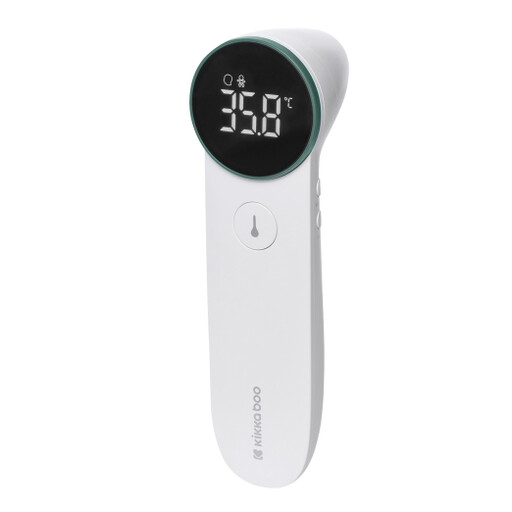
Why This Fits Their Persona: Ideal for parents who want a single device for multiple types of measurements. It combines forehead, ear, and object modes (e.g., for bathwater or milk bottles), making it a practical all-rounder for the entire household.
It doesn't require expensive disposable probe covers and combines multiple functions in one device, eliminating the need to buy separate thermometers and reducing complexity.
3-in-1 measurement modes (forehead, ear, object). Silent mode for taking readings from a sleeping child. Automatic mode switching via a magnetic cap.
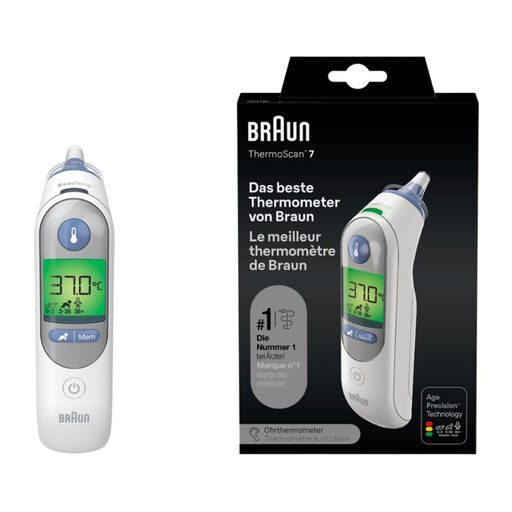
Why This Fits Their Persona: For parents who prioritise clinically validated precision. Eardrum measurements are considered highly reliable, and the Braun brand is renowned for its medical technology.
The pre-warmed tip and the ExacTemp positioning system minimise user error and actively counter the inaccuracy trap. Its operation is focused on the essentials.
Age Precision technology for age-appropriate fever interpretation. Pre-warmed tip for greater accuracy. Colour-coded display for quick assessment.
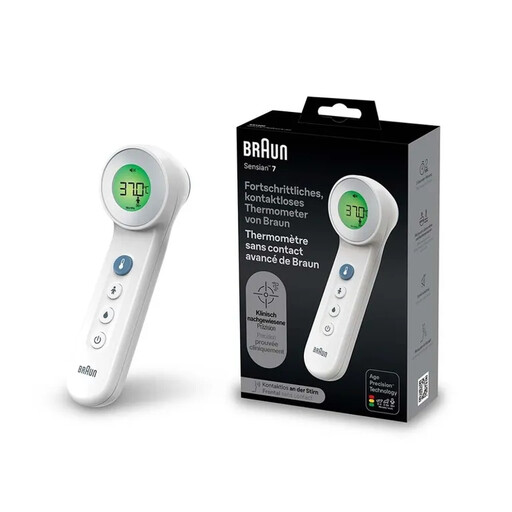
Why This Fits Their Persona: Perfect for parents who want the fastest and least disruptive measurement possible. The no-touch technology and silent mode are ideal for checking a temperature without waking or disturbing the child.
The PositionCheck technology, with its light and proximity sensor, guides the user to the correct position, reducing the risk of measurement errors common with basic contactless devices.
Dual technology (no-touch or with skin contact). PositionCheck system for correct application. Also measures liquids and food.
We have compiled a complete, up-to-date list of products that fully meet these strict selection criteria and all relevant safety standards.
The measurement probe or sensor is the most sensitive component. Clean it carefully with a soft cotton swab lightly moistened with medical-grade alcohol (70% isopropyl). The housing can be wiped with a soft, dry cloth. Never submerge the device in water or use abrasive cleaning agents.
Many manufacturers state that their ear thermometers can be used from birth. However, a newborn's ear canal is often very narrow, which can make it difficult to position the probe tip correctly. Some paediatricians recommend rectal measurement as the reference method for the first few months of life, switching to an ear thermometer from around 6 months of age. Always follow the specific manufacturer's instructions.
It is normal for measurements taken at different body sites to vary slightly. The temperature in the ear (near the eardrum) is typically slightly higher and closer to the body's true core temperature than the temperature measured on the surface of the forehead. Forehead temperature can also be influenced by external factors like room temperature or sweat. The key is to always measure at the same location to get a meaningful temperature trend.