
Lieferung heute & morgen

Qualitätsgarantie

Willkommens-Angebote freischalten: KOSTENLOSE Lieferung | Bis zu 80 % RABATT | Kostenlose 30-Tage-JoyPlus-Testphase
App herunterladen
The choice of baby and toddler toys ranges from simple grasping toys to electronic activity centres. However, not every brightly advertised product is automatically suitable for parents, grandparents and carers. Small details often determine whether a toy remains practical for everyday use or ends up unused in the cupboard after a short time.
Illuminated buttons, melodies and moving elements may seem appealing. However, the key question is whether the child can use these features at their current stage of development. A toy labelled as suitable from 1 year does not automatically suit a baby who is only just learning to grasp objects securely or sit unaided.
You should therefore check the specific age recommendation, the child’s physical development and the intended stage of use. A baby play gym is used differently from a baby activity table or a baby walker.
Terms such as ‘non-toxic’, ‘safe’ or ‘BPA-free’ should not be the only basis for your decision. You should also check:
For some of the products in this selection, the manufacturer’s information refers to CE and EN 71. This is product information and does not replace checking the specific item, its packaging and the instructions for use.
Baby musical toys and interactive toys from 1 year often require batteries. When buying, you should therefore check whether batteries are included, how many are required and whether the volume can be adjusted. For fabric elements, removable and washable parts are helpful in family life. Plastic surfaces should be easy to clean with a damp cloth.
For babies from 0 months, a play gym, a play mat or a simple sensory toy may be suitable. Products designed for tummy time should lie securely on the floor and must not be attached to raised surfaces unless this is expressly intended.
From around 6 months, grasping, turning and sound elements may become interesting. According to the product description, an activity table with detachable legs can initially be used as a floor play panel and later as a table. Once a child can stand securely, a baby walker or a push-and-sort toy may be suitable, depending on the model.
ABS plastic, painted wood, polypropylene and textiles have different care requirements. It is not just the material description that matters, but also:
For a ride-on toy for children, you should also observe the permitted load and use on level ground. A product without a brake is not designed for stairs, slopes or road use.
Electronic learning toys for toddlers can demonstrate cause-and-effect relationships: the child presses a button and hears a sound or sees a light. Volume control and an off function make them easier to use at home, when travelling or during quiet times.
Multiple features are only useful if the child can reach them independently. Less complex baby motor-skills toys with rotary knobs, sliders or flaps may be more suitable for short, focused play sessions than a product with numerous signals.
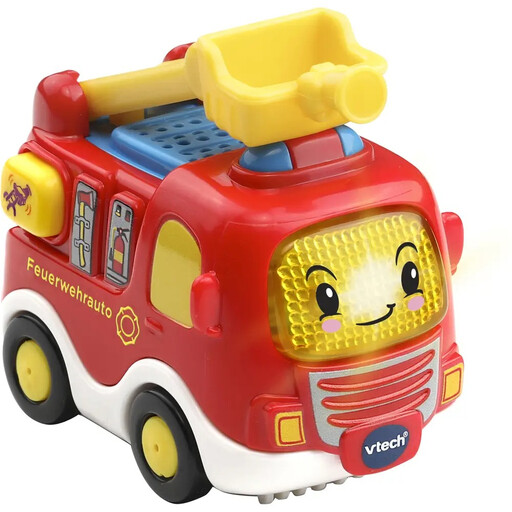
Why this product suits this profile: According to the manufacturer, this compact vehicle is designed for children from 1 year and requires two AAA batteries, which are included. It is ideal for families looking for a handy musical toy with a vehicle theme.
The age recommendation, battery requirements and warning for children under 1 year are clearly stated in the product information.
Lights, sounds, three songs and six melodies; a movable turntable ladder and compatible Magic sensors.
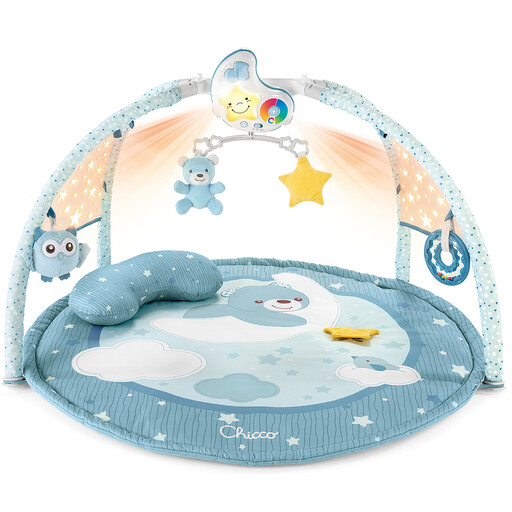
Why this product suits this profile: The combination of play mat, cushion, hanging toys and detachable projector is ideal for households looking to bring together a range of play options for babies from birth in one set.
A timer with 15- or 30-minute settings, together with the machine-washable mat and cushion, makes use and care more straightforward.
An 83 cm play mat, three light and melody modes, plus a detachable projector with a night-light function.
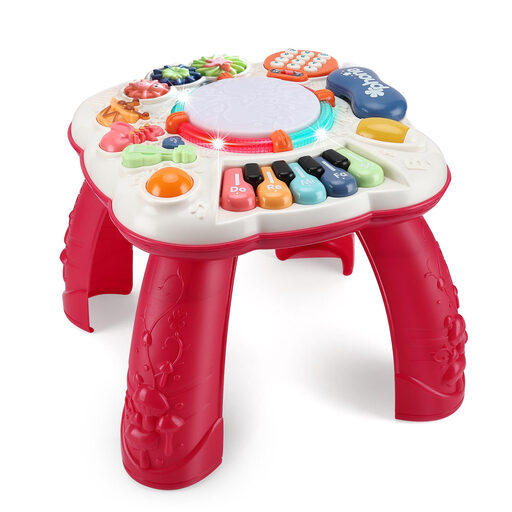
Why this product suits this profile: According to the seller, the 2-in-1 design can initially be used as a floor play panel and later as an activity table. It is an appealing choice for families looking for a versatile sensory toy for several stages of development.
The six play areas are clearly specified, while volume control and mute functions are also listed. Batteries are not included.
A piano, drum, telephone, gears and instrument buttons in one product; stated usage range of 6 to 36 months.
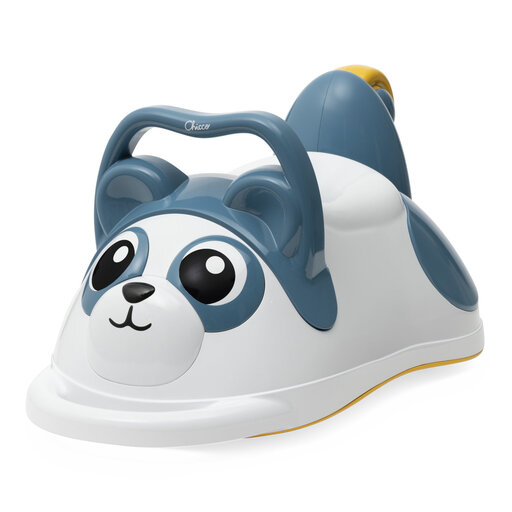
Why this product suits this profile: This model combines a ride-on toy, shape sorter and wheelbarrow function. According to the product information, it is designed for children aged 12 to 36 months and suits families with changing play interests.
The three configurations and their respective age ranges are specified. Important safety points remain: there is no brake, it must not be used on slopes and it is for supervised use only.
Convertible design, seat, storage space and a stated maximum load of 20 kg.
For more products related to movement and outdoor play, it is also worth taking a look at garden toys from 1 year.
We have put together a complete, regularly updated list of products that fully meet these strict selection criteria and the safety regulations applicable in the EU.
From 1 year, simple vehicles, motor-skills toys with rotary and sliding elements, activity cubes or a suitable baby walker may be considered. The specific age recommendation, stability and the child’s ability to sit, stand or walk safely are the key factors.
This depends on its construction and age range. A product with several positions for use may remain interesting for longer than a toy with just one function. Check the connections, wheels, seams, battery compartment and surfaces regularly. Damaged parts should not be used any further.
Look for adjustable volume, an off function and a protected battery compartment. Batteries should be inserted correctly and removed if the toy will not be used for an extended period. Adult supervision is still required, even with musical toys.