
Lieferung heute & morgen

Qualitätsgarantie

Willkommens-Angebote freischalten: KOSTENLOSE Lieferung | Bis zu 80 % RABATT | Kostenlose 30-Tage-JoyPlus-Testphase
App herunterladen
Baby toys for 1-3 year olds should keep curious little ones entertained, encourage independence, and remain practical for everyday life. With flashing buttons, music functions and Montessori promises, it’s not always immediately clear which product truly suits the child, your living situation and the intended use.
That’s why the Joybuy Product Recommendation Officer has filtered out the most important selection criteria, showing what parents and family members should look out for before making a purchase.
A toy with lots of buttons and sounds may seem versatile at first glance. What really matters, however, is whether the features are easy for a child aged 1 to 3 to reach and understand. If the controls are too small, too stiff, or only work through complicated button combinations, the product often becomes uninteresting after a short time.
What works well are clearly recognisable activities such as turning, pressing, pushing, tapping or simple role play. These movements can be tried out without lengthy explanation.
“Suitable for toddlers” is not sufficient information. Pay attention to the specific age rating as well as warnings about small parts, batteries and the need for supervision. A product labelled from 12 months is not automatically right for every child between 1 and 3 years old.
Body size and stability also play a role. A baby activity table should stand securely, while a cube or a small motor skills toy for babies should be easy to grip and carry.
Musical baby toys and interactive baby toys often require batteries. Before buying, you should check whether batteries are included, what size is needed, and whether the volume can be adjusted. A missing volume control can be impractical in a flat, a restaurant or while travelling.
With electronic products, the battery compartment must be securely fastened. Batteries should be kept out of children’s hands and removed if the toy is not used for a long time.
The age recommendation on the product page and packaging is a key point to check. In addition, parents should verify:
For products with small accessories, the manufacturer’s instructions are decisive. Even a seemingly sturdy toy should not be used if parts are loose, broken or have sharp edges.
With plastic toys, ABS, BPA-free materials and rounded edges are often mentioned. These details should be clearly stated in the product description or on the packaging. A CE mark is important, but it does not replace checking the age recommendation, build quality and warning labels.
For everyday life in British households, cleaning is also relevant. Smooth surfaces are usually easier to wipe down with a damp cloth. Electronic components must not be submerged in water. Fabric elements should be cleanable according to the care instructions provided.
A compact activity cube measuring 23 × 23 × 24 cm is better suited for the floor, a table or travel. A play table, on the other hand, needs enough floor space and should stand on a level surface. Walk-along products like the Chicco Happy Hippy Walker require an obstacle-free environment and are not intended for stairs, sloping surfaces or narrow doorways.
Sensory toys don’t have to be electronic. Gears, sliders, spinning surfaces, textured elements and role-play also offer a variety of sensory and movement experiences.

Why this product fits the profile: The compact activity cube combines eight play areas on a footprint of 23 × 23 × 24 cm, making it ideal for smaller homes or on the go.
The functions aren’t limited to a single type of play: piano, guitar, telephone, gears and a windmill offer a variety of manual activities.
ABS plastic, rounded edges and an integrated carry handle. According to the product details, the model is intended for ages 1 to 3.
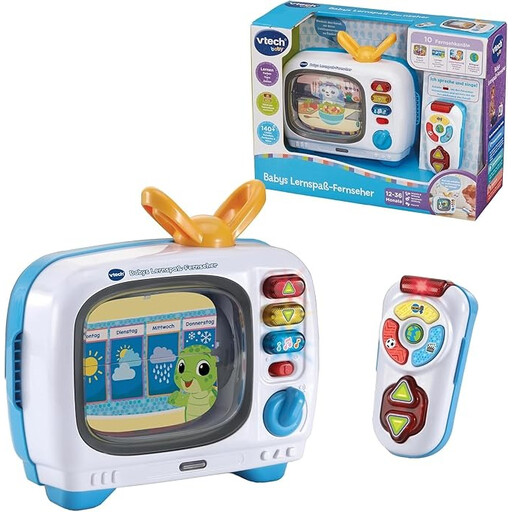
Why this product fits the profile: This electronic learning toy combines lights, music, animal sounds, buttons and turning functions in one clearly defined device.
The age rating from 12 months is clearly stated. At the same time, the product information notes small parts and the need for supervision.
Dimensions of 13.3 × 32.5 × 24.1 cm, weight of 930 g and runs on two AAA batteries; batteries are reportedly included.
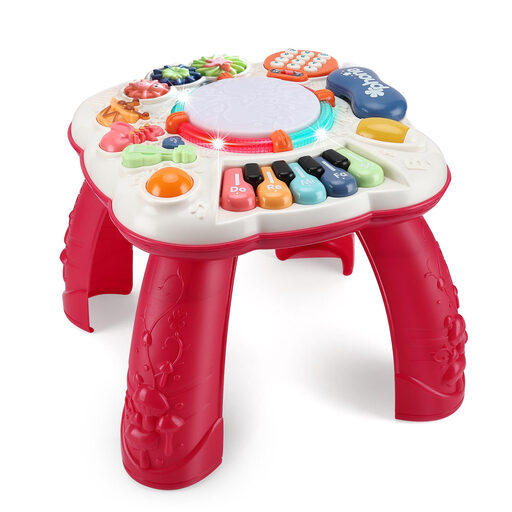
Why this product fits the profile: The baby activity table offers six play areas and, according to the product description, can be used as a floor play mat with removable legs.
A stated volume control and a sleep mode help adapt the music functions to your living situation. Batteries are not included.
ABS plastic, rounded edges, six play zones and an age range of 6 to 36 months according to the product details.
We’ve put together a full, regularly updated list of products that fully meet these strict selection criteria and the safety regulations in force in the EU.
Products with intuitive movements and easy-to-reach controls are a good choice. Activity cubes, simple motor skills toys, sorting games and play tables can encourage independent exploration. Parents should still stay nearby and check safety regularly.
The lifespan depends on the material, build quality, the child’s interest and how well it’s looked after. A toy with several different types of play can stay interesting for longer than a product with just one function. Electronic models also require checking the battery compartment and that everything is working properly.
The ongoing costs mainly come from batteries. Before buying, check the battery type, whether batteries are included, and whether the product has an automatic shut-off or a sleep mode. For frequent play, rechargeable batteries can be a practical option, provided they are suitable for the device.