
Lieferung heute & morgen

Qualitätsgarantie

Willkommens-Angebote freischalten: KOSTENLOSE Lieferung | Bis zu 80 % RABATT | Kostenlose 30-Tage-JoyPlus-Testphase
App herunterladen
Baby toys should be enjoyable, safe and suited to your child’s stage of development. However, bright colours, numerous features and terms such as “educational toy” or “Montessori” alone reveal little about how practical a toy will be in everyday life. Before buying, parents, grandparents and other family members should therefore check whether the toy is suitable for the child’s age, environment and abilities.
Some products are advertised for several age groups, even though certain features only become useful or safe much later. For example, a toy with small parts is not suitable for babies simply because it is described as being “for toddlers”. The specific age recommendation, safety warnings and intended use are what matter.
Lights, music, sensors and numerous buttons may seem versatile at first glance. For younger babies, however, simple activities such as grasping, touching, shaking and observing are often enough. For electronic baby toys, you should also check the battery type, volume control, automatic switch-off and cleaning options.
Wooden toys for babies can be robust, but they require regular checks. Flaking, splinters, loose buttons or damaged paintwork are reasons not to use a toy. Information such as FSC-certified wood refers to the origin of the timber; it does not replace checking the individual product before play.
A baby teether or rattle for babies should sit comfortably in the hand and be free from small parts that can come loose easily. For toys with buttons, balls or removable elements, the rule is simple: the recommended minimum age must be followed. Regular visual checks are also sensible, even for suitable products.
For baby toys from 12 months, simple inserting, sorting and puzzle activities may be suitable. A wooden children’s puzzle should be designed so that the pieces are easy to grasp. Small handles can make them easier to use, while rounded edges may reduce the risk of injury during normal use.
Look for:
Electronic products must not be immersed in water unless the manufacturer expressly allows this. Textile toys are more practical when covers or battery compartments can be removed for cleaning.
A baby activity centre or play arch requires sufficient floor space and a level surface. For smaller homes, compact motor-skill toys, teethers or shape-sorting puzzles may be more suitable. For baby walkers and push-along toys, you should also check the brakes, locks, wheels and whether they are suitable for use on uneven surfaces.
“Helps develop motor skills” is not, by itself, a general mark of quality. The specific play activities are objectively verifiable: grasping, inserting, sorting, shaking, pressing or pushing. These activities can usefully complement toys for developing fine motor skills, but they do not replace age-appropriate supervision and unrestricted movement.
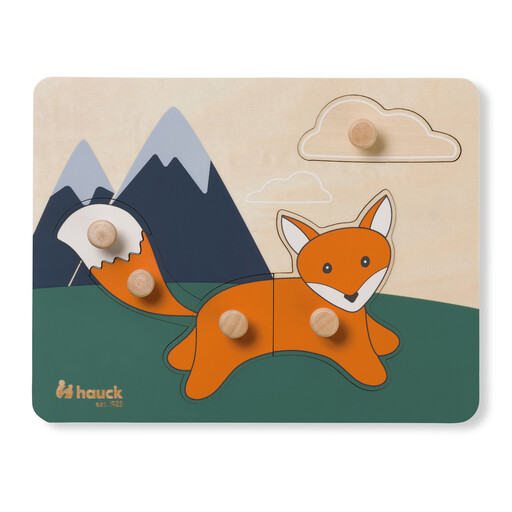
Why this product suits this profile: According to the product information, this compact wooden puzzle is designed for children from 12 months and offers a clear matching activity without additional electronic features.
The recommendation for children from 12 months and the manageable number of pieces make it easier to choose. The pieces and surface should be checked before every use.
FSC-certified wood, animal design, grasping knobs and compact product dimensions of 22 × 17 × 2 cm according to the product description.
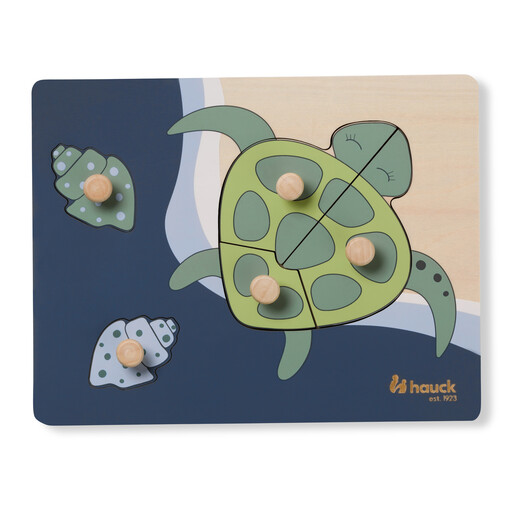
Why this product suits this profile: This motor-skills toy combines shape matching with a multi-piece animal design, making it suitable for families who value a clearly defined way to play.
The stated suitability from 12 months distinguishes this product from toys for younger babies. The handles help children remove and insert the pieces.
FSC-certified wood, rounded design and stated dimensions of 22 × 17 cm.
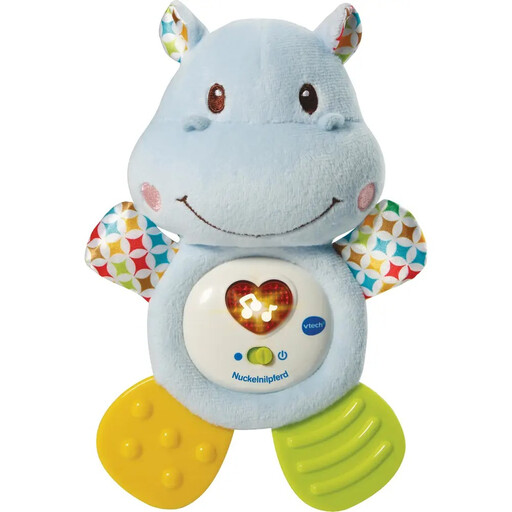
Why this product suits this profile: According to the product information, this toy is designed for babies from birth to around 2 years and combines soft, textured materials with sound and light features.
According to the product description, it features volume control, automatic switch-off and a child-safe battery compartment. Supervision is still required.
Two soft teething feet, different textures, three sung songs, ten melodies and volume control according to the manufacturer.
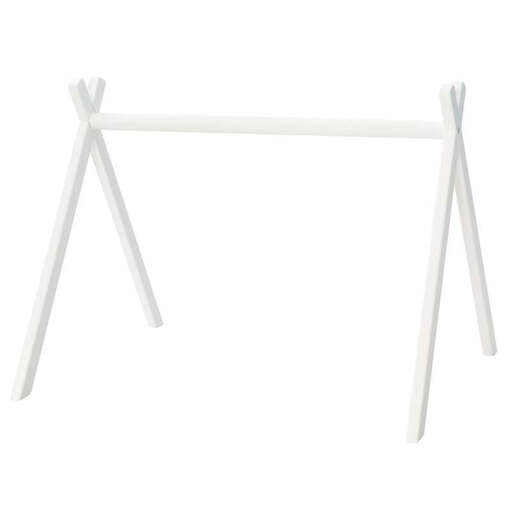
Why this product suits this profile: This play arch is an interesting option for families who want to create a dedicated play area for grasping, observing and exploring.
It must be used on a level, flat surface. Stability, fastenings and any signs of damage should be checked before each use.
Painted wood, wipe-clean surfaces, simple assembly and dimensions of 52 × 70 × 50,5 cm according to the product information.
We have put together a complete, regularly updated list of products that fully meet these strict selection criteria and the safety regulations applicable in the EU.
The term Montessori toy is not a consistent safety or quality standard. What matters is the specific construction, material information, recommended age and the way the child plays with it.
Products without loose small parts, with clearly visible shapes and easy-to-grasp surfaces are suitable for newborns. Electronic toys should have controllable volume. Toys should not be left unsupervised in sleeping environments.
The usable life depends on the recommended age, materials and condition. A wooden puzzle from 12 months may remain interesting for longer if the activities match the child’s stage of development. Edges, connections, paintwork and small parts should be checked every time the toy is used.
Care depends on the material and the manufacturer’s instructions. Wood is generally wiped with a dry or slightly damp cloth and should not be soaked. Electronic components must not get wet. Textile products should only be machine-washed if this is expressly stated.