
Lieferung heute & morgen

Qualitätsgarantie

Willkommens-Angebote freischalten: KOSTENLOSE Lieferung | Bis zu 80 % RABATT | Kostenlose 30-Tage-JoyPlus-Testphase
App herunterladen
Baby toys need to be age-appropriate, safely made, and genuinely useful in everyday life. Many purchasing decisions fall short not because of the price, but due to unclear age guidance, missing cleaning details, or features that aren't yet suitable for the child.
Lights, music, buttons and moving parts can seem versatile at first glance. However, for babies, an overloaded toy can be confusing. What matters is whether the features match the developmental stage: grasping, pressing, turning, sorting or crawling should be achievable in a straightforward way.
A sensory baby toy with a few clear reactions can be more beneficial for younger children than a product with numerous modes that only become understandable in toddlerhood.
"For babies and toddlers" is not enough guidance. A toy with small parts must not be suitable for children under three, while a product from six months onwards has different requirements for size, stability and operation.
Pay attention to:
Statements like "non-toxic", "safe" or "educational" should not be the sole deciding factor. Instead, check the material details, workmanship, warnings and labelling. For products in the range, materials such as ABS plastic or EVA foam are specified. Whether a product is right for your child still depends on age, usage and regular inspection.
For newborns, simple grasping and sensory elements without loose parts are ideal. A learning toy for babies from around six months may include additional pressing, turning or sorting functions. From the first birthday onwards, activity cubes, musical instruments and role-play toys become more interesting. Toys with small parts, such as certain cutting or building sets, should only be used from the specified minimum age.
The age rating is a guide and does not replace observing your child. If a baby regularly puts objects in their mouth, only sufficiently large and robust parts should be available.
Check that the surface is smooth and free from burrs, cracks or sharp transitions. For plastic toys, details such as ABS, BPA-free and rounded edges are relevant product information. However, these should always be cross-referenced with official labelling and safety instructions.
For a baby play mat, also consider:
The EVA puzzle mats on offer consist, according to the product description, of six square pieces with edge borders. Before first use, it is advisable to air them out and clean them according to the manufacturer's instructions.
Musical toys should have an adjustable volume or at least an easily accessible on/off function. Battery-operated products need a securely closed battery compartment; batteries are not included with several of the products mentioned.
Cleaning also affects everyday practicality. A foam play mat can usually be wiped clean. With electronic parts, no liquid should enter the housing or battery compartment. Textile components should be washed according to the care instructions.
The following recommendations do not rank the products in a general order, but rather by age, space requirements and desired style of play.
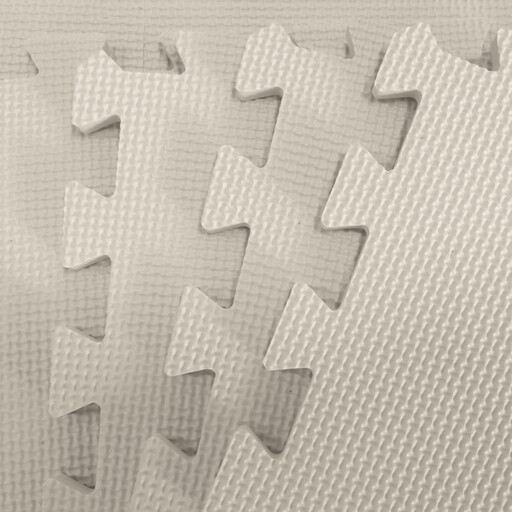
Why this product fits the profile: The six EVA foam pieces create a clearly defined play area for floor activities, crawling practice and early sorting games. The mats can be connected without tools and taken apart again when needed.
Instead of many briefly-used features, the mat offers a flexible foundation for various floor activities. The surface can be wiped clean.
EVA foam, interlocking system, six square pieces and ten edge borders according to the product description.
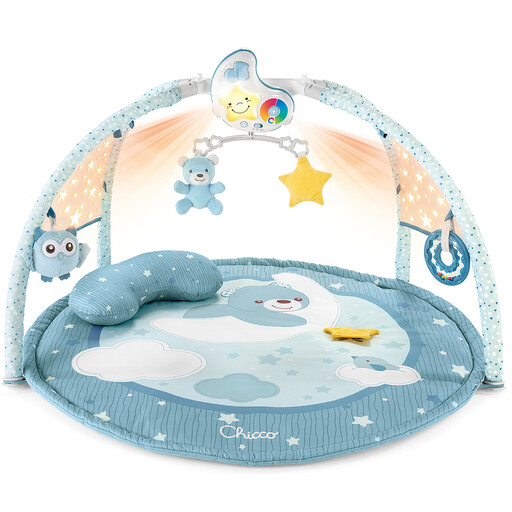
Why this product fits the profile: The 3-in-1 play system combines a round play mat with a cushion, removable play elements and a projector. It is specified for use from birth and is suitable for families looking for multiple functions in one set.
The usage scenarios are more clearly separated thanks to the removable components. Care instructions for the mat and cushion, as well as warnings about the projector and small parts, are provided.
83 cm play mat, removable projector, 15- or 30-minute timer and washable textile parts according to the product description.

Why this product fits the profile: The activity cube combines eight play sides in a compact format. Piano, guitar, telephone function, gears and other elements appeal to families looking for a portable toy for the home, travel or visits.
The age rating of 1 to 3 years distinguishes its use from baby toys for newborns. Before purchasing, parents should consider the small controls and warning notices.
Dimensions of approximately 23 × 23 × 24 cm, carry handle, multiple operation modes, plus ABS plastic and rounded edges according to the product description.
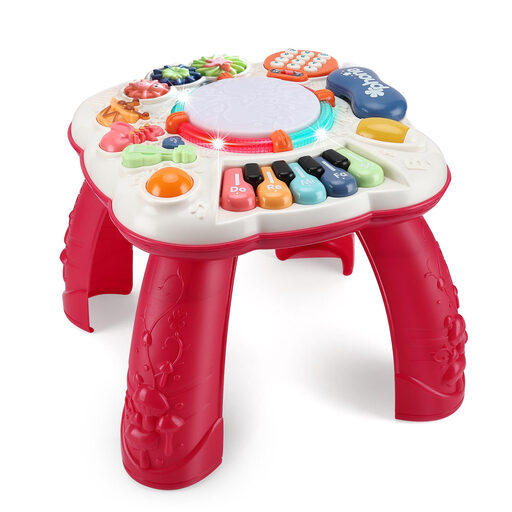
Why this product fits the profile: The baby activity table can first be used as a flat floor play board and later with the legs attached. This allows it to adapt to different play positions.
The removable legs prevent the table from being bought for just a single developmental stage. The volume can be adjusted according to the product description.
Six play areas, removable legs, volume control, plus details on ABS plastic and BPA-free materials.
We have compiled a complete, regularly updated list of products that fully meet these strict selection criteria and the safety regulations in force in the EU.
From six months, grasping, stacking, sorting and simple musical elements are suitable, provided they are specified for this age. A drum toy with shapes, colours and animal sounds can combine different operating movements. Parents should ensure that all parts are sufficiently large and firmly attached.
The duration of use depends on the age rating, workmanship and the child's interest. Products with an adjustable or 2-in-1 design can be used for longer. Nevertheless, every toy should be regularly checked for cracks, loose parts, damaged edges and functional battery compartments.
For a gift, products with a clear age rating that fit the available space are ideal. A baby play mat is comparatively straightforward, while a musical toy requires consideration of power supply and volume. For children from one year old, an activity cube or activity table could be suitable. With sets containing small parts, the age limit must be observed particularly carefully.