
Lieferung heute & morgen

Qualitätsgarantie

Willkommens-Angebote freischalten: KOSTENLOSE Lieferung | Bis zu 80 % RABATT | Kostenlose 30-Tage-JoyPlus-Testphase
App herunterladen
Baby toys should encourage little hands to grasp, shake and explore. At the same time, parents, grandparents and other family members need to check age recommendations, materials, cleaning instructions and any small parts. An eye-catching design alone tells you little about whether a toy is right for a child’s stage of development.
A toy may look like a baby rattle but, according to the manufacturer, may only be suitable for older children. This can apply, for example, to figures with small parts that are sewn on or attached. For products intended for children under 3, the specific age recommendation on the packaging and product page is therefore important.
“Baby toys from 3 months” and “baby toys from 6 months” are not interchangeable categories, either. A 3-month-old baby will usually need lightweight shapes that are easy to grasp. From 6 months, textured surfaces, rolling toys and moving parts may become more engaging.
Rattles, lights, music and moving parts can engage different senses. However, this does not automatically mean that a toy has proven educational or therapeutic benefits. Terms such as baby motor skills toys or baby learning toys often describe how a product is intended to be used, rather than guaranteeing a particular developmental outcome.
So check the details: can your child grasp the toy independently? Can you adjust the volume? Are there any parts that could come loose? Does the toy suit your everyday routine, for example on a play mat, in the pushchair or in the bath?
Fabric toys are handled regularly and sometimes put in a child’s mouth. A baby comforter should therefore have clear care instructions wherever possible. With musical toys and electronic baby toys, the musical mechanism or battery compartment often needs to be removed before washing. Depending on the material, a teething ring may be suitable for cleaning in the dishwasher – but don’t assume that it is.
Check the age recommendation given by the manufacturer and the product dimensions. Lightweight products with easy-to-grasp shapes are a good choice for younger babies. A baby rattle should be neither too heavy nor so small that it could fit entirely into your baby’s mouth.
For rattles and toys attached to a pushchair or infant car seat, it’s also important to make sure that the fastenings are secure. Hanging toys should not be placed in the sleep area, and you should regularly check them for damaged stitching, tears or loose parts.
Material details such as silicone, polyester, plastic or jersey can help you choose, but they don’t replace care and safety instructions. Different textures can encourage little ones to explore by touch. For a teething ring, check how it can be cleaned and whether it is intended for the stated age group.
Products with soft fillings, ribbons, buttons or plastic parts need to be checked visually before each use. If a product is damaged, stop using it.
For electronic toys, battery type, volume control and an off switch are practical points to consider. Battery compartments must stay closed and be inaccessible to children. Mechanical musical toys don’t need batteries, but should still be attached out of reach and checked regularly.
Also compare care instructions: some fabric toys are machine washable, while others can only be wiped clean. A removable electronic unit can make cleaning easier, but it doesn’t mean the toy is suitable for every washing method.
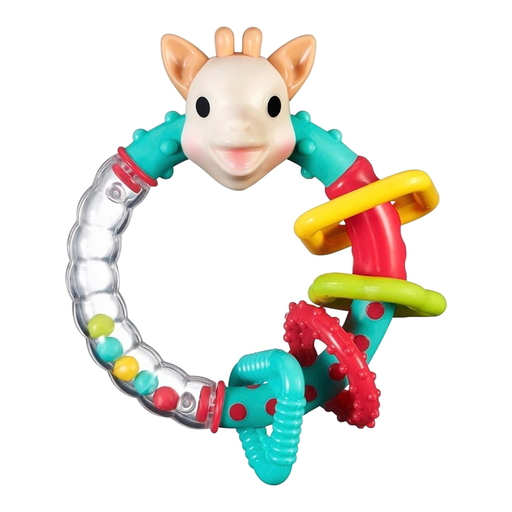
Why this product suits this profile: This combined grasping toy and teething ring is intended for babies from 3 months, according to the product information. It combines a rattle with textured surfaces for touching and teething.
The product description gives the age recommendation, a size of around 9 cm and instructions to clean it with a damp cloth. It is not intended to be cleaned in the dishwasher or at high temperatures.
Four moving rings, different materials, and a combination of rattle and teething features.
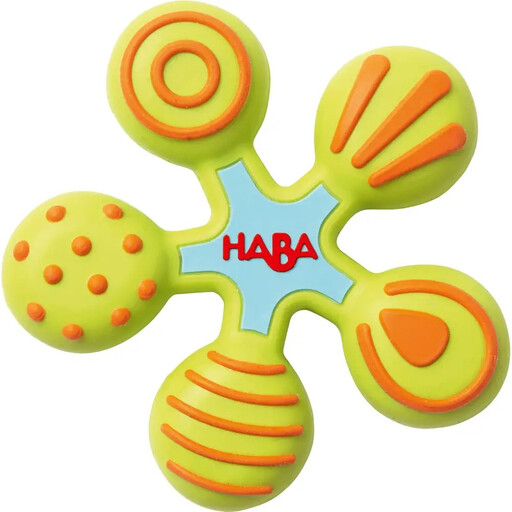
Why this product suits this profile: According to the product information, this silicone toy is suitable from 6 months and has different surfaces for oral and tactile exploration.
The product information specifies the material, approximate dimensions of 8 × 8 cm and suitability for cleaning in the dishwasher. Use should be supervised.
Silicone construction, textured surfaces and a clearly stated age recommendation of 6 months and over.
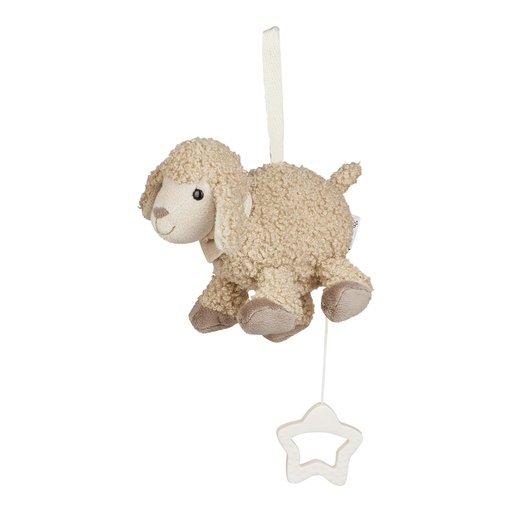
Why this product suits this profile: According to the product information, this mechanical musical toy is suitable from birth. Ribbons let you attach it to a pushchair, infant car seat or baby carrier.
The musical feature doesn’t need batteries. The musical mechanism can be removed using the safety fastening before machine washing.
A mechanical musical mechanism and removable unit, with the plush toy suitable for machine washing at 40 °C according to the care instructions.

Why this product suits this profile: According to the product information, this lightweight ball is suitable from 3 months. It can be used on play mats, in a playpen or, under supervision, in shallow bath water.
The product information advises checking the ball before each use. Do not continue using it if it has cracks or small parts are coming loose.
A lightweight, water-resistant design with a visible duck and confetti inside; ideal for grasping, shaking and rolling.
We’ve put together a complete, regularly updated list of products that meet these strict selection criteria and fully comply with the safety regulations in force in the EU.
Lightweight grasping toys, simple rattles and products with easy-to-reach shapes are suitable choices. Check for a stated age recommendation, sturdy attachments and a size that cannot fit entirely into your baby’s mouth. According to the product information, the Vulli grasping toy in our selection is suitable from 3 months.
It depends on the age recommendation, your child’s stage of development and the condition of the product. A toy can continue to be used as long as it is suitable for your child’s age and undamaged. Regularly check the stitching, ribbons, cracks, battery compartments and detachable parts. If you notice any damage, stop using the toy.
Mechanical rattles, grasping toys and musical toys generally don’t incur battery costs. Electronic baby learning toys and sound-making soft toys, on the other hand, need batteries or rechargeable batteries. There may also be care costs if a product has special cleaning requirements. So, as well as the purchase price, check the power requirements, washability and availability of replacement parts.