
Lieferung heute & morgen

Qualitätsgarantie

Willkommens-Angebote freischalten: KOSTENLOSE Lieferung | Bis zu 80 % RABATT | Kostenlose 30-Tage-JoyPlus-Testphase
App herunterladen
A child's first unsteady steps are an unforgettable milestone. During this phase, a baby walker can be valuable for training balance and promoting mobility. However, the market is overwhelming, and not every model is a worthwhile or safe investment. Many products have design flaws that cause more frustration than joy. As your Joybuy Product Recommendation Officer, I'll help you recognise the common pitfalls and make an informed decision.
Before you decide on a model, you should be aware of the most common problems that often only become apparent in daily use after the purchase.
To avoid these traps, you should focus on a few critical features during your selection. These define the quality and safety of a walking aid.
The most important characteristic of a baby walking aid is its stability. A wooden baby walker often has an advantage here, as the material is naturally heavier than plastic. Look for a wide wheelbase and a low centre of gravity. The construction should be designed so that the walker remains stable even when the child pulls themselves up on the handle with their full weight. All edges must be rounded and the finish free of splinters or sharp edges.
An indispensable feature is an integrated and adjustable braking system. A baby walker with brakes allows you to adapt the rolling resistance of the wheels to the child's abilities. Initially, when the child is still very unsteady, you set the resistance high. As their confidence grows, the brake can be gradually loosened. Rubber-coated wheels are an additional advantage, as they are quieter and protect delicate floors like parquet.
A good baby walker is more than just a support; it is also a baby activity centre and a baby push toy. Instead of relying on short-lived electronic effects, high-quality models foster development through motor skill toys: rotating elements, shape sorters, or small compartments for putting things in and taking them out. Such walkers often remain interesting as toys long after the child has learned to walk, offering more sustainable value.
Here are some models that are suitable for different needs and priorities, based on objective criteria.
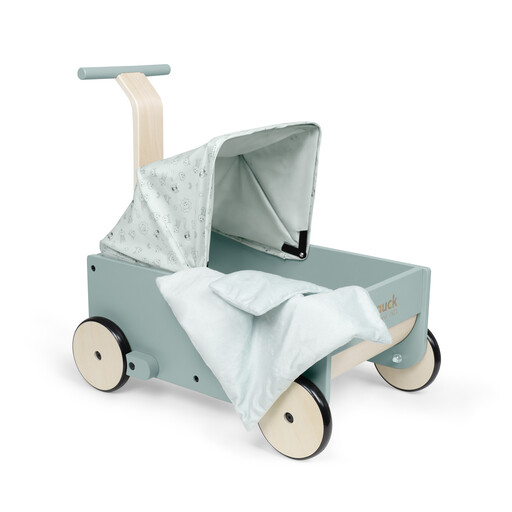
Why It's a Match: Ideal for families who value long-lasting toys. Its dual function as a baby walker and a doll's pram encourages role-playing and ensures it will be used long after those first steps.
According to the manufacturer, the model is made from FSC-certified wood, which ensures stability. The individually adjustable brakes prevent it from rolling away uncontrollably on smooth floors.
The height-adjustable handle (45-49 cm) grows with your child. Rubber-coated wooden wheels protect the floor and reduce noise.
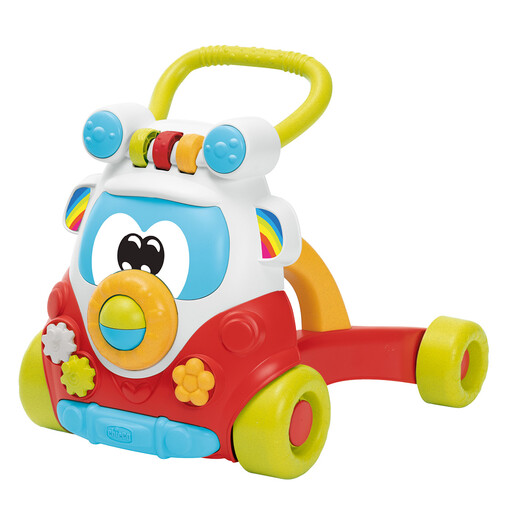
Why It's a Match: This 2-in-1 model combines a walking aid with an extensive, purely mechanical play centre. It's designed for parents seeking targeted fine motor skill development without electronic distractions.
The four large wheels and wide design ensure good balance and stability. The activity centre intentionally avoids batteries, focusing instead on five manual activities that promote concentration.
The play console on the front can also be used while sitting. The activities (e.g., rotating cylinders, sliding elements) are designed to develop fine motor skills and logical reasoning.
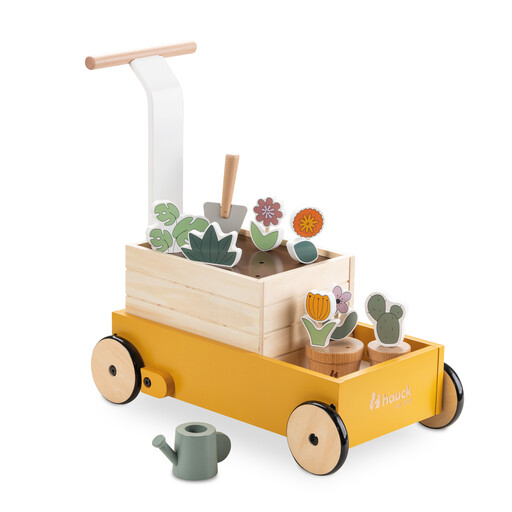
Why It's a Match: This model is aimed at parents who place a clear focus on fostering imagination and motor skills through role-playing. The gardener theme offers concrete, tangible play incentives.
The sturdy construction from FSC-certified wood provides the necessary stability. The wheel speed is individually adjustable via the brake, which ensures safety in the initial phase.
Numerous accessories like wooden plants and garden tools promote fine motor skills and imaginative play. The large cargo area can also be used to transport other toys.
We've compiled a complete, up-to-date list of products that fully meet these strict selection criteria and UK safety regulations.
A baby walker is useful when a child begins to pull themselves up on furniture independently and makes their first attempts at standing. This is typically between 9 and 12 months of age. It is important that it is a push walker that the child moves in front of them. So-called "sit-in" walkers, where the child is placed inside, are not recommended by paediatricians and physiotherapists.
On most wooden models, braking is achieved via a screw-based system that applies pressure directly to the axle or wheels. Tightening the screws creates friction, which increases the rolling resistance. For beginner walkers, the resistance should be set high enough that the walker can only be moved with effort. As the child becomes more confident, the brake can be gradually loosened.
Both materials have specific advantages and disadvantages.