
Lieferung heute & morgen

Qualitätsgarantie

Willkommens-Angebote freischalten: KOSTENLOSE Lieferung | Bis zu 80 % RABATT | Kostenlose 30-Tage-JoyPlus-Testphase
App herunterladen
A child's first steps are an unforgettable milestone. A baby walker can support this exciting transition while also serving as an engaging toy. However, the market is flooded with models whose promises often outweigh their actual utility. Many products have design flaws that not only strain your wallet but can also compromise your child's safety. This guide will help you identify the crucial features and avoid common purchasing pitfalls.
Before choosing a model, it's important to understand the typical weaknesses that often only become apparent with daily use.
To make an informed decision, you should focus on objective, measurable criteria. These three aspects are crucial for the safety and long-term value of a baby walker.
The construction is the most critical factor. A 2-in-1 baby walker should have a wide, sturdy base, ideally with a stable triangular structure. This form of weight distribution significantly minimizes the risk of tipping. Also, look for rounded corners and edges to prevent injuries from bumps. The material should be robust and non-toxic, typically PP (Polypropylene) or ABS plastic. These materials are durable and safe for toddlers. Such a push walker is a thoughtful alternative to seated walkers, as it encourages the child to adopt an active, upright posture instead of being passively held in a seat.
A good baby walker grows with your child's abilities. The most important feature here is adjustable wheel speed. For the first attempts, a slower setting (or even a locking function) can give the child the necessary security. Once they are more confident on their feet, the speed can be increased. This adaptability boosts self-confidence and significantly extends the product's lifespan. Additional features like a baby walker with music or light effects can further enhance motivation but should be switchable to avoid sensory overload.
A well-designed baby activity center transforms the walker into a versatile motor skills toy for ages 1 and up. Look for models with a variety of elements that target different skills:
Elements inspired by Montessori toys, such as simple wooden shapes or mechanical elements without electronics, often offer particularly long-lasting play value.
Instead of making a one-size-fits-all recommendation, we have identified models tailored to the specific needs of families.
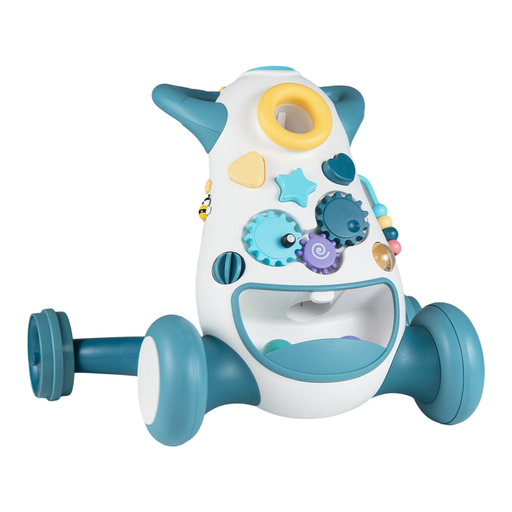
Why This Fits Their Persona: Ideal for parents who want to make no compromises on safety during their child's first steps. The combination of a stable design and adjustable speed creates a controlled and secure learning environment.
The stable triangular structure counteracts the risk of tipping, while the adjustable speed on the rear wheels prevents it from rolling away uncontrollably.
Adjustable wheel speed for safe learning progression; stable triangular structure for high tip-over resistance.
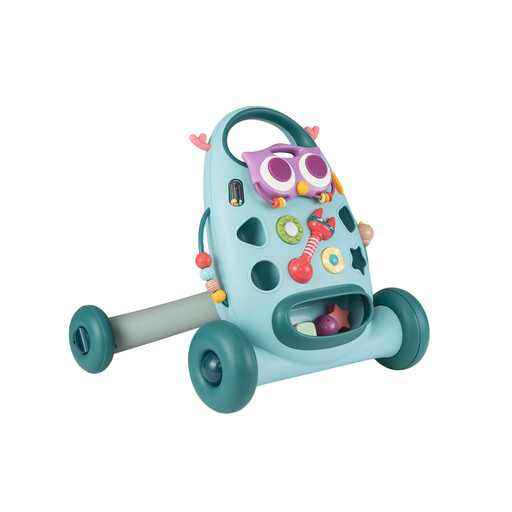
Why This Fits Their Persona: Perfect for families looking for a multifunctional toy that offers value beyond the learn-to-walk phase. The detachable play panel can be used separately, which saves space and extends its play value.
This model avoids the "short-lived play value" trap because the activity center can still be used even after the walker is no longer needed as a walking aid.
Detachable play panel for flexible floor play; integrated shape sorter toy promotes cognitive development.
We've compiled a complete, up-to-date list of products that fully meet these strict selection criteria and safety regulations.
A push-style baby walker is generally appropriate when a child begins to pull themselves up on furniture and take their first sideways steps. This often happens between 10 and 12 months of age. It is important that the child already has some core stability. The walker serves as a support for pushing, not for sitting in.
Yes, push walkers are considered by many experts to be a beneficial alternative to seated walkers. Unlike traditional seated models where the child sits or hangs passively, a push walker encourages active participation. The child must support their own weight, naturally training their balance, coordination, and proper foot position.
Pay attention to the materials used. Plastic models should be made from high-quality, safety-rated polymers like PP (Polypropylene) and ABS (Acrylonitrile Butadiene Styrene). These are robust and free of plasticizers. For wooden models, which often follow the Montessori toy concept, a smooth, splinter-free finish and the use of non-toxic paints and varnishes are crucial.