
Lieferung heute & morgen

Qualitätsgarantie

Willkommens-Angebote freischalten: KOSTENLOSE Lieferung | Bis zu 80 % RABATT | Kostenlose 30-Tage-JoyPlus-Testphase
App herunterladen
A baby walker can give children something extra to do as they move from sitting to standing and pushing. Models also vary considerably in their wheel control, materials, age recommendations and features. For families in Germany, the number of play options isn’t the only thing to consider. It’s also important to choose a walker that suits your child’s stage of development, your home and how you plan to use it.
A baby walker with toys may look fully equipped, with music, lights, a shape sorter and moving parts. For younger children, however, easy-to-reach activities that are simple to understand can be more useful than an overcrowded front panel. Check whether the activity centre can be removed, or if it gets in the way when your child is pushing the walker.
A wide frame, several wheels and a low weight can all make a walker easier to handle. What matters most, though, is its specific design, centre of gravity, handle height and how the wheels perform on your floors. A stable baby walker shouldn’t tip easily when your child pulls themselves up using the handle. You can’t reliably judge this from marketing claims alone.
A baby walker with a brake or adjustable rolling resistance can help control speed. It won’t protect your child from stairs, door thresholds, cables or slippery surfaces, though. Children should only use the walker on a clear, level surface and under direct supervision. Always follow the age and weight guidance provided by the manufacturer.
The recommended age is a guide, not a substitute for considering your child’s individual development. A baby walker from 12 months may suit children who can already sit unaided and pull themselves up on furniture. Some models are recommended from 9 months, while others are intended for children aged 12 months and over. Make sure your child can reach the handle securely without leaning too far forwards.
A push-along baby walker may still appeal to children who can already walk confidently. Check, however, that the manufacturer recommends the model for this stage of development. The Chicco Happy Hippy Walker, for example, is listed for children aged 9 to 24 months. According to the product information, it is not suitable for children who can already walk independently or weigh more than 20 kg.
The wheels should move smoothly and maintain good contact with the floor. Rubberised or non-slip wheel surfaces can be useful on smooth floors, as they may reduce noise and help protect the floor. Pushing the walker can be harder on carpets, over high thresholds or across uneven surfaces.
If a model has adjustable rolling resistance, check whether you can set it to move slowly or lock the wheels completely. The Costway model is described as having two speed settings for the rear wheels. This is a specific feature, but it doesn’t guarantee safe performance on every surface.
With a wooden baby walker, smooth surfaces, rounded corners and well-finished joints are especially important. Plastic models should have frames and activity centres without sharp edges. Before first use, check that all parts are fitted or screwed together correctly.
The CE mark is a mandatory conformity marking for many products, but it isn’t an independent quality seal. Depending on the features, toy standards such as EN 71 may also be relevant. The complete manufacturer’s information, warnings and instructions remain essential. Electronic features also mean more cleaning and care: keep the battery compartment, cables and speaker area dry.
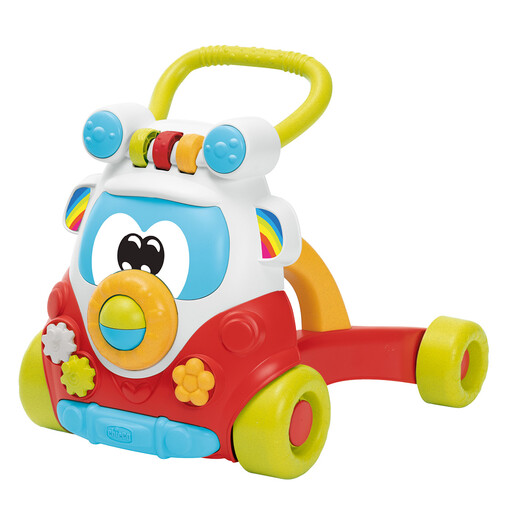
Why it suits this profile: This compact 2-in-1 walker combines a walking aid with a manual activity centre. According to the product information, it is intended for children aged 9 to 24 months.
Its five manual activities don’t include any listed lights or music. This keeps the features simple and makes the walker easier to care for.
Four large wheels, manual play features and a listed weight of 1.4 kg.
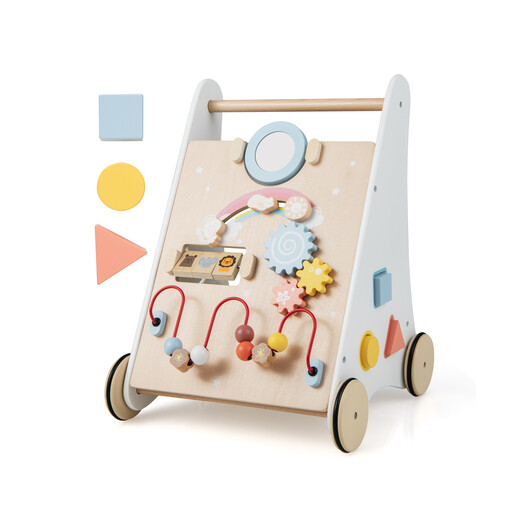
Why it suits this profile: Made from lime wood and MDF, this model is designed for families looking for a wooden baby walker with a simple design and an integrated play area.
The rubberised wheels are described as non-slip and noise-reducing. Rounded corners and a smooth surface help address common concerns about finish and construction.
Measures 34,5 × 32,5 × 45 cm and includes three building blocks and a basket at the back, according to the product description.
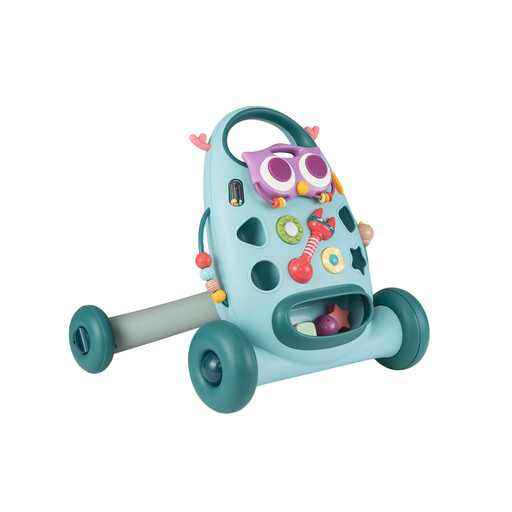
Why it suits this profile: Combining a walking aid with a removable activity centre, this model suits families who want to use the walker both for walking practice and separate playtime.
According to the description, the rear wheels can be slowed down or locked. This helps address the risk of uncontrolled speed, but doesn’t replace supervision.
Four shape-sorting blocks, moving play features, music and lights, plus a stated load capacity of up to 25 kg.
We’ve put together a complete, regularly updated list of products that meet these strict selection criteria and fully comply with the safety regulations in force in the EU.
It depends on the manufacturer’s guidance and your child’s motor development. Many models are intended for children from around 9 or 12 months who can sit unaided and hold on securely. Also check the weight limit, handle height and warnings.
How long a walker can be used depends not only on your child’s age, but also on their weight, height and stage of development. If your child can no longer control the walker safely, or has started walking independently, check the manufacturer’s guidance and reassess whether it’s still suitable.
Mechanical models generally have no ongoing costs beyond the purchase price. A baby walker with music or lights may need batteries. Before buying, check the battery type, how easy it is to access the battery compartment and the cleaning instructions.