
Lieferung heute & morgen

Qualitätsgarantie

Willkommens-Angebote freischalten: KOSTENLOSE Lieferung | Bis zu 80 % RABATT | Kostenlose 30-Tage-JoyPlus-Testphase
App herunterladen
A child's first steps are an unforgettable milestone. A baby walker can be a valuable support during this phase, providing security and promoting motor skill development. However, the market is overwhelming, and many products don't live up to their promises. As your Joybuy Product Recommendation Officer, I'll help you separate the wheat from the chaff and make an informed decision based on facts, not marketing hype.
Many well-intentioned purchases quickly turn out to be impractical or even unsafe. Look out for these three common problems to avoid disappointment:
To find the right baby walker, you should focus on objective features. These three parameters are crucial for safety and durability.
Stability is paramount. A safe walker needs a wide wheelbase and a low centre of gravity to minimise the risk of tipping. Its own weight also plays a role. Models made of solid wood, such as a wooden walker, are often heavier and therefore more stable than lightweight plastic versions. Look for robust construction with no sharp edges or loose small parts. The wheels should be rubberised to protect floors and provide better grip.
Adjustable wheel speed is not a luxury, but a necessity. A good system allows you to set the rolling resistance of the wheels steplessly or in several stages. At the beginning, when the child is still unsteady, set a high resistance. This makes the walker roll slowly and provides secure support. As the child's confidence and walking ability increase, you can loosen the brake and allow for more speed. This feature makes the baby walker a companion that grows with your child.
An activity baby walker can be a meaningful addition if the toys promote motor development. Look for models with tactile elements like rotating blocks, sliding elements, or shape sorters. These developmental toys for ages 1 and up train hand-eye coordination and fine motor skills. When it comes to material, you have a choice:
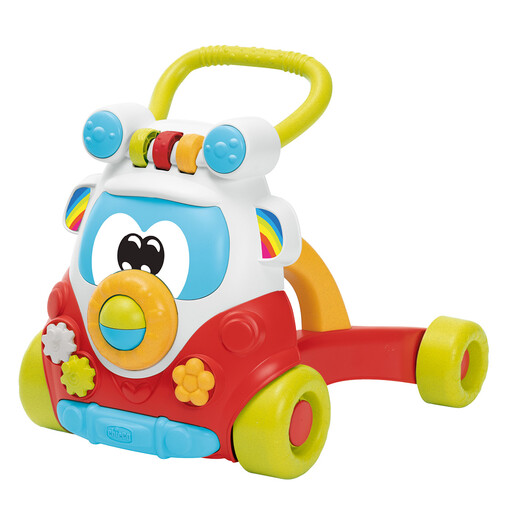
Why this model is a great fit: Ideal for the very first attempts. The four large, wide wheels provide a solid base and excellent stability. The integrated activity centre with manual play functions keeps the child engaged even while sitting and promotes fine motor skills without overwhelming them with electronic stimuli.
The wide wheel design counteracts the risk of tipping (Pitfall 1). It deliberately omits batteries and relies on mechanical toys, which prevents overstimulation (Pitfall 3).
2-in-1 function as a walker and activity centre. Sturdy construction for high safety during the first steps.
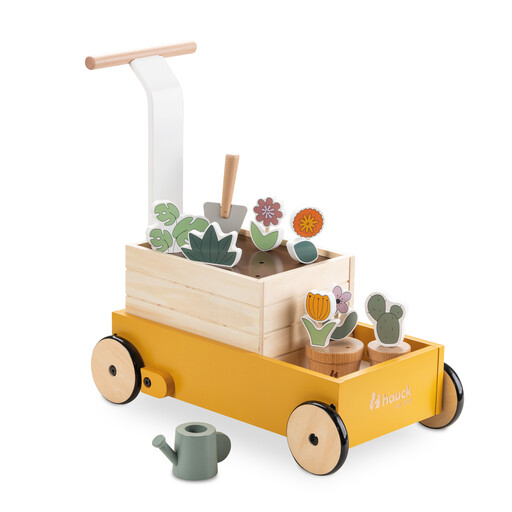
Why this model is a great fit: Made from sustainable, FSC-certified wood, this model appeals to parents who value ecology and durability. It combines the walking function with a creative gardener role-play set that stimulates the imagination and goes far beyond simple motor skill exercises.
The solid wood construction ensures a high weight and stability (Pitfall 1). An integrated, adjustable braking system allows for speed control (Pitfall 2). The focus is on imaginative role-play instead of electronics (Pitfall 3).
Sustainable FSC wood, adjustable wheel brake, promotes creativity with role-play accessories. Large cargo area can also be used as a doll's pram.
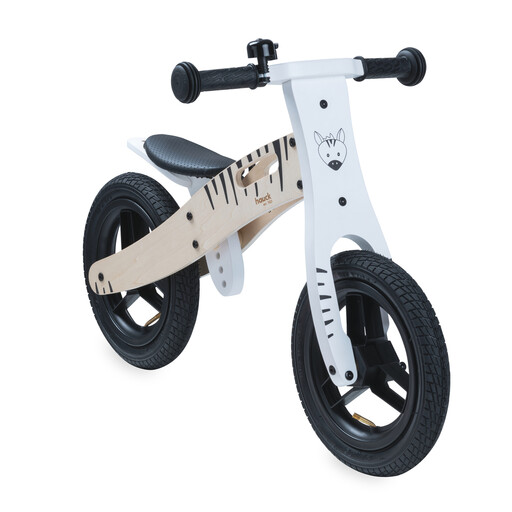
Why this model is a great fit: For children from around 18 months who are already walking confidently, a **wooden balance bike** is the next logical step. It specifically trains the sense of balance, coordination, and muscles in preparation for riding a bicycle. The height-adjustable saddle ensures a long period of use.
As a specialised training device for balance, it has a clear purpose and doesn't try to combine multiple functions poorly. It is designed for an advanced developmental stage, thus bypassing the typical problems of beginner walkers.
Specifically trains balance and coordination. Grows with the child thanks to a 4-level height-adjustable seat. Sustainable FSC wood and comfortable 12-inch pneumatic tyres.
We have compiled a complete, up-to-date list of products that fully meet these strict selection criteria and UK safety regulations.
A baby walker is not tied to a specific age, but to the child's developmental stage. It is useful when your child can pull themselves up on furniture independently and stand freely for a few moments. This is usually between the 9th and 12th month. Using one too early is not recommended.
These terms are often confused. A push walker (also called a baby push car) is a device that the child pushes in front of them. They stand on their own feet, which promotes a natural posture and the development of core muscles. A classic seated walker is a frame with a seat in which the child sits or hangs, pushing off with their toes. These seated models are often discouraged for orthopaedic reasons as they can promote an unhealthy posture.
Start with the tightest brake setting, so that the wheels turn only with considerable effort. The walker should be a firm support and not slip away. Observe your child: as soon as they walk more confidently and begin to push the walker effortlessly, you can gradually reduce the resistance. On smooth floors like parquet or tiles, a higher resistance is needed for longer than on carpet.