
Lieferung heute & morgen

Qualitätsgarantie

Willkommens-Angebote freischalten: KOSTENLOSE Lieferung | Bis zu 80 % RABATT | Kostenlose 30-Tage-JoyPlus-Testphase
App herunterladen
A baby walker can help your little one stand, push and play. In practice, however, models vary considerably in stability, how easily they roll, age suitability and features. If you focus only on eye-catching looks or a long list of toys, you could overlook important details.
This buying guide from the Joybuy Product Recommendation Officer takes an objective look at the key features and shows which baby walker may suit different everyday situations.
A baby walker with activities can look appealing thanks to music, lights, sorting games and moving parts. But when your baby is taking their first steps, it’s more important that the walker doesn’t tip easily when they hold or push it. A wide base, a sturdy frame and suitably large wheels matter more in everyday use than an especially extensive play area.
If a walker moves too quickly on a smooth floor, your child may not be able to follow it safely. On carpet, a model that’s too hard to push can be frustrating. Check that the way it rolls is suitable for your home and whether the wheels can be braked or adjusted.
The label ‘baby walker from 12 months’ is not an automatic recommendation for every child of that age. What matters is whether your child can sit independently, stand securely and reach the handle comfortably. Always check the manufacturer’s guidance on age, weight and use before buying and before each use.
A stable baby walker should have a sufficiently wide base and a firm handle that’s easy for your child to reach. Rounded edges and a smooth finish help reduce the risk of sharp joins causing problems. For wooden models, well-finished edges, strong connections between the parts and clear assembly instructions are also important.
Check the following:
Rubberised or non-slip wheels can reduce noise on delicate floors and improve grip. However, this alone is no substitute for supervision. Models with adjustable rolling resistance or a locking function can be useful. One example is the Costway walker, which has two settings on the rear wheels according to the product description: you can slow it down or lock it in place.
Use a baby walker only on a clear, level surface. Stairs, thresholds, sloping areas, cables and slippery floors should be kept out of the walking area.
For plastic models, material details and care instructions should be clearly stated. With a wooden baby walker, the finish, surface quality and regular checks of the joints are important. A walker with an activity board that can be removed may also be easier to adapt to different play situations.
Check before buying and after assembly:
The CE marking is an important indication of the manufacturer’s declaration, but it does not replace your own checks of the product in question. A baby walker is no substitute for adult supervision.
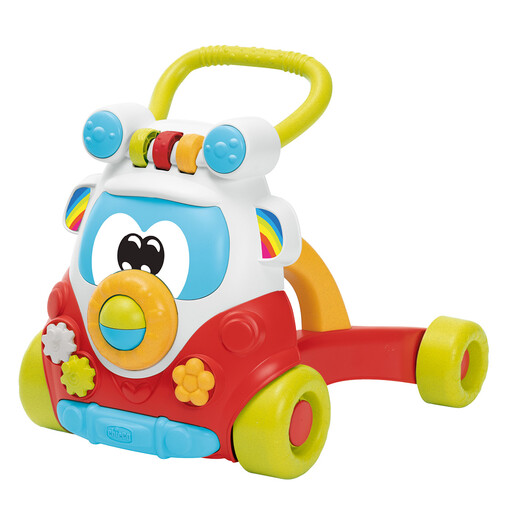
Why this product suits this profile: This 2-in-1 walker combines a walking aid with a manual activity centre and, according to the product information, is designed for children aged 9 to 24 months.
Five manual play elements keep things simple, with no music or lights mentioned. The four large wheels and wide design are intended to make pushing more controlled.
2-in-1 design, five mechanical activities, dimensions of 33 × 42.5 × 37 cm and a stated weight of 1.4 kg.
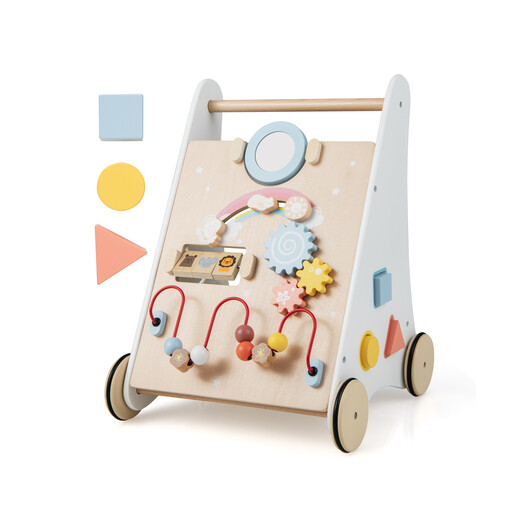
Why this product suits this profile: Made from lime wood and MDF, this model is aimed at households looking for a classic wooden baby walker with extra activities.
The wheels are described as rubberised and non-slip, and designed to reduce noise. Rounded corners and a smooth finish help address common construction concerns.
Seven features listed in the description, a rear basket, dimensions of 34.5 × 32.5 × 45 cm and a net weight of 2.2 kg.
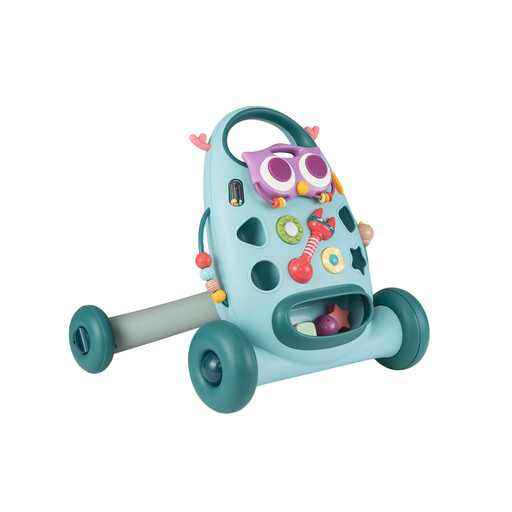
Why this product suits this profile: This model is for families who prefer a toddler walking aid with adjustable rolling speed and a removable playboard.
According to the product description, the rear wheels have two settings for slowing the walker down or locking it in place. The removable playboard means it can be used with or without the built-in activities.
Shape sorter with four shapes, moving play elements, music and lights, and a stated load capacity of up to 25 kg.
We’ve put together a complete, regularly updated list of products that meet these strict selection criteria and fully comply with the safety regulations in force in the EU.
Before using the walker for the first time, assemble it fully and check for any loose connections. Use it only on a clear, level surface. Adults should supervise the child during use. Keep the walker away from stairs, doors, heat sources and water.
For care, a soft, slightly damp cloth is usually sufficient, depending on the manufacturer’s instructions. Do not immerse electronic components in water. Regularly check the wheels, axles, screws, playboard and handle. Stop using the product if you notice any cracks, sharp edges or unstable connections.
That depends on the model and your child’s developmental stage. Some products are designed for children aged around 9 to 24 months, while others are for children from 12 months up to 36 months. Always follow the manufacturer’s guidance and make sure your child can sit securely, stand up and push the walker in a controlled way.
How long it can be used depends on the age and weight limits, your child’s height and their motor skills. Stop using the walker if the handle is no longer at a suitable height, your child can overload it by themselves, or they have reached the limit specified by the manufacturer.
Music, lights and sorting games can offer extra entertainment. However, they’re no substitute for a stable design and controlled rolling. If you prefer fewer distractions, you could choose a manual wooden baby walker or a model with a removable activity feature.