
Lieferung heute & morgen

Qualitätsgarantie

Willkommens-Angebote freischalten: KOSTENLOSE Lieferung | Bis zu 80 % RABATT | Kostenlose 30-Tage-JoyPlus-Testphase
App herunterladen
A baby walker can support babies and toddlers as they take their first steps, while also providing an engaging activity. However, baby push walkers vary considerably in their construction, wheels, materials and recommended age. An eye-catching activity centre alone says little about whether a model is practical and stable for everyday family life.
Three purchasing misconceptions are particularly likely to lead to the wrong choice:
A baby walker should not immediately roll forwards when pushed. A sufficiently wide base, a stable frame and an appropriate weight can make it easier to control. On smooth floors such as parquet or tiles, wheels with a non-slip surface are particularly important.
A baby walker with a brake can provide additional speed control. Parents should check that the brake is actually designed for the model in question and that it can be operated reliably. A brake does not replace a clear, level path or supervision by an adult.
Important: The walker should not be used on stairs, sloping surfaces or near thresholds. Cables, rug edges and toys left on the floor should be cleared away.
With a wooden baby walker, rounded edges, a smooth surface and securely attached components are useful points to check. Wood can be robust, but it should be inspected regularly for cracks, loose screws and splinters. With plastic models, stable connections and an easy-to-clean surface are among the factors to consider.
The CE mark indicates that the manufacturer has declared compliance with the applicable EU requirements. However, it is not an independent quality or safety seal and, on its own, says nothing about the product’s stability in a particular home. The manufacturer’s age and weight recommendations must match the child’s stage of development.
A baby walker with activities or a baby walker with a play centre can make the time before and after pushing more varied. Elements that are easy to reach while sitting or standing are useful, without requiring the child to lean too far over the walker.
Spinning parts, sliders, gears and shape sorters encourage different hand movements. These play features can help keep children occupied and support the practice of hand-eye coordination. No medical or therapeutic effect should be inferred from them. Noise levels, ease of cleaning and whether small parts are securely attached should also be considered when choosing a model.
The following models are organised by specific usage situations. Dimensions, materials and features are based on the available product information.
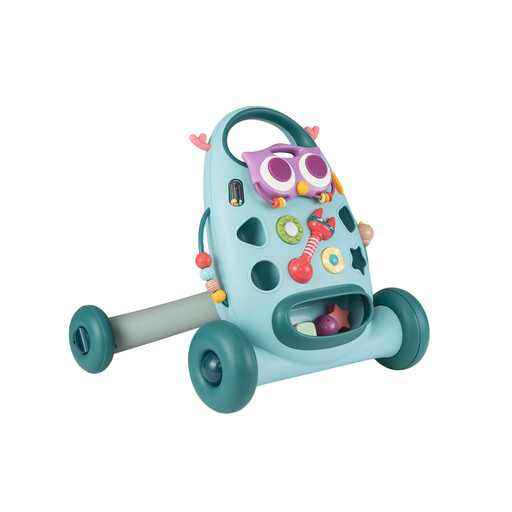
Why this product suits this profile: The removable oval playboard and shape-sorting toy appeal to families looking for a simple walking aid with interchangeable activities.
The removable play surface keeps the features manageable. Before buying, check the information on age, wheel movement and stability directly on the product page.
Removable oval playboard; integrated shape-sorting toy.
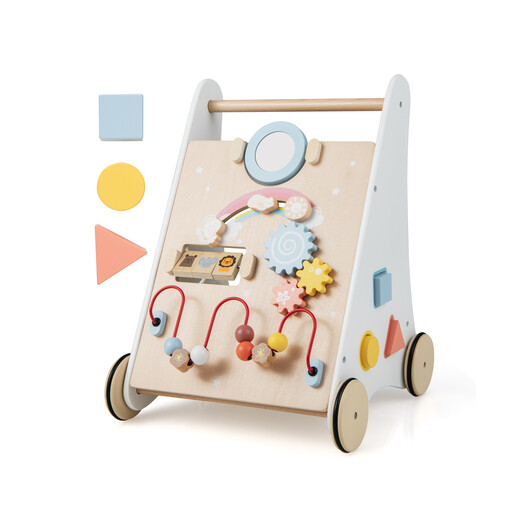
Why this product suits this profile: The walker combines a wooden construction with several activity features and a storage area for toys. According to the product information, it is intended for children aged 12 months and over.
According to the product description, the rubberised, non-slip wheels are designed for smoother movement and to protect delicate flooring. The edges and surface are rounded and smooth respectively.
Linden wood and MDF; seven activity areas according to the product information; dimensions of 34,5 × 32,5 × 45 cm.
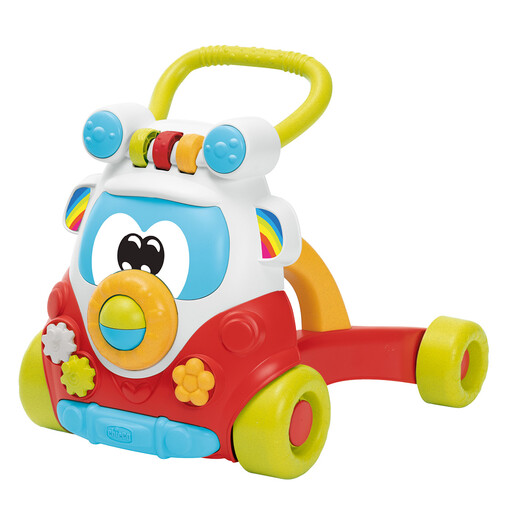
Why this product suits this profile: This 2-in-1 model combines push-walking support with a manual activity centre and, according to the manufacturer, is suitable for children aged 9 to 24 months.
The age range, maximum weight of 20 kg and specific warnings are clearly stated. This makes it easier to check whether the model is suitable for the intended use.
Four large wheels; five manual activities; polypropylene and ABS plastic; dimensions of 33 × 42,5 × 37 cm.
Before assembling and using the walker, parents should:
A baby walker from 1 year is therefore not automatically suitable for every twelve-month-old child. Some children initially need gentler support, while others may already be walking independently. The walker should only be used if the child can sit independently and the movement is controlled.
We have put together a complete, regularly updated list of products that fully meet these strict selection criteria and the safety regulations applicable in the EU.
This depends on the model and the child’s stage of development. Many products are specified for approximately 9 to 24 months or from 12 months. The key point is that the child must be able to sit independently and push the walker safely. The manufacturer’s information should be followed before buying and before use.
The period of use depends on the age and weight limits, the child’s height and the condition of the product. Once the child can no longer control the walker, is walking independently or reaches the stated load limit, it should no longer be used. Regular checks do not automatically extend the permitted period of use, but they can help identify damage at an early stage.
An activity centre can provide additional ways to play, for example with shape sorters, spinning parts or sliders. However, it is not an essential feature for taking those first steps. A suitable size, controlled wheels, sturdy construction and a safe environment remain the priorities. For families looking for a gift for toddlers, a model with a play centre may be a good choice if its age recommendation and features suit the child.