
Lieferung heute & morgen

Qualitätsgarantie

Willkommens-Angebote freischalten: KOSTENLOSE Lieferung | Bis zu 80 % RABATT | Kostenlose 30-Tage-JoyPlus-Testphase
App herunterladen
The first mealtimes present parents with practical questions: which baby weaning set is right for their child’s age? Is baby tableware really easy to clean? And does a baby need a complete baby plate bowl cup set from the start, or just a spoon to begin with?
Marketing promises are only so helpful when making your choice. What’s far more telling are the specific details about material, age recommendation, dimensions, care and safety. By focusing on these, you can avoid a few typical buying pitfalls.
A five-piece baby feeding set with a plate, bowl, cup, fork and spoon might seem practical. For a child from around six months old, however, such a set can be more than you actually need. In the early weaning stage, a suitable spoon is often all that’s required. Forks and cups become more important once your child starts reaching and eating more independently.
The age recommendation should therefore match your child’s developmental stage. A cutlery set labelled from 12 or 18 months isn’t automatically suitable for younger babies.
Not every product with a soft surface is made entirely from silicone. When buying baby cutlery made from silicone, you should check whether the manufacturer lists the material for every component, and whether details such as food-grade platinum silicone or BPA-free are provided.
BPA-free claims are only credible if they are explicitly stated in the product information. For coated or multi-part products, it’s also worth looking at the material details for the handle, cutlery head and tableware body.
Dishwasher-safe baby tableware reduces the cleaning effort, but it doesn’t remove every care requirement. Food residue should be removed promptly. What’s more, products need to be checked regularly for cracks, loose parts, warping or sharp edges.
With silicone, odours from strongly seasoned foods can linger. The manufacturer’s instructions on temperature, dishwasher, microwave and steriliser are therefore more important than a general marketing claim about being easy to care for.
For babies from around six months, short, lightweight cutlery pieces with easy-to-grip handles make sense. A spoon shouldn’t be too deep, so your child can bring it to their mouth more easily. For forks, rounded prongs are a key safety feature.
For older toddlers, a classic children’s cutlery set from 6 months can already be too small or too light. The manufacturer’s specific age recommendation remains the most important guide. MiaMia, for example, notes that its four-piece set is suitable from around 12 months, while the six-piece set is intended from 18 months.
Silicone is flexible and, in a well-made design, feels pleasant in the hand. The Kikka-Boo sets are specified as 100% food-grade platinum silicone. For these products, the manufacturer states a temperature range of -40 °C to 230 °C, as well as suitability for the dishwasher, microwave, freezer and steam steriliser.
High temperature resistance doesn’t mean food should be served immediately after heating. Food can be significantly hotter inside than the surface. Always check the temperature before feeding.
A complete baby plate bowl cup set can be practical for families who regularly prepare meals at home. For on-the-go, however, a compact cutlery set is often enough. What matters are:
For products with standard markings, these should be read carefully. According to the product information, the MiaMia cutlery is linked to the safety requirements of EN 14372 for cutlery and tableware for infants and young children. The manufacturer’s own information remains decisive for actual use.

Why this product suits the profile: This two-piece set is designed for babies from six months and covers the basics for those first independent meals.
The compact contents prevent you from buying unnecessary pieces before they’re needed. The product details clearly state the material, age and care instructions.
Fork and spoon made from stated platinum silicone, BPA-free, and suitable for the dishwasher, microwave and steriliser.
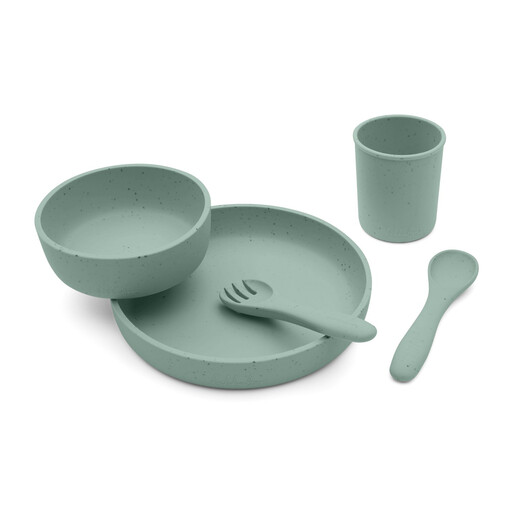
Why this product suits the profile: This set is aimed at families who need a plate, bowl, cup and cutlery all in one bundle for the weaning stage.
The product data lists the individual pieces and their sizes: plate with 400 ml, bowl with 200 ml and cup with 150 ml. This lets you assess the contents before buying.
Five pieces made from stated platinum silicone; according to the product information, BPA-free and suitable for the dishwasher, microwave, freezer and steriliser.

Why this product suits the profile: Two forks, two spoons and two knives are practical for households where several meals happen daily or where spare cutlery is needed.
The age recommendation from 18 months prevents you choosing it too early for a baby. Rounded spoons, blunt fork prongs and the stated dishwasher suitability are all clearly specified.
18/10 stainless steel on the cutlery heads, PP plastic handles and six pieces for regular use.
We’ve put together a full, regularly updated list of products that meet these strict selection criteria and the safety regulations in force across the EU.
Even a well-thought-out baby tableware set needs regular checking. Before every meal, parents and carers should:
When using a microwave, stir the food afterwards, as hot spots can form. Also, make sure a cup, plate or bowl isn’t placed near the edge of the table if your child could pull on it or lean against it.
Many sets are labelled from six months and are therefore suitable for the start of weaning. What really matters, however, is the specific age recommendation, your child’s motor skills and the type of meal. A large set isn’t essential if you’re only feeding purée at first.
Both materials have different properties. Silicone is flexible and, in suitable products, is described as soft and lightweight. Stainless steel cutlery heads are rigid and durable; with MiaMia, 18/10 stainless steel and rounded or blunt shapes are specified. What counts are the material details, handle size, age recommendation and care instructions.
There’s no fixed lifespan that applies to all products. It depends on the material, how often it’s used and how it’s cared for. The tableware should be checked before each use and replaced if you spot any visible damage, cracks or weak points. The age recommendation can also help you decide when a larger or differently shaped children’s cutlery set becomes appropriate.