
Lieferung heute & morgen

Qualitätsgarantie

Willkommens-Angebote freischalten: KOSTENLOSE Lieferung | Bis zu 80 % RABATT | Kostenlose 30-Tage-JoyPlus-Testphase
App herunterladen
By Joybuy Product Recommendation Officer, August 28, 2026
The arrival of a baby brings immense joy, but often, restless nights as well. Many parents search for an effective baby sleep aid and come across what are known as white noise machines. These devices can create a soothing soundscape that helps the baby relax and sleep better.
However, the market is saturated with models whose marketing promises often create more confusion than clarity. Before you make a decision, it's important to understand the common pitfalls that can lead to a purchase you'll regret.
To make an informed choice, you should focus on the objective product features that determine its actual value.
A good sound machine for babies offers more than just a single sound. Look for a diverse library that includes various types of sounds.
The quality of the playback is crucial. The sounds should be clear and play without audible repetitions (loops) to ensure a constant and undisturbed sound environment.
User-friendliness is essential in daily life. Features that make life easier are often worth more than unnecessary gimmicks.
Your child's safety is the top priority. Therefore, check the following aspects:
Based on the criteria above, we have identified products that are suitable for different needs. This is a selection, not a comprehensive market comparison.
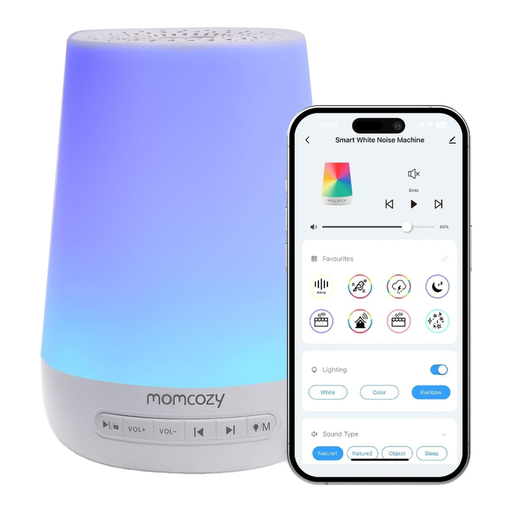
Why It's a Match: This device is aimed at parents who value flexibility and smart features. The app control allows you to adjust sounds, volume, and light without having to enter the room. Personalized sleep routines can automate the falling asleep and waking up process, which is a significant relief in daily life. It also makes for a thoughtful newborn gift.
With 34 different sounds, it bypasses the trap of monotonous sound loops. The intuitive app control and timer function solve the problem of impractical nighttime operation.
The ability to create custom sleep routines via the app that combine sound and light. The device is also USB-rechargeable, making it portable.
We've compiled a full, up-to-date list of products that fully meet these strict selection criteria and EU safety regulations.
The volume should not exceed 50 decibels (dB), which is roughly the loudness of a quiet conversation or a running refrigerator. Also, place the device at least one meter (about 3 feet) away from the baby's crib to protect the child's hearing. Always start with the lowest volume setting and adjust it carefully as needed.
Yes, as with many routines, babies can get used to the soundscape. Many parents see this as a positive, as it helps the child fall asleep more easily in different places (e.g., while traveling). If you later want to stop using the device, it is recommended to gradually reduce the volume over several weeks to gently wean the child off it.
The main difference lies in the distribution of frequencies. White noise has equal intensity across all frequencies, which makes it very effective at blocking out other sounds. Pink noise has more energy in the lower frequencies, making it sound softer and less "sharp," similar to a gentle waterfall. Some babies (and adults) find pink noise more pleasant and relaxing.