
Lieferung heute & morgen

Qualitätsgarantie

Willkommens-Angebote freischalten: KOSTENLOSE Lieferung | Bis zu 80 % RABATT | Kostenlose 30-Tage-JoyPlus-Testphase
App herunterladen
A baby bottle needs to suit more than just your child’s age. The teat flow, capacity, material, cleaning requirements and use alongside breastfeeding and supplementary feeding all affect everyday life. If you focus solely on attractive design or claims such as “particularly natural”, it is easy to overlook important details.
A high-flow teat is not automatically better. For newborns and younger babies, milk that flows too quickly can be impractical. Pay attention to the age recommendation and labels such as “Slow Flow”, “Normal Flow”, “Medium Flow” or “Fast Flow”. Your baby’s needs may change as their drinking habits develop.
A baby bottle with a breast-shaped teat can be a suitable option when switching between breastfeeding and bottle feeding. However, the shape alone does not guarantee that your baby will accept it easily. Teat firmness, opening, feeding position and your baby’s individual rhythm are also important. When choosing a baby bottle for breastfeeding and supplementary feeding, do not select the teat based on appearance alone.
Many components can increase the cleaning effort. Valves, sealing rings and multi-part teats must be completely taken apart. A dishwasher-safe baby bottle makes care easier, but it does not replace checking every individual part. Residue can collect particularly around joins and valve openings.
For a baby bottle for newborns, compact sizes such as 140 or 150 ml are often easier to manage. They make it easier to measure smaller feeds and are generally more comfortable to hold. Models with capacities of 250 to 260 ml offer more room as your baby’s intake increases. According to the respective product details, 330-ml bottles with a fast teat flow are intended for babies from around six months.
The age indication is a guide and should be considered alongside your child’s drinking habits. A larger capacity does not mean that the bottle should be filled completely from the outset.
Many models are designed with a slow flow for the early months. A medium or fast flow may be suitable for older babies, provided the product is approved for this use. Depending on the model, an anti-colic baby bottle may feature a double valve, an AirFree valve or a valve in the teat. These designs are technical features of the individual product; no particular effect on discomfort should be inferred from them.
The shape of the teat is also relevant. Soft silicone teats with a wide base or angled shape are designed on several models to support a breast-like feeding position. When supplementing feeds, it may be sensible to buy a single bottle first and observe whether your baby accepts it before purchasing a larger baby bottle set.
For plastic bottles, the product details should explicitly state BPA-free or “BPA-Free”. Polypropylene, or PP for short, is a commonly used bottle material. The teat is usually made from silicone. Also check the following:
A baby bottle steriliser can save time when you have several bottles, breast pump parts and small accessories to clean. A baby bottle warmer is useful when breast milk or infant formula needs to be heated in a controlled way. The temperature must always be checked before feeding.
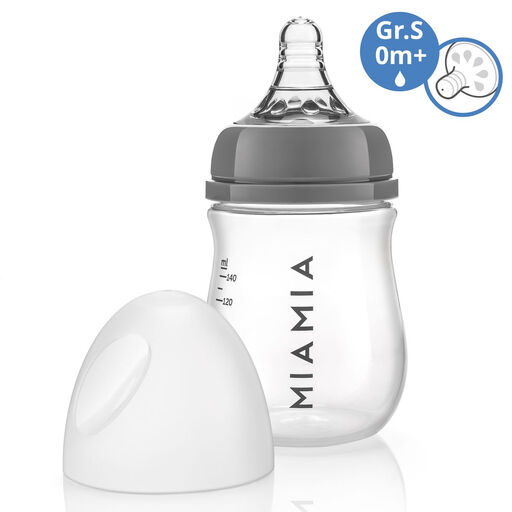
Why this product suits this profile: According to the product details, the 140 ml capacity and size S teat are designed for use from birth. This makes the bottle suitable for families initially looking for a compact milk bottle for babies.
The clear size and teat specifications reduce the risk of choosing an unnecessarily large bottle or a teat that flows too quickly for the early months.
BPA-free PP, silicone teat, wide bottle neck, dishwasher-safe and tested in accordance with EN 14350, according to the product details.
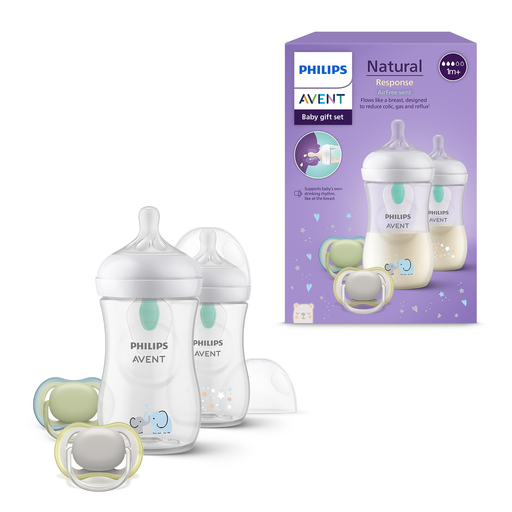
Why this product suits this profile: The set includes two 260 ml bottles with Natural Response teats, plus two soothers for different everyday situations. The product details state that the milk flow responds to your baby’s active drinking.
The teat size, age range and valve are clearly specified. This makes it easier to assess whether the set fits your feeding routine.
BPA-free PP, AirFree valve, dishwasher-safe components and two 260 ml bottles included.
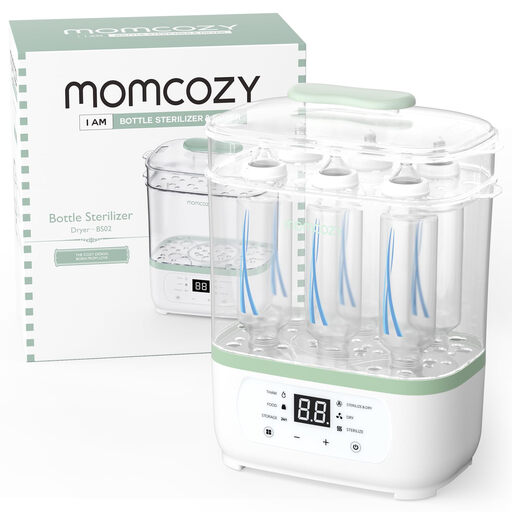
Why this product suits this profile: For households with several bottles, teats or breast pump parts, this electric appliance combines sterilising, drying, defrosting and warming baby food in one device.
The capacity for up to eight standard bottles is clearly stated. This allows you to check before buying whether the appliance suits your daily bottle requirements.
Steam sterilisation, hot-air drying, 8-in-1 functions and an air filtration system according to the manufacturer’s details.
We have put together a complete, regularly updated list of products that fully meet these strict selection criteria and the safety regulations applicable in the EU.
Look for the labels “from birth” or “0+ months”, a small capacity and a slow or normal teat flow. Models such as the MiaMia Baby Bottle 140 ml or certain Chicco bottles with a 150 ml capacity are intended for this age range according to the product details. Actual suitability also depends on your baby’s drinking habits.
With proper care, the bottle body can be used for longer. However, teats, valves and seals should be checked regularly and replaced if they develop cracks, become deformed or sticky, or if the drinking flow changes. The manufacturer’s care instructions are decisive. A damaged baby bottle should not be used further.
This depends on your household and feeding situation. If you use only a few bottles, thorough cleaning and a sterilisation method recommended by the manufacturer are often sufficient. If you have several bottles, pump parts or frequently provide supplementary feeds, a steriliser can make things easier to organise. A bottle warmer is useful if milk or formula needs to be heated in a controlled way on a regular basis. In all cases: never operate the appliance unattended and check the temperature before feeding.