
Lieferung heute & morgen

Qualitätsgarantie

Willkommens-Angebote freischalten: KOSTENLOSE Lieferung | Bis zu 80 % RABATT | Kostenlose 30-Tage-JoyPlus-Testphase
App herunterladen
A baby bottle warmer can make preparing milk and baby food easier in everyday life. However, appliances vary considerably in terms of heating method, bottle compatibility, portability and operation. If you only look for claims such as “fast” or “multifunctional”, you may overlook important details.
As a Joybuy Product Recommendation Officer, I filter the relevant product information according to transparent criteria. It is not about blanket promises, but about answering the question: which bottle warmer for baby bottles fits your daily routine?
Manufacturers’ heating-time specifications often refer to a particular quantity of milk, a specific starting temperature and a certain bottle format. A larger glass bottle, cold milk or a wide container can change the actual heating time. You should therefore check the conditions under which the stated time applies.
Many appliances fit standard bottles, but not necessarily every wide-neck bottle, breast milk bag or baby food jar. The key factors are the maximum diameter, the height and, where applicable, a supplied adapter. For example, an appliance with a chamber for containers up to 7 cm in diameter is not automatically suitable for every particularly wide bottle.
A bottle warmer with a keep-warm function maintains the contents at temperature for different lengths of time depending on the model. This does not replace safe storage and should not result in milk or baby food being left in the appliance unnecessarily. A defrosting function is practical, but its speed varies depending on the quantity and starting temperature. Always check the temperature before feeding.
With a bottle warmer for breast milk or a bottle warmer for baby food, even heating is more important than an isolated time specification. Appliances with a water bath heat the container from the outside. Models with continuous circulation can help reduce temperature differences within the contents. Nevertheless, the milk should be gently swirled and checked after heating.
Look out for:
Before buying, check the diameter of your bottles and jars. Glass and plastic can behave differently when heated. Some appliances require a basket for small containers, while others offer adapters for different bottle brands.
For plastic components, specifications such as BPA-free and food-safe are relevant. They should refer to the specific product components and the manufacturer’s information, rather than general advertising claims. A CE mark indicates a declaration of conformity with relevant EU requirements; however, it is not an independent quality assessment.
An electric bottle warmer for home use generally requires a mains connection and is designed for a stable, level surface. A portable bottle warmer or USB bottle warmer can offer greater flexibility when travelling, but requires a charged battery or a suitable power source.
For car journeys, a bottle warmer with a car adapter may be worth considering. Check whether the adapter is designed for a 12-volt socket and whether the cable can be routed safely. For battery-powered appliances, charging time, connection standard, included adapters and secure attachment to the bottle are also important.
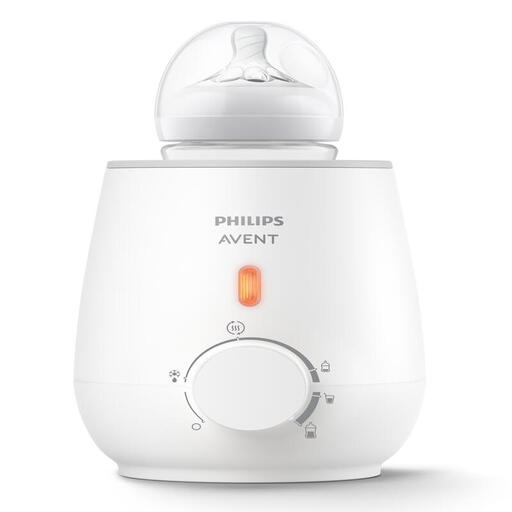
Why this product suits this profile: This appliance is designed for home use and can be operated using a rotary dial. It is suitable for milk, baby food and selected bottles and jars.
The specifications state a maximum container diameter of 7 cm as well as an integrated defrosting function. This makes it easier to check compatibility and the available functions before buying.
220–240-volt mains operation, a keep-warm function and compatibility with certain Philips Avent containers as well as standard commercially available vessels.
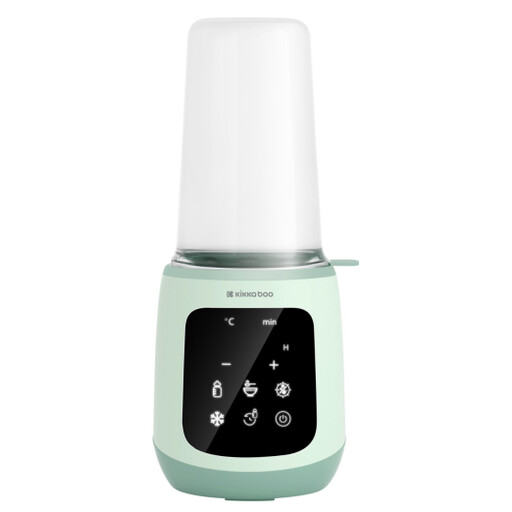
Why this product suits this profile: This model combines several clearly specified functions with a touchscreen and timer. It is aimed at households that want to bring milk and baby food preparation together in one appliance.
Rather than simply advertising fast heating, the product description lists defrosting, sterilising, heating and keeping warm as separate functions.
Automatic switch-off, basket and lid included, plus a compact design with a stated diameter of 7.5 cm.
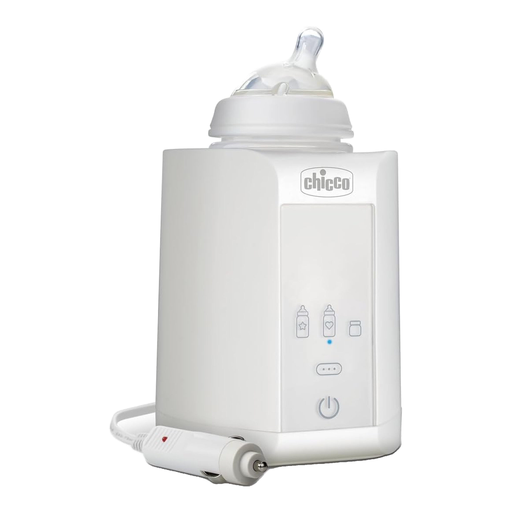
Why this product suits this profile: This model is designed for use at home and on the go. The supplied cigarette-lighter adapter extends its usefulness for car journeys.
The power supply is specified as 220–240 V for home use and 12 V for the car. This means buyers do not have to search for a suitable adapter afterwards.
Five programmes, including defrosting and keeping warm for up to one hour, plus automatic switch-off and an audible signal.

Why this product suits this profile: This battery-powered portable bottle warmer is designed for days out and travelling. Adapters for several bottle brands are listed as included.
The product information explicitly highlights using the correct adapter, secure attachment and checking compatibility. With Dr. Brown’s bottles, the green vent system should be removed.
Integrated battery, USB charging function and a reportedly leak-proof design with several bottle adapters.
We have put together a complete, regularly updated list of products that fully meet these strict selection criteria and the safety regulations applicable in the EU.
Regardless of the model, some basic rules always apply:
Its lifespan depends on how often it is used, descaling, cleaning and the condition of the cable or battery. An electrical appliance should be replaced or taken out of use if cracks, damaged wiring, leaks or operational faults occur. With a battery-powered model, the usable operating time may decrease over time.
According to many product descriptions, numerous appliances are designed as bottle warmers for breast milk. The specific programmes and instructions for use are what matter. Do not heat milk for longer than necessary, mix it gently and check the temperature before feeding. The recommendations of the relevant health authorities also apply to the storage and handling of expressed milk.
Power consumption depends on the appliance’s wattage, heating time and frequency of use. An appliance with a 220–240-volt connection uses mains electricity while heating; a portable model is charged via its battery. For a realistic estimate, you can multiply the power consumption by the daily operating time. A keep-warm function can extend the operating time and should only be used for as long as specified in the instructions.