
Lieferung heute & morgen

Qualitätsgarantie

Willkommens-Angebote freischalten: KOSTENLOSE Lieferung | Bis zu 80 % RABATT | Kostenlose 30-Tage-JoyPlus-Testphase
App herunterladen
A baby bottle warmer can make night-time feeds, preparing infant formula and warming breast milk easier. However, models vary considerably in temperature control, compatibility and where they can be used. A cheaper model is not automatically the right choice, while additional programmes are only worthwhile if you will genuinely use them in everyday life.
Claims such as “fast” or “in just a few minutes” often refer to a specific quantity of milk, a defined starting temperature and a particular type of bottle. A large glass bottle containing cold liquid will generally take longer to heat than 60 ml in a plastic bottle at room temperature.
For this reason, pay attention to the specific conditions: fill quantity, starting temperature, container material and bottle shape. This is the only way to make a meaningful comparison between bottle warmers.
Not every bottle fits into every heating chamber. Wide bottles, glass bottles, breast milk bags or jars may require a specific diameter or a suitable basket. Check the following before buying:
Some devices are designed for containers up to approximately 7 to 7.5 cm in diameter. This specification should be compared with your own equipment.
A keep-warm function maintains the selected temperature for a specific period, but it does not replace correct storage and monitoring. Milk and baby food should not be kept warm for longer than recommended by the manufacturer and relevant expert guidance. The temperature must be checked before every feed, for example on the inside of your wrist.
For breast milk and infant formula, heating as evenly as possible is important. Water-bath systems warm the container from the outside. Functions such as automatic programmes, timers or settings based on the starting temperature can make operation easier, but they do not remove the need for you to check the final temperature.
An electric bottle warmer for home use should have easy-to-understand controls, a stable base and either automatic shut-off or an audible signal. Also check whether programmes for milk, baby food, defrosting and keeping warm can be selected separately.
Mains voltage is an important purchasing criterion in Germany. According to the product data, the Philips Avent model SCF355/09 is designed for 220–240 V at 50/60 Hz. A USB bottle warmer or portable bottle warmer, on the other hand, usually uses a battery or USB power supply. The key points here are:
A car bottle warmer should not simply be operated via any available connection. For mobile use, you need a suitable 12-volt adapter or a system approved by the manufacturer.
Water-bath devices require regular care, as limescale can build up on the heating surface. Removable parts make cleaning easier. Check whether components are dishwasher-safe and which cleaning products may be used according to the instructions.
Several of the models described specify BPA-free plastic components and stainless-steel heating elements. However, these material specifications do not replace checking the complete user manual. The device must not be immersed in water and should be allowed to cool down completely before cleaning.
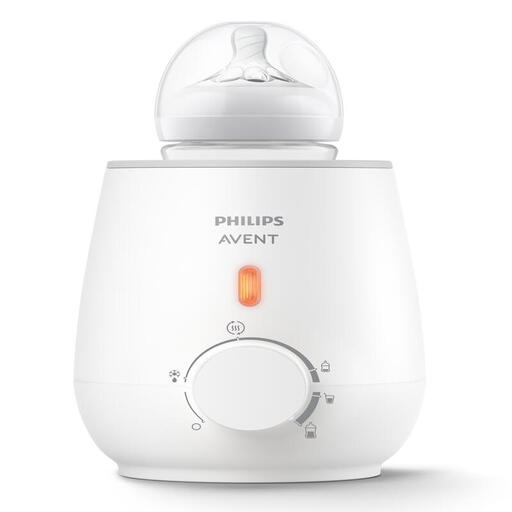
Why this product suits this profile: This device is designed for the essential tasks of warming, defrosting and keeping warm, and is operated using a rotary control. It is suitable for stationary use at home.
The product description states that it is compatible with AVENT containers as well as standard bottles, jars and cups up to 7 cm in diameter. This makes it easier to check container compatibility before buying.
Integrated defrosting function and keep-warm setting; mains operation at 220–240 V.
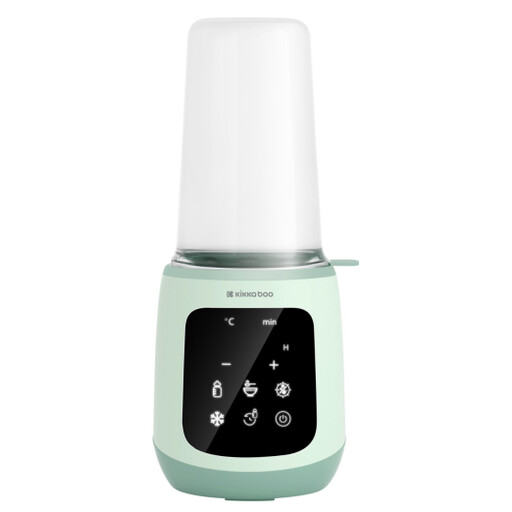
Why this product suits this profile: If you are looking for several functions in one compact device, this model offers programmes for warming, defrosting, sterilising and keeping warm.
The touchscreen, timer and automatic shut-off make the settings easy to understand. However, the maximum container width of 7.5 cm should still be checked against your own bottles.
Four functions, with basket and lid included; the product description states that the materials are BPA-free and food-safe.
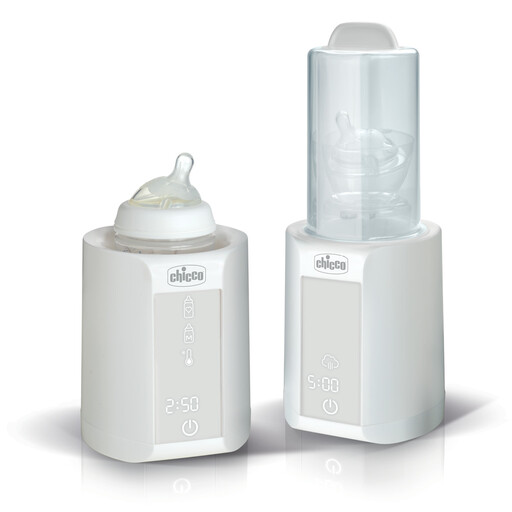
Why this product suits this profile: This 2-in-1 device is aimed at families who regularly warm bottles or small items and also want to use a sterilisation mode.
Selecting settings according to bottle size, material and starting temperature reduces uncertainty when choosing a programme. According to the product description, a descaling indicator shows when maintenance is required.
Sterilisation function, programmable timer and automatic shut-off with audible signal.

Why this product suits this profile: The integrated battery and several adapters are designed for day trips, travelling and situations without direct access to mains power.
The adapters and dual leak protection address two common challenges when using a warmer on the go. According to the product information, the internal green valve system must be removed before connecting Dr Brown’s bottles.
Rechargeable battery, USB charging and compatibility with several bottle brands.
For a permanent place in the kitchen, a mains-powered baby bottle warmer is generally more convenient. It does not need to be charged and, depending on the model, can also handle jars, defrosting or sterilisation. A portable bottle warmer, on the other hand, is more flexible but needs to be charged and requires suitable adapters.
For car journeys, the Chicco model is designed to be used with the supplied adapter cable for the cigarette lighter socket. According to the product description, it operates at 220–240 V at home and 12 V in the car. Here too, the actual heating time also depends on the quantity, container and starting temperature.
We have put together a complete, regularly updated list of products that fully meet these strict selection criteria and the safety regulations applicable in the EU.
Place the device on a flat, heat-resistant surface and only add the amount of water specified in the instructions. Position the bottle or jar securely and select the programme, container material and starting temperature, if these options are available. After warming, stir or swirl carefully and check the temperature before feeding.
Its lifespan depends on how often it is used, descaling, cleaning and the condition of the cable, seals and heating surface. A device should no longer be used if the cable is damaged, cracks appear, water leaks out or the automatic shut-off does not work reliably. The relevant manufacturer’s information on warranty, care and spare parts is decisive.
Consumption depends on the power rating and operating time. A short heating cycle normally uses less energy than keeping food warm for a long period. For running costs, therefore, it is not just the wattage that matters, but also daily usage time and keep-warm habits. With a battery model, charging losses and the need to recharge must also be taken into account.