
Lieferung heute & morgen

Qualitätsgarantie

Willkommens-Angebote freischalten: KOSTENLOSE Lieferung | Bis zu 80 % RABATT | Kostenlose 30-Tage-JoyPlus-Testphase
App herunterladen
A baby dummy should be soothing, comfortable in the mouth and easy to clean as part of your daily routine. However, the choice can quickly seem overwhelming: silicone dummies, orthodontic shapes, large air holes, BPA-free materials and different age ranges are often combined with promotional claims. What matters is not having as many extra features as possible, but choosing the right size, checking clear material specifications and using the dummy hygienically.
A dummy for newborns is not automatically suitable for an older child. Teat size and shield shape change with the size of the mouth and the child’s stage of development. A 0–6 months dummy should therefore not be used permanently as a 6–16 months dummy or a 16–36 months dummy.
Pay attention to the manufacturer’s specific age recommendation. During transitions, for example from 6–16 to 16–36 months, it may be sensible to buy individual pieces first and see whether your child accepts them.
An orthodontic dummy usually has a symmetrical or flatter teat neck. This can help the dummy sit similarly in the mouth in different positions. However, this does not justify any general claim about dental or jaw development.
More meaningful are verifiable features such as a symmetrical teat shape, slim teat neck, suitable age range and the EN 1400 safety standard. Regular checks and changing to an age-appropriate dummy also remain important.
A shield with large air holes can reduce direct skin contact and support air circulation. However, it is no substitute for cleaning and will not prevent every skin reaction. A dummy case is only practical if it is kept clean and used exclusively for dummies that have been hygienically prepared.
Also make sure never to extend a dummy clip with additional ribbons, cords or long loops. The clip must not be placed around the neck and should only be attached to clothing as intended.
Use the information shown on the packaging and product page as your guide:
A silicone dummy is odourless and tasteless and is generally easy to clean. Check whether the teat is made from 100% silicone, and find out which plastic is used for the shield, ring or case. A BPA-free dummy should be explicitly labelled as BPA-free. Some products also state that they are free from BPS.
Natural rubber is an alternative material group, for example in a baby teething ring. However, it should not be treated as equivalent to a silicone dummy and requires care in accordance with the manufacturer’s instructions.
Before first use, the dummy must be cleaned and, depending on the model, sterilised. Suitable methods may include boiling, steam sterilisation or using a supplied dummy case with a sterilisation function.
Check the teat before every use, especially once your child has teeth. Gently pull it in several directions and dispose of it if you notice cracks, a sticky surface, deformation or any other damage. Depending on the manufacturer’s instructions, the dummy should be replaced after around four weeks or after one to two months. A dummy in a 2-pack or 4-pack makes it easier to change dummies when out and about and during cleaning.
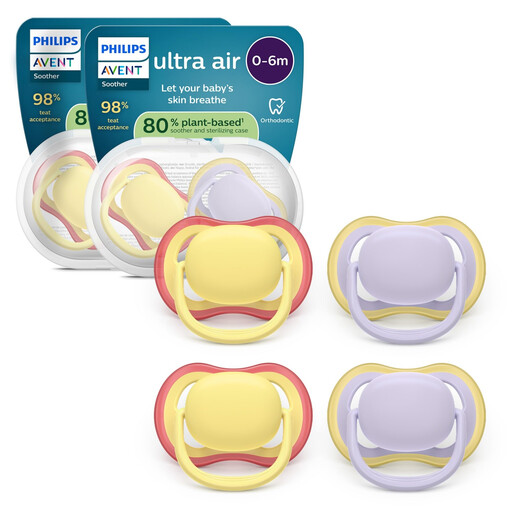
Why this product suits this profile: Four dummies and two transport and sterilisation containers provide a practical basic set for use at home and when out and about.
The 0–6 months age recommendation is clearly stated. The large air holes and symmetrical teat shape are specific product features rather than a blanket marketing claim.
BPA-free silicone teat, 4-pack and reusable containers with a stated microwave sterilisation function.
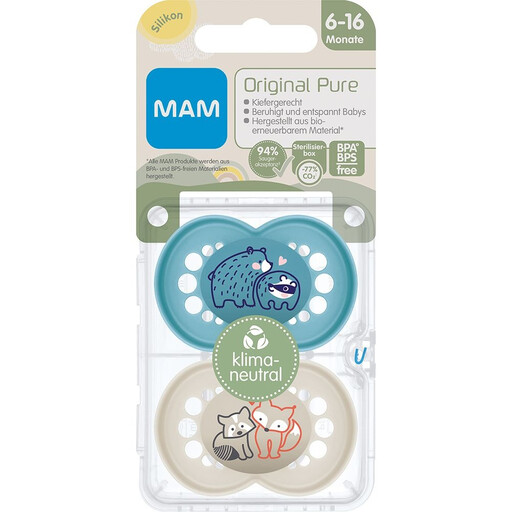
Why this product suits this profile: The combination of a flat, symmetrical teat shape, SkinSoft silicone and a sterilisation and transport case appeals to buyers who compare material and hygiene details carefully.
The product details state that it is free from BPA and BPS, has large air holes and carries a clear age recommendation. This makes it possible to check the relevant criteria before buying.
Symmetrical silicone teat, 2-pack and supplied case for storage and sterilisation in accordance with the instructions.
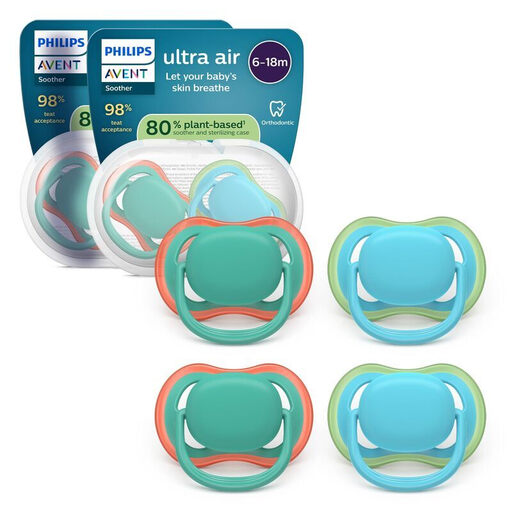
Why this product suits this profile: The 4-pack is ideal for families who need several dummies in different places, such as the pram, changing bag and home.
This version is labelled for 6–18 months and is not sold as a universal size. The sterilisation containers help keep dummies stored separately.
Extra-large air holes, symmetrical silicone teat, 4 dummies and two reusable transport containers.

Why this product suits this profile: This age range is designed for toddlers who need a larger version. The matt surface and supplied travel case are made for everyday use.
The pack states 16 months as the minimum age and includes large air holes. It also highlights the need to check the dummy for children with teeth.
Symmetrical, orthodontic silicone teat, 2-pack, sterilisation case and stated compliance with EN 1400.
A dummy clip will not prevent the teat from becoming dirty, but it can reduce the risk of the dummy falling to the ground. Only use clips designed for this purpose. According to the product details, the NUK Pacifier Clip is BPA- and phthalate-free and is intended to be attached to clothing.
For storage when out and about, a dummy case with a smooth, easy-to-clean surface is practical. According to the product description, the MiaMia Pacifier Box is made from food-grade silicone, is BPA- and PVC-free, and is suitable for cleaning in the dishwasher.
A baby bottle teat serves a different purpose from a soothing dummy. For Chicco NaturalFeeling, depending on the model, a Normal Flow teat is specified from 0 months or a Medium Flow teat from 2 months. An integrated anti-colic valve is a technical feature; no medical effect should be inferred from it. For teething, a baby teething ring such as the Vulli Sophie la Girafe So Pure Teether may also be suitable. The same applies here: check for damage before every use and supervise your child.
We have put together a complete, regularly updated list of products that fully meet these strict selection criteria and the safety regulations applicable in the EU.
This depends on the material, how often it is used and the manufacturer’s instructions. Four weeks or one to two months are often recommended. Regardless of this, a dummy must be replaced immediately if the teat shows cracks, discolouration, stickiness or any other damage.
Large air holes can improve air circulation around the shield and reduce skin contact. However, they are no substitute for regular cleaning, drying and checking for skin reactions. The shield should also be sufficiently large and meet the applicable safety requirements.
Choose a model explicitly approved for 0–6 months or from birth. Look for a suitable teat size, a sturdy shield, clearly stated material information and sterilisation instructions. A model for older babies should not be used solely because it has a similar shape.