
Lieferung heute & morgen

Qualitätsgarantie

Willkommens-Angebote freischalten: KOSTENLOSE Lieferung | Bis zu 80 % RABATT | Kostenlose 30-Tage-JoyPlus-Testphase
App herunterladen
A baby walker can help toddlers pull themselves up and push along, or serve as a floor-based activity centre. At the same time, models differ considerably in terms of brakes, handle height, wheels, materials and intended use. Focusing only on colourful features or low prices can easily mean overlooking important details.
A baby walker is not automatically suitable for every child from the same age. Some models are intended for children aged 12 months and over, while others are designed for an age range of 9 to 24 months. A baby walker for 12 months and over should only be used once the child can sit securely, pull themselves up under supervision and hold the handle in a controlled manner.
The stated age does not replace observing the child’s individual stage of development. The manufacturer’s weight limits and usage instructions must also be followed.
A baby walker with activities can provide additional entertainment through rotating elements, shapes, flaps or cogs. However, what matters is whether these elements are easy to reach, securely attached and suitable for the child’s age. A long list of features says little about how practical the product is for everyday use.
With a 2-in-1 baby walker, it should also be clear whether the activity centre can be used separately while sitting, or whether it is only accessible while pushing the walker.
Smooth wheels can accelerate quickly on hard floors. For children who are taking their first steps, a baby walker with a brake may be easier to control. With some doll’s prams and baby walkers, the rolling resistance or brake can be adjusted to suit the child’s stage of development.
However, a brake does not eliminate every risk. The walker must not be used near stairs, thresholds, open doors or cables. Adults should supervise the child directly while the product is in use.
A wide base, sturdy frame and securely fitted handle all affect control when pushing. Check the following:
With a wooden baby walker, rounded edges, a smooth surface and a splinter-free frame are particularly important. The material alone is not proof of safety; workmanship and regular checks are also essential.
The product details should state at least the recommended age, maximum weight and intended use. A seat, safety harness or ride-on board changes the product’s area of use and must not be treated as equivalent to a conventional push-along walker.
For a stroller board with seat, for example, the permitted weight, suitability for the particular pushchair model and correct attachment are all crucial. A child should be able to sit upright independently on such a product and hold on securely.
Before buying, measure doorways, narrow hallways and the available storage space. The baby walker’s dimensions may be more important in everyday use than additional play elements. Flooring also plays a role: rubberised wheels can reduce noise and help protect delicate floors, but they do not replace careful use.
With a stroller ride-on board, the adapter length, adapter height, turning circle and seat position should also be compatible with your existing pushchair.
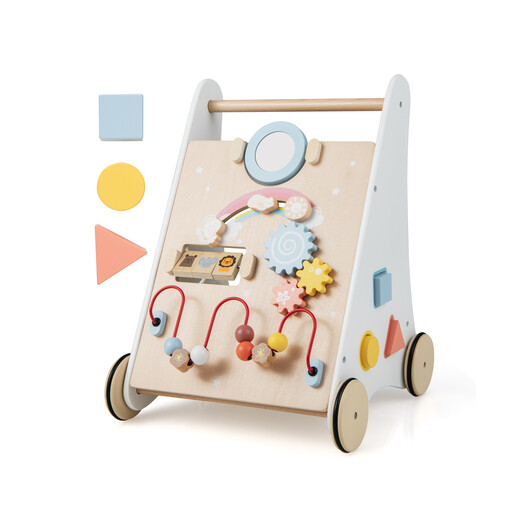
Why this product suits the profile: According to the product details, this push-along walker is suitable for children aged 12 months and over, combining walking support with several activity elements.
The product details specify a weight of 2.2 kg, rubberised non-slip wheels, rounded edges and a smooth surface.
A wooden frame, storage basket and seven functions in total, including activity elements.
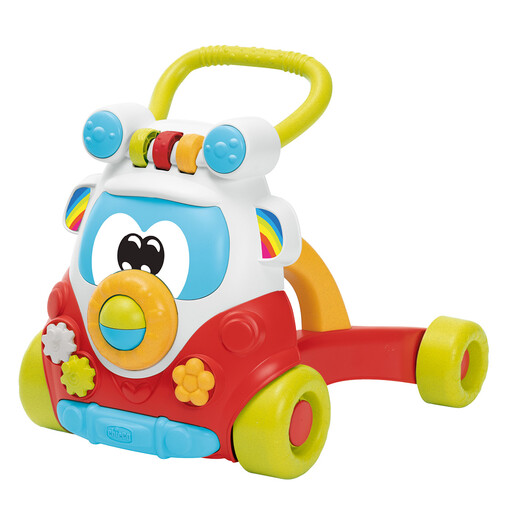
Why this product suits the profile: This 2-in-1 model combines a push-along aid with a mechanical activity centre and, according to the product details, is suitable for children aged 9 to 24 months.
The product details specify four large wheels, five manual activities and clear safety warnings about supervised use.
Dimensions of 33 × 42,5 × 37 cm, a weight of 1,4 kg and material details confirming that it is BPA- and phthalate-free.
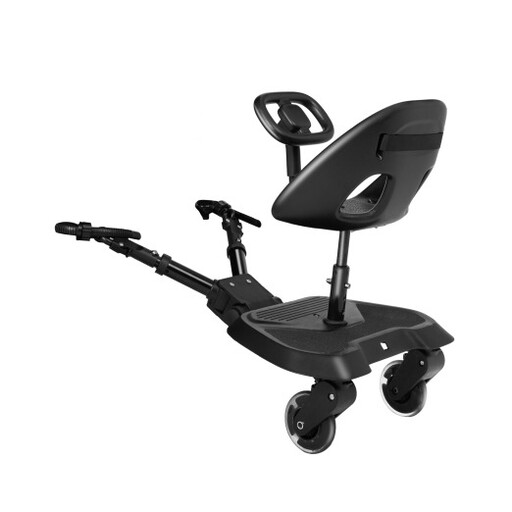
Why this product suits the profile: This product is designed for families with two young children and provides a stroller ride-on board with a removable seat.
The adapter length and height can be adjusted in several ways. It also features a 2-point safety harness, a non-slip footboard and a safety strap.
Suitable from 15 months up to a maximum of 20 kg, with 360-degree swivel wheels, suspension and three-stage seat-height adjustment.
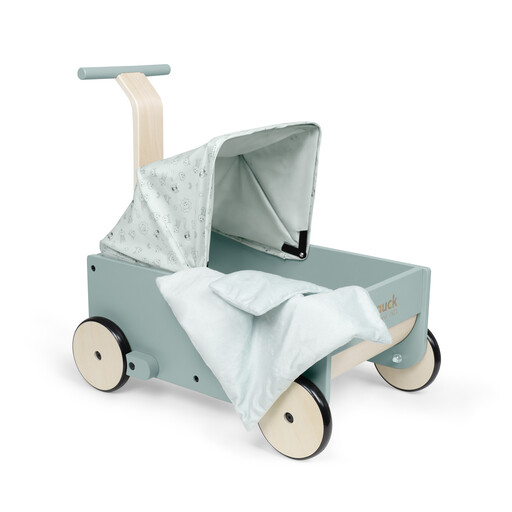
Why this product suits the profile: This doll’s pram and baby walker combines a push-along aid with a doll’s pram, making it ideal for role play.
An individually adjustable brake and a height-adjustable handle from 45 to 49 cm allow the product to be adapted to the child’s stage of development.
FSC-certified wood according to the product details, rubberised wooden wheels and machine-washable doll’s pram bedding.
We have put together a complete, regularly updated list of products that fully meet these strict selection criteria and the safety regulations applicable in the EU.
Regardless of the model chosen, parents should check a few points before every use:
With a wooden model, you should also check for splinters, cracks and damaged paintwork. With a stroller board with seat, check before every journey that the connection to the pushchair is fully engaged and that the safety harness is correctly adjusted.
This depends on the individual model and the child’s stage of development. The product details may, for example, recommend use from 9 or 12 months. What matters is that the child can sit independently, hold on securely and be supervised directly while using the product.
The period of use depends less on a fixed timescale than on the child’s age, weight, height and progress. A baby walker should no longer be used once the child reaches the weight limit, moves the walker uncontrollably or can walk safely without support. For a ride-on board, the manufacturer’s specified age and weight limits apply.
An adjustable brake can adapt the rolling behaviour to the child’s stage of development. It can stop the walker from rolling away too quickly, but it does not replace supervision or a safe environment. Extra care is particularly important on smooth floors, near thresholds or close to stairs.